

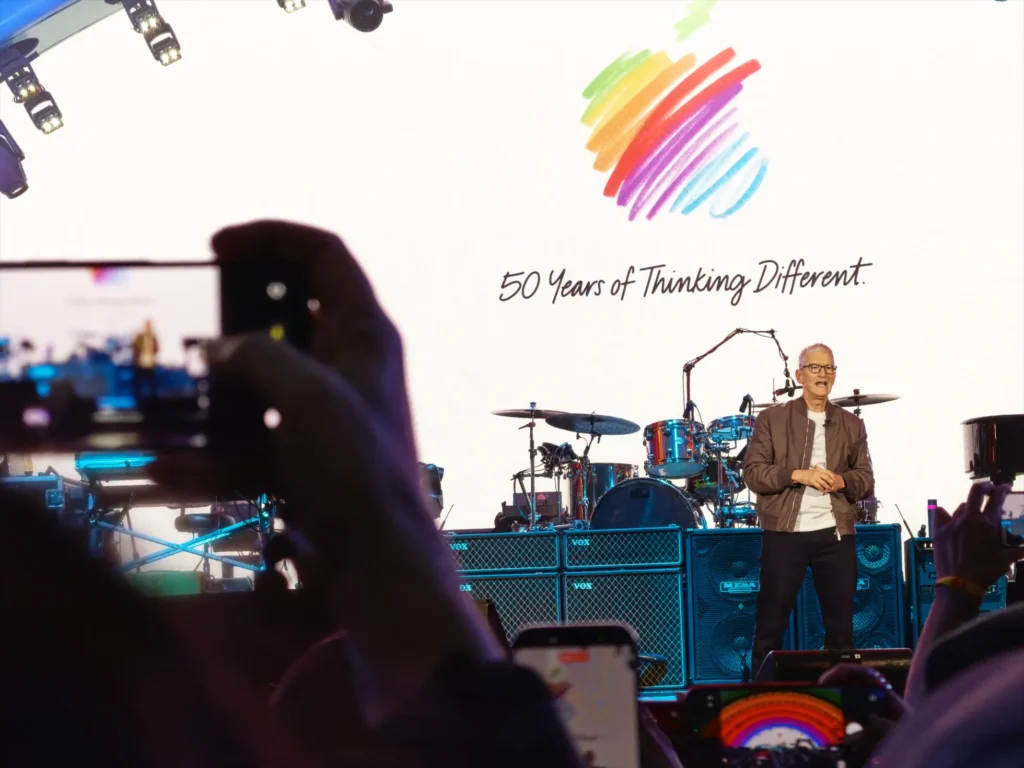
Apple Celebrates 50 Years: Tim Cook Revives the Spirit of Steve Jobs
Fifty years after its inception, Apple reflects on both its past and its future. In a message to his teams for the company’s anniversary, Tim Cook emphasized a founding idea from Steve Jobs: The world is not static; it can still be transformed by those who dare to build it.
A Symbolic Celebration for a Company That Has Become an Institution
On April 1, 2026, Apple officially marked its 50th anniversary. The company had been preparing for the event since March, promoting a special communication around “50 years of thinking different,” while its Newsroom highlighted this milestone as a pivotal moment in its history.
In this context, Tim Cook’s internal memo was more than just a commemorative message; it served as an ideological reminder. He quoted Steve Jobs’ famous notion of each individual’s ability to change the world, influence their environment, and create useful things for others. Cook presents this philosophy as one of the deepest engines of Apple’s culture.
Tim Cook Revives the Steve Jobs Mindset
The choice of this quotation is significant. As Apple has become a global giant, Tim Cook seems to remind us that the company was not founded on a logic of preservation but rather on a desire for disruption.
According to memos from the communication, Cook explains that this worldview has shaped Apple since its inception, from the earliest prototypes to the approximately 2.5 billion active devices today. He also expressed gratitude to employees, both past and present, and stressed a simple idea: the opportunities that lie ahead could be among the most significant the company has ever encountered.
This cleverly connects two eras. On one hand, there’s the mythical Apple of Jobs, built on intuition, design, and creative provocation. On the other, there’s Cook’s Apple, larger and more methodical, yet still in search of a narrative that justifies its place in the future.
A 50-Year-Old Company with a Story Focused on the Future
Perhaps the most intriguing aspect of this address is not the tribute to Steve Jobs, but what it reveals about Tim Cook’s mindset. The Apple CEO is not merely celebrating the past; he is attempting to convince internally that the company’s potential remains largely untapped.
This positioning comes at a strategic time. Apple is still one of the most influential companies in the sector, but it is also operating in a more mature market where innovation is no longer measured solely by the launch of a new iconic product. It now requires defending a vision: one of a company still capable of redefining use cases, despite its size, age, and the constant pressure of expectations.
Tim Cook’s message serves this purpose: to remind that Apple does not wish to become a museum brand, trapped by its own icons.
Apple Cultivates Its Legend to Protect Its Future
This memo showcases a typically Apple reflex. When a major anniversary occurs, the brand does not use nostalgia as an end in itself but as a narrative lever. The past is invoked to enrich the future, not to find refuge in it.
By quoting Jobs, Cook revitalizes the mythological core of the company: the idea that technology can be personal, transformative, and even cultural. It’s also a way to unite the teams around a common ambition at a moment when Apple must continue to prove it can remain decisive over the next fifty years.
The subtext is clear: Apple’s history is vast, but it must not become a glass ceiling.
A Milestone Rather Than a Commemoration
At fifty years old, Apple is not just celebrating its longevity. It seeks to assert that it remains a forward-looking enterprise, not merely one of legacy.
Tim Cook delivers a message that is both simple and strategic. Behind the anniversary slogan lies a foundational conviction: products change, markets evolve, and technological cycles come and go — but Apple’s identity continues to tell a story of transformation.
Perhaps, at its core, the real challenge of the next fifty years is not merely to endure but to continue to matter.



