

Android 17 Transforms Instagram and Adobe with Google’s Embedded AI
Google did not wait for the main conference at Google I/O to unveil its vision for Android 17. During its Android Show, the message was clear: the smartphone is now a creation tool assisted by artificial intelligence.
This time, Google is not just improving Android itself. The company is gradually transforming the entire mobile ecosystem — Instagram, Adobe Premiere, video, photo, and audio — into a much more fluid and automated logic.
Screen Reactions: Google Automates Reaction Videos
One of the most noteworthy new features is called “Screen Reactions.”
The principle is simple: simultaneously record the smartphone screen and the user’s video reaction to automatically create content in the reaction video format, which has become ubiquitous on social media. Google aims to drastically reduce creative friction: screen capture, camera reaction, synchronization, simplified editing, and quick sharing.
This feature will arrive this summer on Pixel smartphones.
This detail highlights one thing: Android 17 is now designed around the native creative uses of modern social platforms.
Instagram Becomes a Technological Showcase for Android 17
The partnership with Meta Platforms regarding Instagram is likely the most strategic announcement. Google is bringing several advanced technologies directly into the app: Night Sight, Ultra HDR, native video stabilization, and automatic rendering optimization.
The goal is clear: to improve the quality of content from the moment of capture, without relying on heavy post-production workflows.
The integration of Ultra HDR is particularly interesting. Android aims to turn Instagram into a platform capable of fully utilizing the capabilities of modern HDR screens, offering more luminosity depth and visual realism.
Google is also trying to tackle a longstanding Android issue: quality degradation during uploads to social networks.
Android Foldables and Tablets Finally Taken Seriously
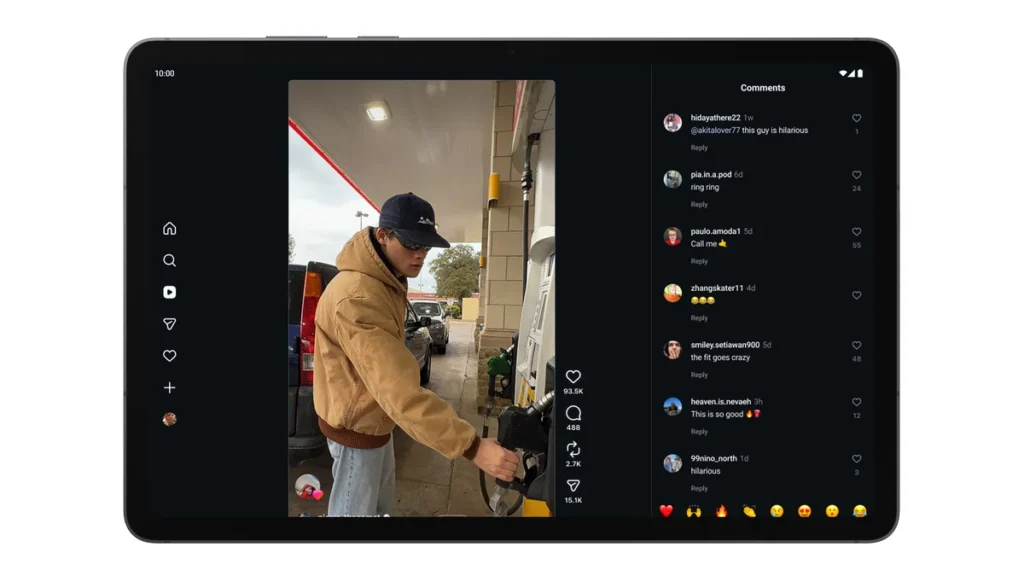
Android 17 also significantly enhances the Instagram experience on larger screens. For years, social applications on Android have suffered from poor adaptation to tablets and foldable smartphones. Google now aims to rectify this by introducing multi-column interfaces, optimized tablet displays, better multitasking management, and navigation designed for larger screens.
This evolution naturally aligns with the rise of foldable devices from Samsung, Google, and OnePlus.
Local AI Becomes the New Creative Engine for Android
The Instagram Edits app perfectly illustrates Google’s new direction: AI embedded directly on the device. With on-device AI, Android 17 will be able to reimagine images, automatically enhance videos, isolate sounds, remove background noise, and amplify certain voices or ambient sounds.
This strategy is crucial for Google. Local AI allows for better privacy, instantaneous execution, reduced cloud dependency, and faster creative workflows.
It is progressively transforming the smartphone into a true standalone multimedia production studio.
Adobe Premiere Fully Arrives on Smartphone
Another significant announcement is that Adobe is preparing a much more ambitious mobile version of Premiere. The application will bring special effects, advanced templates, optimized mobile editing, and direct export to YouTube Shorts.
Google is also promoting the Advanced Professional Video (APV) format on compatible Snapdragon 8 Elite smartphones, notably the Samsung Galaxy S26 Ultra and vivo X300 Ultra.
The idea is clear: to gradually bridge the professional desktop workflows with mobile capabilities.
Android Becomes an Operating System for AI Creators
The most interesting aspect of all these announcements is not a single feature but the overall coherence of the strategy. Google is transforming Android into a creative platform assisted by AI: capturing, editing, enhancing, organizing, publishing, and sharing. Everything is becoming more contextual, automated, and faster.
The smartphone is no longer just a communication device; it is becoming a portable creative studio powered by Gemini and embedded AI.
This evolution could profoundly change the way creators produce content daily.



