

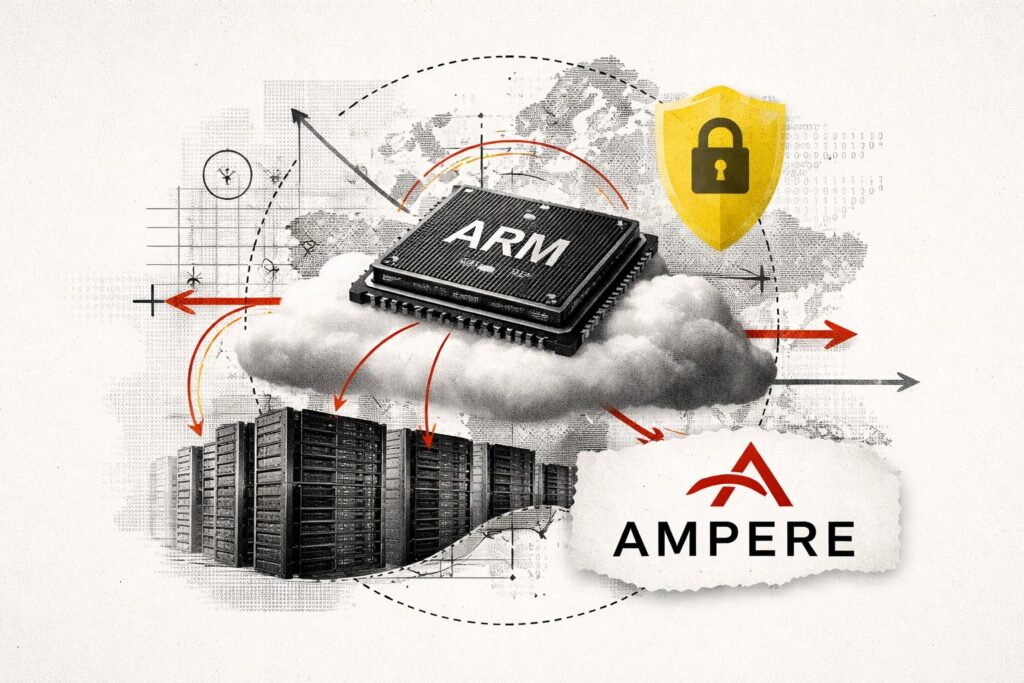
Ampere Computing Launches AmpereOne and AmpereOne M Processors for European Cloud Operators
Ampere Computing is rolling out its AmpereOne and AmpereOne M processors among European cloud operators, enhancing services across France, the Netherlands, Germany, Sweden, and Switzerland. Key partners such as Hetzner, Glesys, C41.ch, and CloudSigma are participating, each targeting distinct segments, from general-purpose computing to AI inference offerings. This coordinated deployment highlights three simultaneous trends facing European enterprises: the energy constraints of data centers, the surging demand for large-scale AI inference, and an increasing requirement for data localization.
The announcement from Ampere highlights two generations of processors currently in production: AmpereOne and AmpereOne M. These server chips leverage Arm architecture, designed to deliver high performance per core while significantly reducing energy consumption compared to traditional x86 architectures dominated by Intel and AMD. This efficiency per watt is a crucial selling point for cloud operators who are grappling with escalating power capacity constraints amidst growing workloads from AI inference.
According to Jeff Wittich, Ampere Computing’s product director, “European operators are facing short-term power constraints just as AI workloads are ramping up. A chip that delivers more computation per watt allows them to serve more customers without expanding their physical footprint.” This argument extends beyond simple business positioning; for CIOs managing service-level agreements in real-time inference environments, computation density per watt has become a pivotal architectural consideration.
The Strategic Market of Sovereignty
Despite a focus on sovereignty, Ampere’s announcement includes Oracle among its partners, creating a deliberate ambiguity between two distinct concepts: data residency (physical data stored in Europe) and data sovereignty (data shielded from foreign extraterritorial jurisdiction). Specifically, Oracle has activated the first A4 instances powered by AmpereOne M within its cloud regions in London and Frankfurt. Clients can access these via Oracle EU Sovereign Cloud and the Oracle Alloy framework. However, it’s important to note that Oracle EU Sovereign Cloud and Oracle Alloy are contractual and organizational constructs rather than effective legal breaks. The parent company, Oracle Corporation, remains a U.S.-based firm subject to the Cloud Act, allowing U.S. authorities to demand access to data stored by American operators, including their European subsidiaries, regardless of local law. Thus, storing data physically in London or Frankfurt does not exempt it from U.S. jurisdiction.
On the truly sovereign operator front, Scaleway is deploying AmpereOne instances across its infrastructure in France and the Netherlands. The French provider is presenting this adoption as a competitive edge in energy efficiency and AI inference. Additionally, German operator Hetzner, which launched Europe’s first Ampere-powered Arm servers in 2023, is currently qualifying the AmpereOne for anticipated deployments in 2026. Meanwhile, Swedish operator Glesys is setting up AmpereOne infrastructure in a hardware-as-a-service model, with cloud availability expected in the second or third quarter. Swiss operator C41.ch is also expanding its platform with AmpereOne instances and is making AmpereOne M available for preliminary testing ahead of broader deployment.
Segmentation between General Workloads and AI Services
CloudSigma is taking a distinct trajectory compared to its announced partners. Instead of offering general-purpose compute instances, it is developing an AI-as-a-Service portfolio on the AmpereOne M, including offerings like Token-as-a-Service and Model-as-a-Service. These usage-based billing models are tailored to the real consumption of inference, specifically targeting sovereign cloud and private cloud environments, where control over data processing is a non-negotiable condition.
This segmentation between general workloads and specialized AI services exemplifies Ampere’s strategy in the European market. The company is not aiming to uniformly replace existing x86 processors; rather, it seeks to occupy segments where energy efficiency and deployment flexibility offer distinct advantages. Jeff Wittich expressed this in conversations with Data Center Knowledge: regional operators do not wish to deploy the same generic infrastructure as everyone else; they desire solutions that better meet their local clients’ needs, and AI inference precisely represents the space where differentiation is feasible.
A Sovereign Market Valued at Over €100 Billion by 2030
The trends outlined in Ampere’s announcement occur within a quantifiable market context. According to estimates from Grandview Research, the European sovereign cloud market is projected to exceed €100 billion by 2030, driven by data residency requirements, regulatory compliance, and infrastructure independence. This forecast underscores the commercial appeal of Ampere’s positioning, with its processors serving as a common foundation for a wide array of operators, from hyperscale giants to specialized national providers.
For organizations subjected to GDPR, NIS2, or DORA, the choice of computing infrastructure transcends mere technical performance. Geographic server location, data residency, and the legal dependency chain of suppliers are now integral to the decision-making process. In this regard, Ampere’s situation warrants careful consideration: the company is U.S.-based and subject to American jurisdiction, meaning that deployments using its chips with operators exposed to the Cloud Act do not automatically guarantee the sovereignty that some operators associate with Arm architecture. True sovereignty relies on the legal status of the cloud operator, not the chip’s origin.
Nevertheless, Ampere is establishing a substantial European presence, leveraging previous partnerships with entities like Ionos, Gcore, Leaseweb, and Infomaniak. This new wave of deployments complements its existing partnerships, enabling the company to cater to both hyperscale and regionally focused national operators, effectively differentiating itself from x86 alternatives that necessitate scaling through large American suppliers.



