

At Advancing AI 2026, AMD unveiled a comprehensive computing stack for the agent era, ranging from data centers to workstations. Central to this offering are the Helios rack, the Instinct MI400 GPUs, the EPYC Venice processors, the ROCm.ai software, and a partnership with Cerebras. This strategic move targets a near $2 trillion market by 2030, based on projections and comparisons set by the chipmaker itself.
Advancing AI serves as AMD’s annual conference, gathering partners, customers, and developers within its ecosystem. The announcements made during the event showcase a continuous offering that spans data centers, workstations, and robotics, revolving around the concept of agents. This full-stack approach aims to challenge Nvidia’s dominance with its proprietary ecosystem. AMD CEO Lisa Su laid out the thesis: “We understood that this agentic era would require the most powerful GPUs and CPUs working together. We are the only ones who have built both.”
This strategy addresses a shift in computational demands. While training models has absorbed years of investment, usage has now taken center stage. AMD estimates the AI accelerator market to reach nearly $1.4 trillion by 2030, compared to last year’s prediction of $500 billion for 2028. The chipmaker is broadening its target across all segments, from data centers to workstations and embedded systems.
Helios, MI400, and Venice: The Foundation of Data Centers
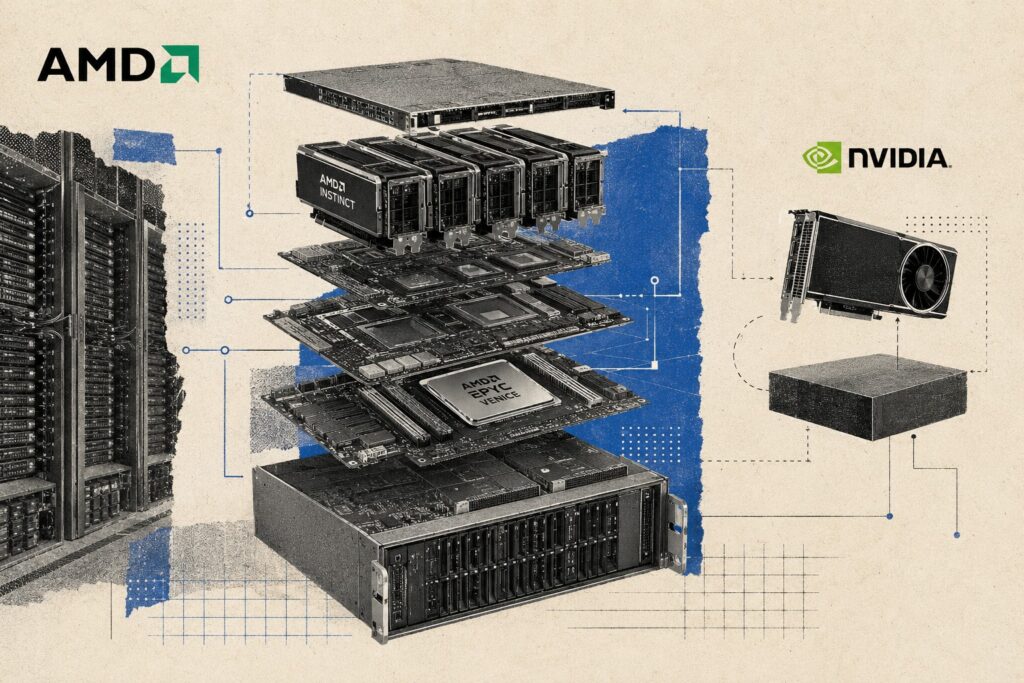
The centerpiece of AMD’s announcement is the Helios rack, touted as the most powerful AI rack on the market. Each Helios rack comprises 72 Instinct MI455X GPUs and 18 EPYC Venice processors, interconnected by Pensando networking chips. AMD claims that each rack delivers 2.9 exaflops of FP4 precision and 31 terabytes of HBM4 memory. In comparison to Nvidia’s Vera Rubin NVL72 system, AMD boasts 15% more FP4 computation, 50% greater memory capacity, and up to 30% more tokens per dollar. Helios is set to begin production for gigawatt-scale deployments, with industrial partners like Bull, HPE, Lenovo, and Supermicro.
The rack is based on the new Instinct MI400 series. The MI455X is designed for large model training and high-volume inference, promising a token throughput up to 34 times greater than its predecessor. The MI430X, aimed at scientific computing and sovereign AI, achieves 288 teraflops in double precision. On the processor side, the sixth-generation EPYC, codenamed Venice, is built on the Zen 6 architecture and claims up to 1.8 times the performance of the Turin generation, with up to 512 threads per processor. This lineup includes variants tailored for agent sandboxes, GPU host nodes, and enterprise servers, boasting up to 2.08 times more cores per rack than Nvidia’s Vera processor. The EPYC range already powers over 60% of Fortune 100 companies and captured 46% of the server market value in the last quarter.
Shifting the Focus from Training to Inference
AMD’s reasoning hinges on this shift in computational burden. By 2026, the usage of models will surpass their training. “For the first time, the world is dedicating more computing power to running models than to training them,” noted Lisa Su, estimating that inference accounts for about 60% of global capacity. The proliferation of agents accelerates this trend, as an agent executes numerous reasoning steps and tool calls.
This transition redistributes demand between the two families of chips. GPUs handle reasoning, while CPUs orchestrate each step. AMD perceives a new category of servers emerging: “The greatest growth lies in agent servers, what we call agent sandboxes, a completely new class of workload,” explained Su. The company anticipates a sharp rise in the server processor market, expecting it to grow from $25 billion to over $200 billion by 2030 due to these workloads.
From Cerebras to Workstations: AI at Every Level
The stack also extends beyond high-volume data centers. For ultra-low latency inference, AMD has teamed up with Cerebras in a so-called disaggregated approach. The Helios rack handles query preparation and lengthy contexts, while Cerebras’ engine, etched onto an entire silicon wafer, accelerates token generation. Together, they promise up to five times more tokens per second per watt than a standalone engine. This solution will initially be available on Cerebras’ cloud in the second half of 2026 for real-time copilots, coding, and agents.
AMD is also pushing inference to the workstation level. The Ryzen AI Halo platform features 128 gigabytes of unified memory and can run models of up to 200 billion parameters, while the Ryzen AI Max PRO 400 series scales up to 192 gigabytes and 300 billion parameters. The Ryzen AI Halo platform has been available for pre-order since June, bundled with a year’s access to the Hugging Face open model library. AMD positions local AI as a response to privacy, latency, and the costs associated with all-cloud solutions. This aligns with the push from PC manufacturers towards local inference and agentic AI, which shifts some computation back to the devices themselves.
At the very edge, AMD is adapting its Kria modules and Ryzen AI Embedded X100 processors for robotics and embedded applications, launching a dedicated partner network. In the enterprise sector, Cisco is integrating AMD’s Ryzen AI engines with its networking and governance for local agents, while telecom operator AT&T develops an AI initiative based on this infrastructure. The consistency claimed across this approach stems from a unified software stack that extends from data centers to connected devices.
An Open Ecosystem: A Response to Nvidia
Software comprises the second half of AMD’s strategy. The company introduced ROCm.ai, an evolution of its open ROCm stack, featuring an agentic system called HyperLoom. This tool automates the optimization of inference workloads, a task that previously required weeks of engineering effort. Programming assistants already used by developers, such as Claude, Cursor, and Codex, can access ROCm.ai natively to generate and refine code for AMD chips. Compared to its predecessor, AMD reports an average boost of 3.3 times in inference performance and 2.4 times in training efficiency. Major development frameworks, including PyTorch, vLLM, and Hugging Face, are already optimized for the MI455X, ensuring seamless adoption from day one.
Openness also applies to hardware, with UALink and Ultra Ethernet standards connecting the chips. “We believe an open ecosystem is essential to the future of AI,” asserted Lisa Su, seeing it as a multiplier effect. This approach directly challenges Nvidia’s CUDA suite, from which the industry is eager to break free. Deployment commitments are in motion, with OpenAI planning for up to 6 gigawatts of AMD infrastructure, Meta matching that capacity, and Anthropic aiming for up to 2 gigawatts with Helios.
A Roadmap to 2030 and Its Implications for CIOs
AMD also laid out a multi-year roadmap. The Instinct MI500 series and Helios 500 rack, coupled with the Verano processor, are expected in 2027. The Zen 7 architecture and MI600 series will follow in 2028, with Zen 8 architecture anticipated by 2030. This annual cadence is designed to keep pace with Nvidia while positioning AMD as a sustainable second source rather than an auxiliary supplier.
For IT leaders, the benefits extend beyond raw performance. A credible alternative to Nvidia opens up leverage in negotiations and reduces dependence on a single supplier, particularly regarding token cost and power constraints in data centers. However, this promise hinges on the availability of open software since IT directors will only migrate workloads if the software tracks the hardware. Additionally, the market projections and performance comparisons remain those of the chipmaker, necessitating real-world deployment validation.
Advancing AI 2026 marks the launch of a processing chain strategy with the assembly of a comprehensive stack—from racked systems to workstations—centered on inference and agents. AMD expands its offering from GPUs and CPUs to include software and IoT, using openness as a primary competitive lever against Nvidia. For technology decision-makers, the flexibility enabled by each infrastructure choice is now just as critical as the available power. Evidence of this will emerge from the initial deployments of Helios and the genuine maturity of ROCm.ai, both expected by year’s end.



