

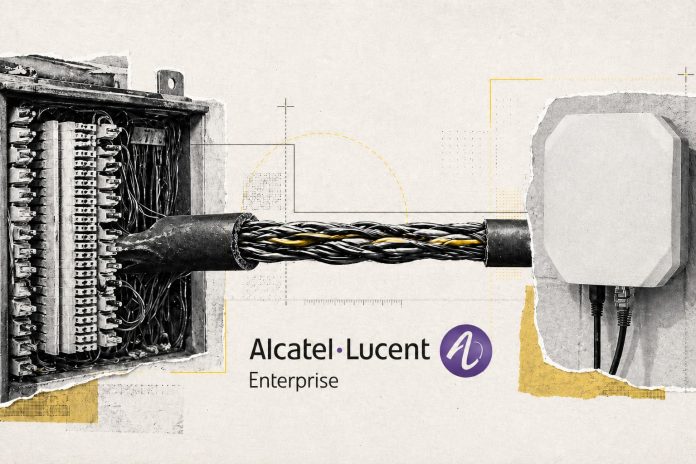
Countless miles of single-pair copper wiring remain dormant within the walls of hospitals, factories, and government buildings – a remnant of decades of traditional telephony. Alcatel-Lucent Enterprise is shifting the narrative away from mere replacement by integrating Single Pair Ethernet (SPE) into its OmniPCX Enterprise Purple system. This innovation allows for the transmission of IP communications, remote power, and IoT data over existing, depreciated wiring, without the need for rewiring or service interruptions.
This breakthrough leverages the IEEE 802.3cg (10BASE-T1L) standard, which specifies Ethernet transmission over a single twisted pair. Two 10BT-SPE adapters, designed by ALE and manufactured in France, are installed at each end of the existing copper cable. Notably, integration with the OmniPCX Enterprise Purple platform is seamless and requires no additional configuration. The platform continues to manage IP, SIP, and TDM protocols simultaneously, ensuring backward compatibility with existing equipment and maintaining uninterrupted service throughout the transition.
ALE’s approach is built on a clear economic understanding. Organizations that have invested in TDM infrastructures have wiring that has largely depreciated yet retains its physical integrity. The SPE allows these enterprises to modernize communications on existing cables without incurring the structural costs associated with complete rewiring. This valuation strategy is particularly relevant for sectors with tight investment cycles, including manufacturing, energy, utilities, oil and gas, transportation, and healthcare.
Seamless DECT Migration and Voice Communication Resilience
The first application of this technology is the migration of DECT bases from TDM to IP. Organizations utilizing DECT bases connected to single-pair TDM wiring can transition to a fully IP-based DECT mobility simply by placing SPE adapters at both ends of the existing cable. This means no new wiring, no structural work, and no reconfiguration of radio coverage.
The voice infrastructure remains physically separate from the company’s LAN. This separation, inherited from TDM architecture, continues in the IP environment. In the event of IT failures or cyberattacks, voice services continue to function. For CIOs in sensitive sectors such as healthcare, hospitality, or government, where communication availability is critical, this physical isolation offers a substantial security advantage.
Extended Range of Up to 1,000 Meters for Industrial and Classified Environments
While standard Ethernet is limited to 100 meters without intermediate active equipment, this limitation can be prohibitive in factories, hospital corridors, expansive sites, or classified buildings, where communication points often need to be deployed far from the main server room. SPE achieves distances of up to 1,000 meters over existing copper wiring, enabling remote power supply for devices, which eliminates the need for local power sources at every deployment point.
In ATEX classified areas, where explosive atmospheres may be present, such as oil and gas plants or protected heritage buildings, any cabling work requires specific certifications and regulatory compliance. By repurposing existing wiring, organizations can avoid the complications of running new conduits and obtaining new certifications. Here, the economic argument for SPE dovetails with operational feasibility.
IT/OT Convergence and IoT Connectivity Without Dedicated Infrastructure
Apart from voice and DECT mobility, ALE positions SPE as a key facilitator for IT/OT alignment. The same copper infrastructure can serve as an access point for connecting IoT devices, sensors, and measurement equipment that were previously unreachable via the IP network. This unification of the physical network enables voice communications and IoT connectivity without the need for a parallel infrastructure rollout.
This convergence is particularly relevant for manufacturing, energy, utilities, and smart building sectors. “Copper is already embedded in the walls, production lines, and down to the equipment. SPE becomes the foundation for modern IP communications. Our clients can now extend the complete OmniPCX Enterprise Purple experience and IoT connectivity to all critical sites at their own pace, without rewiring. Moreover, since the voice network remains physically separate from the company LAN, service continuity is assured regardless of IT conditions,” explains Nicolas Pfleger, VP of the Terminals & IoT Business Unit at Alcatel-Lucent Enterprise. Organizations embarking on a DECT migration today are setting the stage for a fully connected operational environment, scalable according to their IT/OT priorities.
Availability and Roadmap: 10BT-SPE Adaptor, SPE16-XL Card on the Horizon
The 10BT-SPE adapter is currently available. Compact and plug-and-play, it is designed and produced in France, and is compatible with ALE’s IP-DECT bases and IP/SIP phones. The SPE16-XL card, intended for the OXE XL-Rack chassis, will allow for centralized management of large-scale SPE deployments; its availability is anticipated soon, though no specific date has been provided. The entire OmniPCX Enterprise Purple ecosystem is now fully SIP compatible, expanding integration possibilities with third-party equipment.
The platform’s multi-standard compatibility—supporting IP, SIP, and TDM simultaneously—and the phased deployment approach for SPE enable organizations to control their migration pace without requiring an immediate shift for the entire fleet. This adaptable solution meets the needs of heterogeneous environments, common in large organizations managing diverse site equipment.



