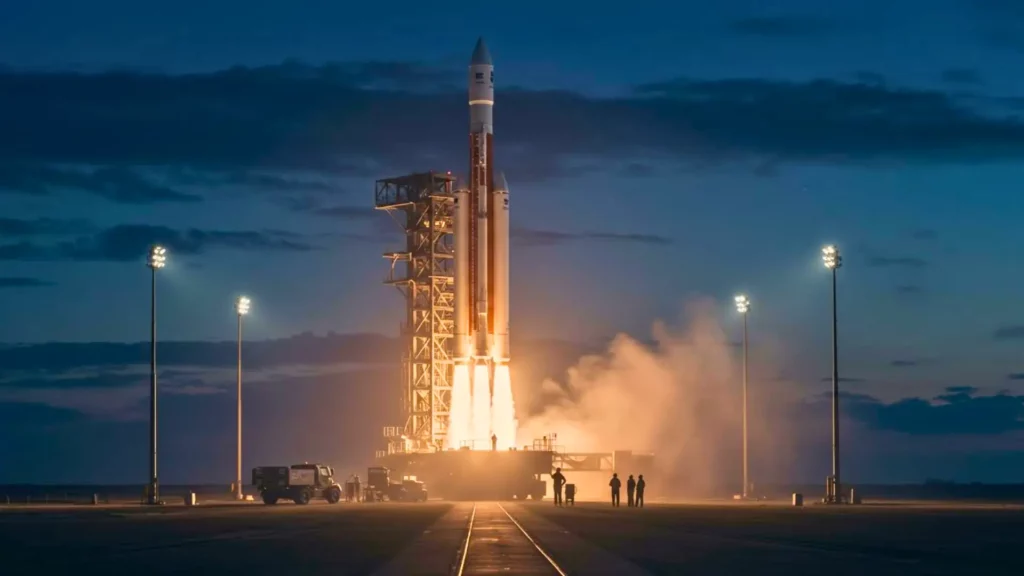
What if artificial intelligence became the invisible co-pilot of our future Mars missions? Behind the engines and rockets, AI is emerging as a key player in space propulsion. What if it is the key to reaching Mars faster?
How AI is reinventing the design of nuclear thermal propulsion engines
Optimizing nuclear thermal propulsion is no small feat. Imagine a stove where the flame is capable of melting steel, and you are asked to adjust it to the exact degree. This is somewhat similar to what engineers experience as they manage the heat transfer between an atomic fuel and an exhaust gas.
It is precisely in this maze of variables that AI excels. Indeed, it can evaluate millions of combinations of materials, shapes, and operating conditions. This enables it to identify configurations that maximize thrust by simulating, comparing, and adjusting in seconds what would take humans months to figure out.
Initial tests, such as those of the Nerva program in the 1960s, used simple uranium blocks. Since then, thanks to machine learning, we are envisioning adaptive internal structures: grooved rings, microchannel networks, or smart cooling circuits. A technological leap akin to going from a hammer to a Swiss watch.
Why reinforcement learning is ideal for managing complex space missions
Far from being just a calculation tool, AI is becoming a true experimental companion. With reinforcement learning, it behaves like a child learning to ride a bike: trials, falls, adjustments… until mastery is achieved. In other words, this method allows the machine to evaluate its choices independently, understand what works or doesn’t, and correct its course.
In the space domain, this means automatically finding the best trajectory, adjusting thrust in flight, and even anticipating fuel needs based on events. Indeed, AI does not just react: it predicts. And in space, this distinction can save a mission.
Compact nuclear fusion: a technological challenge that AI is finally helping to master
While fission is currently understood, fusion remains a technological gamble. More powerful, more clean, but also more unstable. Thus, miniature prototypes like the “polywells” are attempting to replicate the power of the Sun in a cube just a few centimeters wide. And yet again, AI is at the heart of the reactor, literally.
Algorithms control the magnetic fields with a precision that manual handling simply cannot achieve. Every variation, every plasma fluctuation is analyzed, corrected, and stabilized in real time. It’s a balancing act where the slightest misstep can lead to a collapse, but AI finally makes it possible.
Adaptive spacecraft powered by AI: intelligent and responsive propulsion on missions
In the vastness of space, the unexpected is the norm. Debris to avoid, temporary malfunctions, unplanned detours… all critical situations that demand swift reactions. Therefore, it is precisely in this dynamic context that AI reveals its full potential, managing unforeseen circumstances better than a human team under pressure.
Using reinforcement learning, a spacecraft can adjust its propulsion strategy in real time. By learning from each maneuver, it anticipates needs and reduces margins of error. Thus, this onboard intelligence transforms space navigation into an adaptive, fluid, almost living system.
One day, we may remember that the Martian conquest did not start on Mars, but in the algorithms. In these silent systems that, mission after mission, will have propelled humanity ever further. Faster. And perhaps, better than expected.