

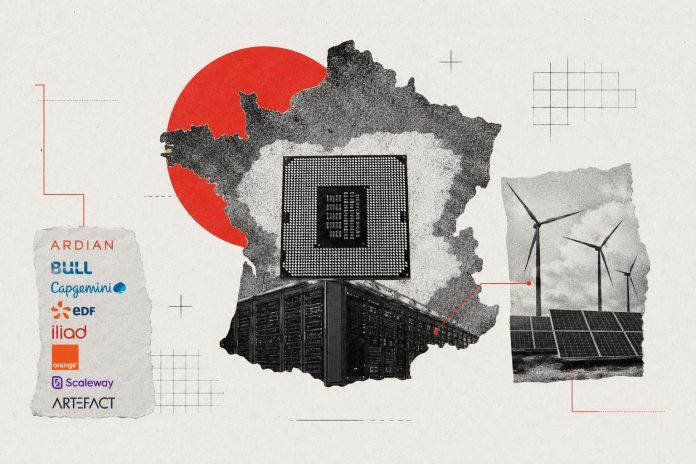
Ardian, Artefact, Bull, Capgemini, EDF, the Iliad Group, Orange, and Scaleway have formed the AION consortium to support France’s bid for an AI Gigafactory. This alliance unites key players across the AI value chain, covering everything from supercomputing and sovereign cloud solutions to decarbonized energy and operational deployment. The expanded ecosystem features around twenty partners from technology, academia, and industry.
The gap in computing capabilities between Europe and the United States has widened significantly in just two years, leading to a dependency on American hyperscalers. Most European companies’ AI models are trained and run on clusters managed by three major U.S. firms, where pricing and resource allocation are influenced by external factors. In response, the European Commission initiated a two-phase industrial program in 2024 via the EuroHPC initiative, which involves deploying AI factories linked to existing supercomputers in Germany, Italy, Spain, and Finland. This will be followed by the establishment of larger AI Gigafactories to provide the continent with training and inference power comparable to North America’s key players.
Within this context, the announcement from the founding members of the AION consortium in Paris emphasizes a unified French effort that combines Ardian’s investment capacity, Bull’s supercomputing expertise, Capgemini and Artefact’s integration and deployment capabilities, EDF’s decarbonized energy supply, Iliad Group and Scaleway’s data center infrastructure and cloud platform, and Orange’s trusted cloud solutions. The goal is to create AI computing infrastructure where the entire value chain—from hardware to software—is predominantly European.
A Comprehensive Value Chain Bid
The AION consortium brings together components previously scattered among competing or complementary stakeholders in the European market. Bull, a subsidiary of Atos, provides supercomputers, microprocessors, quantum computing solutions, and operational software for AI workloads, backed by nearly a century of innovations and a revenue of approximately €720 million, supported by 3,000 experts across 32 countries. Scaleway, also part of the Iliad Group, contributes its sovereign, open, and interoperable cloud and AI platform, along with an expanding network of data centers across Europe. The Iliad Group enhances the development and operational management of large-scale data center infrastructure, while Orange offers sovereign cloud solutions and trusted AI through its Orange Business unit.
EDF supplies abundant, competitive, and low-carbon electricity, essential for facilities with power consumption in the tens of megawatts. Ardian, managing around $200 billion in assets, provides substantial industrial and financial investment capabilities. Capgemini, projecting a €22.5 billion revenue for 2025, and Artefact, specializing in data and AI consultancy, offer operational deployment and industrialization of use cases. The broad ecosystem includes around twenty partners, including Hugging Face, Kyutai, INRIA, Quandela, and Multiverse Computing focused on model frameworks and quantum computing, Schneider Electric and Verne for physical infrastructure, SiPearl for European processors, and Sopra Steria and Future4Care for sector integration, along with academic and public contributions from GENCI and PariSanté Campus.
A Sovereign Infrastructure from Start to Finish
The consortium emphasizes four foundational pillars: performance, with the establishment of a world-class AI infrastructure to support the European economy; trust, through comprehensive control of the value chain from hardware to open-source software, backed by sovereign actors; openness, utilizing open-source technologies and partnerships within the European ecosystem; and responsibility, by developing AI that serves research, businesses, and citizens, with a focus on managing the environmental impact.
The sovereignty framework laid out by the consortium reveals four levels achieved by most founding members: European hosting through the Iliad Group and Scaleway’s data centers, operation by European actors, legal immunity from the U.S. Cloud Act for Scaleway and Orange Business, and technical control over the hardware chain through Bull and SiPearl. The intentional use of open-source for software layers allows for reversibility, provided that available open models meet the performance standards of closed models for the critical workloads demanded by businesses.
An Open Ecosystem Awaiting Finalization
Governance of the consortium is led by Ardian, Iliad Group, and Orange, who will coordinate contributions from other founding members and integrate the broader ecosystem. The project aims to unite French and European stakeholders willing to contribute to this industrial ambition, leaving room for new entrants during the European program’s qualification phase. Details on financing, the operational timeline, implementation site, and targeted computing power have not yet been disclosed.
This announcement comes as several European consortia prepare parallel bids to the Commission, with initial allocations expected during the current budgetary cycle. The French bid leverages its decarbonized electricity mix, the industrial grounding of its founding members, the density of its research fabric, and experience from ongoing EuroHPC programs. For European IT leaders, this initiative opens the door to a potential AI training and inference solution whose value chain would be designed, funded, and operated from within the European Union, impacting the decision-making between American and sovereign infrastructures for critical AI workloads.
The formation of the AION consortium marks a significant step toward establishing a French candidacy, supported by eight founding members and around twenty partners. Their industrial coherence encompasses all the technical and financial components necessary for the European program. While the project has yet to be approved by the Commission, nor scaled publically or dated, it serves as a tangible reference point for senior executives and IT leaders contemplating the trajectory of European autonomy in AI. The coming months will reveal whether commitments to sovereignty can withstand the qualification phase.



