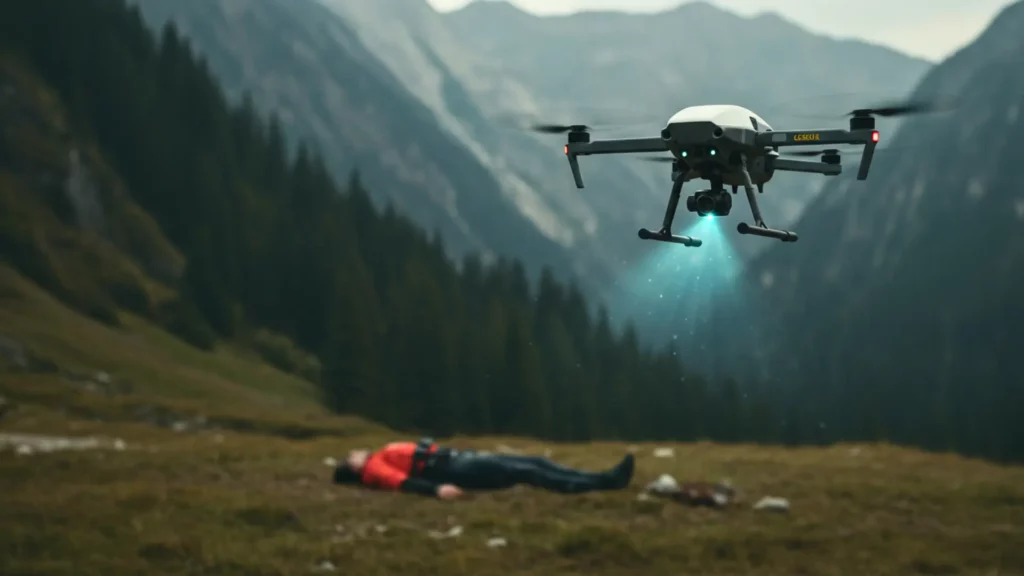
This prototype developed in Italy could revolutionize rescue operations in challenging terrain. Utilizing artificial intelligence and advanced sensors, it enables the location of missing persons and quickly assesses their physiological condition.
A technology that combines thermal imaging and artificial intelligence for location
In remote areas, every intervention relies on one crucial factor: time. Rescuers often start with imprecise information, which slows searches and complicates on-ground coordination. Here, an autonomous detection tool steps in, designed to accelerate the localization process.
Engineers from the Politecnico di Milano have developed this drone, which integrates thermal, infrared, and optical sensors to cover multiple analysis spectra. Furthermore, it is powered by AI capable of continuously analyzing images with a high degree of accuracy. This architecture relies on automated analysis, without constant human intervention.
Intelligent image processing that reduces errors and improves search accuracy
Each captured image is analyzed individually, generating multiple usable localization leads for the system. A tracking module refines these hypotheses to eliminate errors and retain relevant data. Thus, this approach is based on a tracking algorithm, enhancing overall reliability.
Presented in the journal Remote Sensing in September 2025, this method significantly improves the precision of search operations. The AI maintains analytical consistency even in visually complex or disrupted environments, leading to a reduction in errors, which is a major concern in real-life scenarios.
The drone can also operate in challenging conditions, such as dense fog or difficult terrain. Moreover, it can quickly cover large areas while transmitting actionable data in real time to teams on the ground. This capability relies on appropriate sensors, increasing the chances of success.
A unique ability to assess the physiological condition of victims before rescue teams arrive
Beyond localization, the drone also analyzes the victim’s condition using its various onboard sensors. Notably, the sensors measure facial temperature with remarkable accuracy. Therefore, this innovation is based on thermal estimation, which is crucial in critical situations.
This data allows for the detection of loss of consciousness or signs of hypothermia in isolated individuals. Additionally, the system can identify heatstroke based on observed thermal variations. Consequently, this function acts as a decision-making aid, enabling teams to adapt their interventions rapidly.
By relaying this information before rescue teams arrive, the drone saves valuable time for teams on the ground. Thus, the teams can respond with better preparation and an improved understanding of the situation. This approach embodies a medical anticipation, where every minute counts.
Technical challenges to overcome before large-scale coordinated use
Nonetheless, the drone remains a prototype under further development, requiring several technical adjustments. Engineers are working to reduce the weight of the sensors to enhance the overall autonomy of the system. This challenge focuses on energy optimization, essential for extended missions.
Researchers are also exploring sound recognition to detect calls for help in complex environments. This technology would allow identifying a presence even without direct visual contact with the victim. Furthermore, it relies on acoustic analysis, complementing the current sensors.
Finally, deploying multiple drones in a swarm is being considered to optimize search operations. This strategy would enable broad coverage in a short period with increased efficiency, relying on multi-agent coordination and paving the way for even more effective rescues.