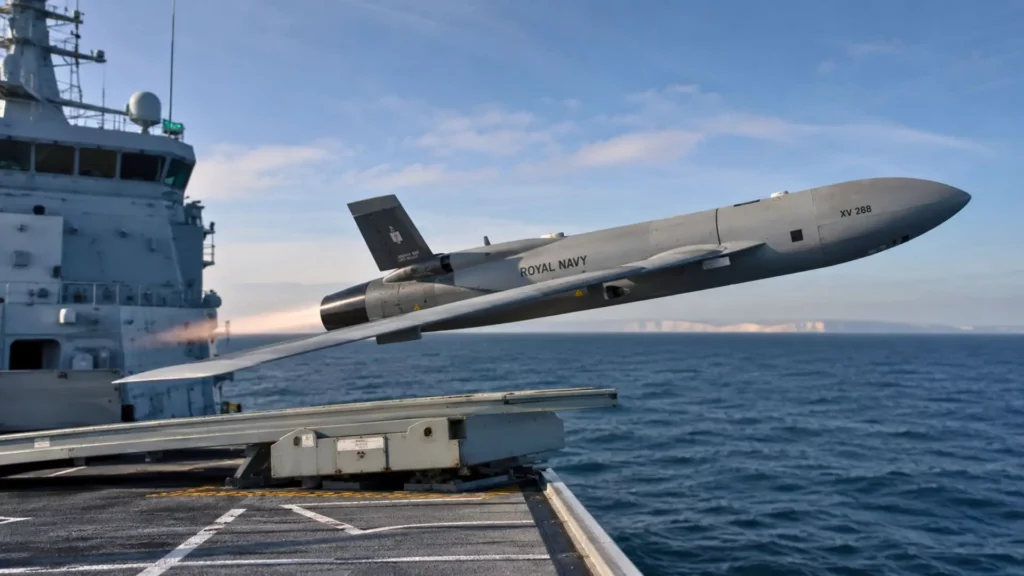
By deploying a single-use autonomous vehicle from a ship at sea for the first time, the British military is accelerating its technological transformation. This successful test heralds the massive integration of low-cost consumable weapons within a fleet now designed to be hybrid.
Successful Inaugural Launch at Sea Validates Deployment of Autonomous Strike Devices from a Ship
Off the coast of England, the experimental vessel XV Patrick Blackett has now become a flying laboratory for the British Army. It was aboard this ship that the Neptune Reach exercise took place, marking the first maritime deployment of this autonomous vehicle.
This single-use weapon system aims to execute precision strikes without endangering the lives of sailors. Military authorities confirm the complete success of this initial operation, marking a significant milestone for the future of the fleet.
The initiative brought together several military branches to coordinate the use of guided equipment from the ocean. According to Minister Luke Pollard, this technical cooperation aims to hasten the availability of resources capable of anticipating adversarial threats.
Technical Specifications of an Affordable Device Already Proven in Military Operations
Conceptualized in 2022 by Callen-Lenz, a subsidiary of BAE Systems, the Nyan drone features a wingspan of 2.9 meters. Powered by a turbojet engine and constructed from carbon fiber, it can travel distances exceeding 150 kilometers.
With a unit cost of less than £100,000, or approximately €117,000, this equipment presents itself as an economical option. Over 1,000 units have already been manufactured, and the model has proven itself in military operations in Ukraine and Estonia.
Towards the Establishment of a Hybrid Fleet Combining Crewed Vessels and Autonomous Systems
This experiment is part of a profound transformation of the Royal Navy. The recent British Defense Strategic Review advocates for the creation of a hybrid fleet that combines traditional ships with unmanned robotic systems capable of operating autonomously.
Led by Captain David Burton, the Vantage Project represents this tactical ambition. Integrating these devices expands the operational range while enhancing the operational cadence and overall impact power of naval forces.
Director General Matt Foster highlights the added value of transitioning from land to sea. The experience gained on continental grounds validates these technologies’ adaptability to unprecedented maritime constraints.
Testing Prospects Aboard the HMS Queen Elizabeth Aircraft Carrier to Change the Game
The data collected during the maneuvers paves the way for deployments on larger vessels. The British Navy is now considering conducting similar strikes from the deck of the HMS Queen Elizabeth aircraft carrier.
This evolution signifies a shift toward a doctrine focused on saturation and tactical agility. By equipping its units with consumable platforms, the UK is adapting its defensive apparatus to meet the new demands of modern warfare.