

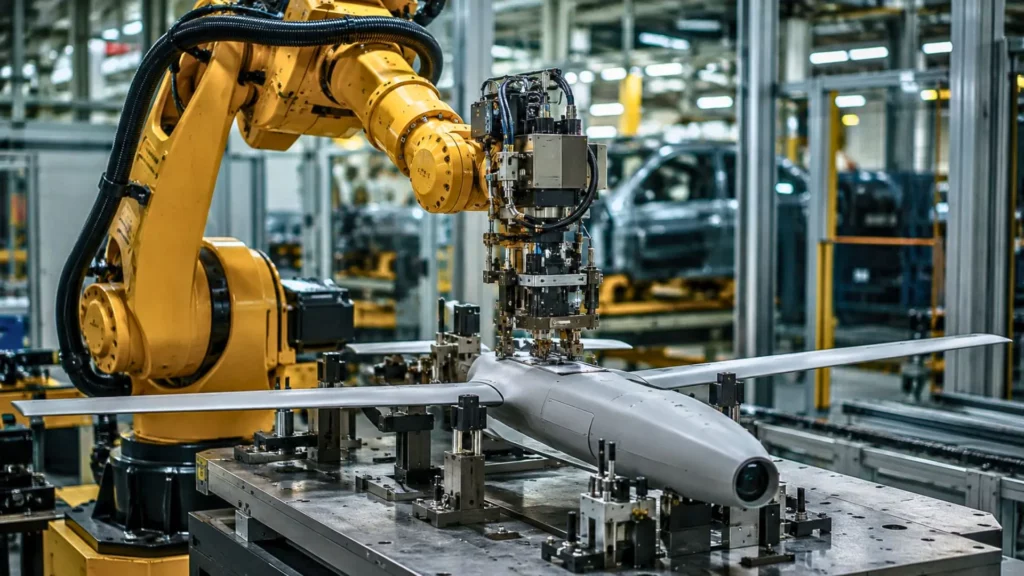
Faced with the demands of modern conflicts, the French military sector must produce more quickly and at a lower cost. To break its structural limitations, the General Directorate of Armament is partnering with the Renault Group to adopt the ultra-fast methods of large-scale automotive production.
Robotic Technology for Military Ammunition to Address Urgent Production Needs
In the Renault factory in Douai, the humanoid robot Calvin handles heavy loads at a rapid pace. This mastery of industrial speed captivates the Ministry of Armed Forces, which faces an urgent need to replenish its equipment stock.
During the Eurosatory trade show, the automaker and Thales forged an alliance to assemble the remotely operated ammunition Toutatis. The goal is to manufacture 1,000 units monthly starting in 2027, achieving a production rate unprecedented for French armaments.
Using Just-in-Time Methods to Accelerate Design Amid Fierce International Competition
To counter the responsiveness of Chinese electric vehicle manufacturers, Renault is implementing its strategic program FutuREady. For instance, the Leap 100 project aims to design a car in just 100 weeks, thereby reducing manufacturing costs by 20%.
This agility appeals to the state, given the traditionally long cycles of the military industry. Thales executives acknowledge that to design quickly and in high volumes, the expertise of large-scale manufacturers is far better suited.
Automotive sites are thus transforming into laboratories for large-scale innovation. The integration of physical artificial intelligence will also facilitate the deployment of 350 robots by 2027, ensuring a technological flexibility essential for swiftly adapting to the evolutions of modern armament.
Choosing Design-to-Manufacturing to Optimize Cutting-Edge Military Equipment Costs
Contemporary wear-and-tear conflicts disrupt the economic balance of modern armed forces. Utilizing high-end, expensive missiles to neutralize low-cost drones creates a financial deadlock that civilian expertise can efficiently circumvent.
The engineering approach applied by the manufacturer facilitates production from the design phase. This standardization reduces the number of parts, resulting in decreasing marginal costs as volumes increase, much like the Chorus drone developed with Turgis Gaillard.
Targeted Mobilization of Skills Without Global Militarization of Production Chains
This close collaboration does not imply a permanent industrial conversion for the diamond-marked brand. Management maintains a clear distinction, limiting these partnerships to specific public contracts without disrupting traditional civil automotive production.
At the Le Mans factory, a hundred voluntary employees will focus solely on the Chorus drone project in a dedicated space. The company provides its logistical expertise and assembly skills, leaving purely military technologies to defense specialists.
This dynamic is also extending to other major equipment manufacturers such as Michelin, Valeo, and Forvia. By mobilizing proven civilian technologies, the French sector is sketching a new form of national industrial sovereignty capable of responding swiftly without starting from scratch.



