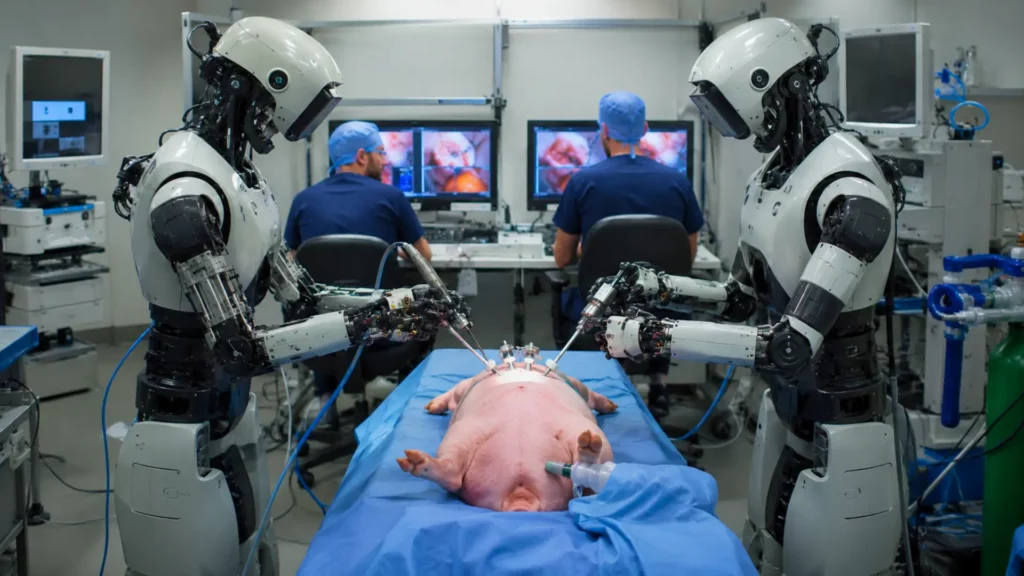
Two mechanical silhouettes standing around an operating table, surgeons positioned at a distance, and between their clamps, the organs of a living animal: this science fiction scene has actually occurred. Are we witnessing the birth of the mobile operating room?
First successful surgery with remotely piloted humanoid robots
The operation conducted at the University of California, San Diego, was indeed real. On two anesthetized living pigs, humanoid robots performed a gallbladder removal via laparoscopy. The study, published on July 8, 2026, in Nature, serves as a preliminary demonstration of this kind.
These machines did not act independently. Named Surgie, the robots were remotely controlled by surgeons using a system that replicated their movements and visual field of the surgical area. During the second operation, two humanoids worked side by side, without a human assistant directly present with the animal.
Versatile robots capable of using standard surgical tools
Robotic surgery is not a new concept. Specialized platforms like da Vinci have long utilized multiple articulated arms fixed around the patient. However, these setups are massive, expensive, and designed for specific environments. In contrast, the humanoids tested in San Diego rely on a versatile form that is compatible with spaces made for humans.
The researchers adapted their hands to grasp standard surgical instruments. This may seem like a minor detail, but it makes a significant difference: a general-purpose robot could theoretically use tools already available in hospitals without requiring a complete reconstruction of an operating room.
The models used stand approximately 1.5 meters tall and weigh 27 kilograms, compared to several hundred kilograms for some specialized surgical platforms. They could also walk, move equipment, or prepare a room. This mobility underscores why engineers aim not just to create a new mechanical scalpel but a true hospital teammate.
Accelerated development over nine months despite ongoing technical challenges
The project has advanced at an unusually rapid pace. Before operating on a living animal, the humanoid robots learned to manipulate objects, position a camera, and perform various surgical exercises. This preparation allowed for testing their precision, coordination, and their ability to integrate into a medical environment without starting from scratch.
During the procedures, everything did not unfold smoothly like in a perfectly functioning futuristic operating room. The teams encountered latency issues, collisions between instruments, and various recalibration needs. As a result, the operations took longer than with established commercial systems.
Technology designed for remote areas, crises, and space missions
The goal extends far beyond large urban hospitals. A compact robot could be transported to a rural clinic, a disaster-stricken area, or an isolated medical post. A specialist situated hundreds of kilometers away could take control. Given the shortage of surgeons in certain regions, this option raises both hope and questions.
Researchers even discuss battlefield scenarios, rescue missions, and space. In these environments, deploying a nearly one-ton machine would be impractical. A humanoid robot capable of transporting equipment, assisting a caregiver, and participating in an operation would offer a level of flexibility that has not been possible until now.
However, there are no imminent plans for human patient engagement. Improvements in communication reliability, reduction of transmission delays, and consistent safety demonstrations are necessary before any clinical approvals. Yet a significant boundary has been crossed: the robot is no longer confined to the operating room. One day, the operating room could travel with it.