

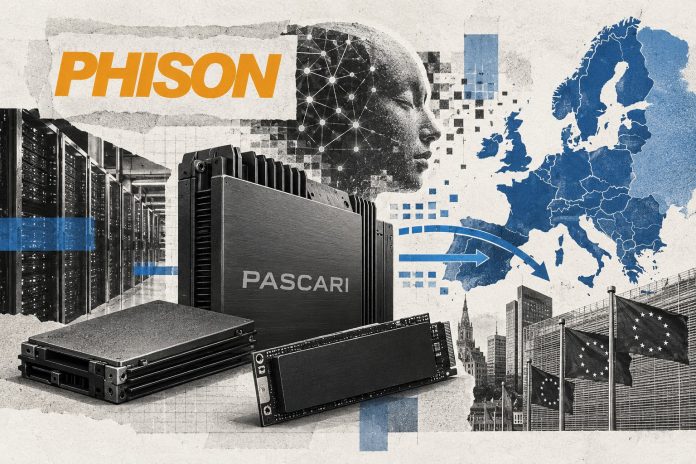
Phison, a Taiwanese manufacturer of SSD controllers, has shifted its strategy to sell directly to European consumers under the brand name Pascari. This move highlights aiDAPTIV+, a unique collection of disks and software designed to offload some data from a model outside the GPU memory.
With the shortage of high-speed memory and the rising costs of accelerators, the challenges for AI projects have shifted. Rather than focusing solely on processing power, the priority now lies in finding efficient storage solutions. The memory hierarchy is being extended downward, incorporating slower but more cost-effective media. Several component manufacturers for AI are pursuing their own paths to address these challenges, and Phison is now offering its own solution directly in the European market.
Antony Zukowski, the regional director for EMEA for the past year, is prioritizing efforts in France, Germany, and the UK, while also having teams in Italy, Spain, Portugal, and the Nordic countries. Target segments include data centers, hyperscalers, integrators, and equipment manufacturers, as well as laboratories, educational institutions, and public sector entities.
A Supplier for 20% of the Global Market
Phison enters the market backed by strong industrial credentials, yet still largely unknown commercially. According to Zukowski, “Of every hundred SSDs on the market, regardless of the brand, twenty percent have a bit of us inside,” claiming a significant share of the global controller market. It’s important to note that this figure comes from the company without independent verification.
This under-the-radar presence among other brands means that European purchasing departments often overlook the Pascari name, although technical directors are more familiar with it. “Buyers don’t know us because we aren’t branded under Western Digital, Seagate, or Micron,” admits Zukowski, observing that technical directors tend to be better informed than their purchasing counterparts. Early business interactions typically start with sample requests and compatibility tests.
Additionally, Phison supplies controllers to SSD brands that compete for the same bids, a common scenario in the components sector. “The controller is the brain,” summarizes Zukowski, highlighting his company’s critical contribution to the assembly.
Driving Memory Architecture Beyond Simple Storage
aiDAPTIV+ represents a departure from conventional storage solutions. Designed to work synergistically, the controller and intermediate software are not merely fast disks but optimized for specific roles. This system targets data that a GPU uses the least, potentially delaying the need for an additional accelerator.
Data management remains in the hands of the user. “It’s up to the user to decide which data to store on the SSD—the least accessed ones,” clarifies Zukowski, noting that the software provides default settings and then optimizes based on access frequencies. Thus, rule-based management replaces inferencing at this level.
Beyond configuration, Phison claims that its series designed for AI can handle up to 100 full disk writes per day, a stark contrast to typical SSDs, which support between 0.3 to 3 writes. Even SSDs for demanding workloads reach up to 60 writes per day, with capacities announced as high as 245.76 terabytes on a single disk.
A Project-Focused Approach Over Volume
The distinctive features of these SSDs come alongside an unusual commercial strategy shaped by supply shortages. Phison is selective about its projects, prioritizing substance over size. Zukowski recounts instances where allocations for as few as 200 units were secured for specific projects, whereas larger orders of 10,000 units without a clear purpose go unanswered. “Are you going to hoard it and resell it when the price triples? We don’t work with that kind of partner,” he explains.
This selectivity also governs the catalog, which Zukowski describes as having around four to five hundred references, available in single or dual ports across various formats. “At Phison, we specialize in high-end custom solutions,” he states. The supply of flash memory remains diversified, with firmware and controllers tailored for each source, supported by long-standing allocation contracts. Regarding the market, he admits, “There is tension.”
Despite this tension, Phison expresses readiness to deliver customized firmware that customers can control, a key area of interest for European public sector buyers. “If a client wants their own controller, they’ll get their own controller,” assures Zukowski, citing tenders where such customization has been discussed. This aligns well with the increasing demand for extended memory solutions at scale, especially for local inference applications.
However, before an IT manager makes a decision, there are two key points to clarify. The manufacturer hasn’t specified whether its firmware can restrict the copying or transport of certain data based on its destination—an important consideration raised during the interview and referred back to engineers—especially since such clauses are standard in sensitive markets. Moreover, technical documentation for the models in question has not been provided, and the announced throughput awaits external validation.
On these points and beyond, Zukowski encapsulates the discussion succinctly: “I feel like everyone buys a GPU just for the sake of having one.” He then questions whether the buyer truly needs it. This reasoning undoubtedly serves to bolster his catalog and underscores a decision-making process that many companies have yet to undertake—determining whether to acquire more processing power or to allocate storage differently for the data that processing manipulates.



