

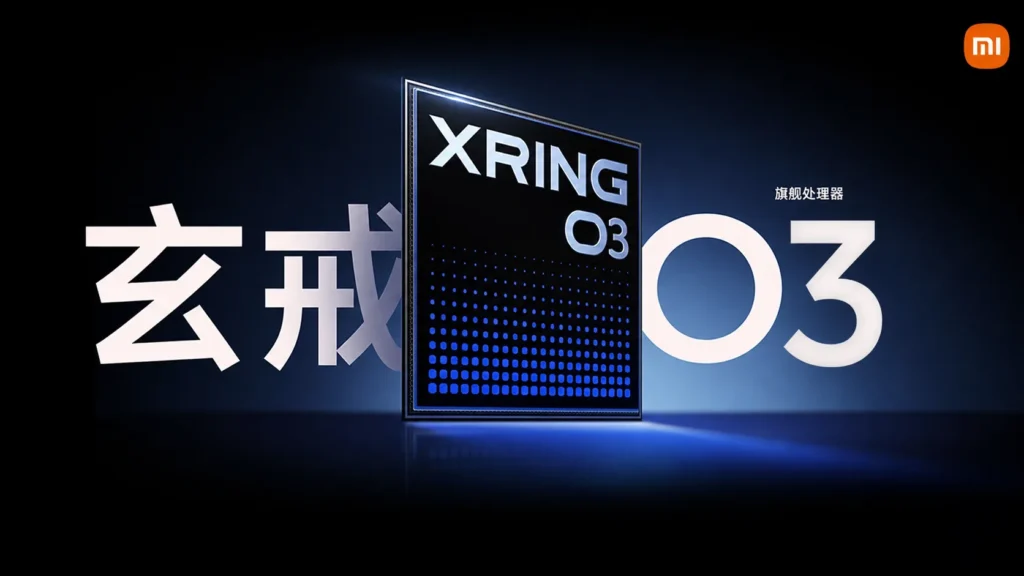
Xiaomi Xring O3: Over 14,000 Points on Geekbench and an Impressive Counter to Qualcomm
Xiaomi is ramping up its efforts in developing in-house chips. The upcoming Xring O3, expected to feature in the Xiaomi 18 Fold and the Xiaomi Pad 9 Pro Max, has recently surfaced in new Geekbench results, achieving a multi-core score exceeding 14,000 points. This significant milestone indicates that Xiaomi aims not just to optimize its devices around third-party components, but to gradually build its own silicon platform.
Although these results stem from preliminary benchmarks and do not fully encapsulate real-world performance, the Xring O3, with its 10-core architecture, 16-core GPU, LPDDR6 memory, and high-level AI acceleration, appears poised to become one of the most ambitious mobile chips of 2026.
Over 14,000 Multi-Core Points on Geekbench
The latest Geekbench entries associated with the model Xiaomi M367FC, presumed to be the upcoming Pad 9 Pro Max, exhibit particularly high performance metrics. The top multi-core score reached 14,319 points, while another test recorded 14,153 points. Single-core scores seem to range from approximately 3,474 to 3,710 points. These numbers could change as the devices approach commercialization.
The tested units might still be using non-final firmware, provisional thermal profiles, or optimization processes, but they certainly provide a solid indication of the performance target.
Xiaomi Aims to Compete Among High-End Chips
Surpassing 14,000 points on Geekbench categorizes the Xring O3 as premium-grade. Xiaomi’s intentions appear to extend beyond merely reducing dependence on external suppliers; the company seeks to compete directly in terms of performance. This represents a significant strategic shift. Designing a SoC for secondary products is one thing; integrating it into a flagship foldable and a Pro Max tablet demands a much higher level of excellence.
A 10-Core CPU Architecture
Benchmark results also reveal the processor’s structure. The Xring O3 is expected to utilize a 10-core CPU organized into different clusters. Four cores may operate up to 3.15 GHz, another set at 3.69 GHz, and two high-performance cores capable of reaching 4.36 GHz. This architecture indicates that Xiaomi is favoring an aggressive design approach.
The two fastest cores are evidently intended to handle particularly heavy loads.
4.36 GHz: A Testament to Mobile Chip Evolution
Achieving frequencies over 4 GHz would have been considered extraordinary for a smartphone just a few years ago. Modern architectures can now reach these levels, although maximum frequencies are typically employed only for short bursts.
The real challenge lies in thermal management.
A chip capable of hitting 4.36 GHz may yield impressive scores, but true performance hinges on its ability to sustain high performance without throttling after a few minutes. The Xiaomi Pad 9 Pro Max could potentially benefit from its larger chassis in this regard.
“Xiaomi’s Xring O3 surpasses the 14k multi-core mark on Geekbench.”
— Anvin (@ZionsAnvin) September 1, 2026
The Pad 9 Pro Max as an Ideal Platform for the Xring O3
Tablets provide more space for heat dissipation compared to smartphones. The cooling system can be more expansive, the battery larger, and thickness constraints usually less stringent.
The Xiaomi Pad 9 Pro Max is thus an ideal device to showcase the sustained performance of the Xring O3, while the Xiaomi 18 Fold may present greater challenges. In a foldable device, every watt dissipated is more critical.
A 16-Core GPU
The graphical capabilities would be handled by a 16-core Mali-G2-Ultra-NX. Xiaomi claims that this new generation offers substantial GPU performance improvements. According to the company’s data, graphics performance could enhance by up to 85% compared to the previous generation.
Furthermore, GPU energy efficiency might rise by 64%, although these figures should be treated as manufacturer claims until independently verified.
Gaming as a Crucial Benchmark
A modern high-end chip needs to perform exceptionally in gaming contexts. This is not solely about raw power; the GPU must maintain frequencies, and drivers must be optimized for major graphical engines while ensuring reasonable power consumption. Qualcomm holds a significant historical advantage here with the Adreno line and years of collaboration with game studios.
Xiaomi must prove its GPU and software ecosystem are sufficiently mature.
CPU Performance Expected to Increase by Up to 60%
Xiaomi also reports a potential 60% performance boost for the CPU from one generation to the next, although this figure can vary depending on the performance scenario. Such a significant improvement could derive from various factors, including a new architecture, higher frequencies, better memory, larger caches, and scheduler optimizations. The Geekbench results do indeed suggest considerable raw advancement.
However, energy efficiency will be just as crucial as peak performance.
The Xring O3 Still Uses a 3 Nm Process
Unlike the upcoming flagship chips from Qualcomm and MediaTek which are expected to utilize more advanced fabrication processes, the Xring O3 would still leverage a 3 nm process. On paper, this may seem a disadvantage against forthcoming 2 nm chips. Yet, fabrication nodes alone do not dictate processor quality.
Architecture, libraries, operating frequencies, caches, memory, and power management all substantially impact performance. Xiaomi appears to be countering the 3 nm limitation with an especially aggressive design and advanced memory integration.
LPDDR6 as a Key Advantage
One of the most intriguing attributes of the Xring O3 may be its pioneering support for LPDDR6. The Xiaomi 18 Fold and Pad 9 Pro Max are expected to utilize 16 GB modules produced by CXMT, capable of reaching 12,800 Mb/s. The anticipated memory bandwidth could reach about 113.8 GB/s.
This is an exceptionally high standard for a mobile device.
Memory Bandwidth Becomes Crucial for AI
For a long time, RAM capacity was the primary selling point—8 GB, 12 GB, 16 GB. However, with the rise of local AI, the emphasis is shifting. Local models need to move large quantities of data between memory and computation units, making bandwidth crucial. A rapid NPU cannot function at full potential if it is constantly bottlenecked by data retrieval.
By adopting LPDDR6 early on, Xiaomi aims to enhance this critical aspect of the system.
The Xiaomi 18 Fold as the First Smartphone to Feature This Technology
Xiaomi has officially announced that the upcoming Xiaomi 18 Fold will be the first smartphone to utilize the newer LPDDR6 from CXMT, alongside the Xring O3. The Pad 9 Pro Max will follow a similar design philosophy. This integration allows Xiaomi to maintain substantial control over numerous components at once: in-house SoC, Chinese memory, and optimized software. This level of integration surpasses mere performance.
It also embodies a significant industrial dimension.
Xiaomi is Gradually Building Its Own Technological Ecosystem
The Xring O3 indeed symbolizes more than a benchmark. Historically, Xiaomi has leaned heavily on Qualcomm and MediaTek for its critical devices. Creating its own SoC allows it to regain some level of control.
The manufacturer can dictate which accelerators to incorporate, how to manage imaging, how to allocate memory, optimize AI, and essentially evolve hardware and software in concert. This philosophy is reminiscent of Apple’s long-held strategy.
This Doesn’t Mean Xiaomi Will Abandon Qualcomm
However, it would be premature to envision a complete break. Chip development is exceedingly costly, and Qualcomm possesses a vast technology portfolio, especially in areas such as modems and connectivity.
Xiaomi can adopt a hybrid strategy: employing its own Xring in select strategic products while still utilizing Snapdragon in other ranges. This approach mitigates risk while allowing the company to forge a path toward internal expertise.
AI as Another Major Priority
Xiaomi has touted various figures regarding AI processing. The Xring O3 could reportedly achieve up to 200 TOPS in tensor computations, with vector performance estimated around 3.13 TFLOPS. The company mentions potential improvements of up to 45% in NPU performance. These data points must be approached with caution, as calculation methodologies for TOPS can vary significantly.
Still, they make it evident that Xiaomi wants to center local AI within its platform.
200 TOPS Doesn’t Tell the Whole Story
AI performance comparisons can be tricky. Different manufacturers may count operations in unique ways, and the numerical precision used can greatly influence the figures—such as INT4, INT8, and FP16 formats, each yielding vastly different results. The pressing question will be which models can run locally, at what speeds, power consumption, and memory requirements.
This is where LPDDR6 may prove decisive.
Computational Photography Should Also Benefit from the New NPU
The AI capabilities of the Xring O3 will not be limited to generative assistants. It could also enhance the photography pipeline—scene recognition, HDR, segmentation, noise reduction, computational zoom, and video processing. By developing its own SoC, Xiaomi can tailor accelerators specifically for its imaging algorithms.
This is one of the most compelling advantages of creating its own chip.
AnTuTu Score of 5.22 Million Announced
Xiaomi also claims a score of 5.22 million points on AnTuTu. If this score is validated with a commercial version under standardized conditions, the Xring O3 could mark one of the first mobile chips to clearly exceed the five million point threshold.
As always, synthetic benchmarks do not reflect everyday experiences directly, but such scores are undeniably indicative of broader trends. Xiaomi clearly does not view the Xring O3 as a compromise SoC.
Concerns About Power Consumption Will Be Central
This is one of the most significant uncertainties. High CPU frequencies, a massive GPU, a powerful NPU, and very fast LPDDR6 could lead to substantial power consumption. A tablet can handle this demand thanks to a large battery. The scenario becomes much trickier in a foldable smartphone. The Xiaomi 18 Fold must maintain solid battery life while staying slim.
The success of the Xring O3 will thus heavily depend on its performance per watt.
3 Nm Process Could Be a Disadvantage Against Future 2 Nm Chips
Qualcomm and MediaTek are readying their next generations using 2 nm processes, which typically promise either better performance or reduced consumption at equivalent levels. The Xring O3 might face rivals with a manufacturing edge due to this.
Xiaomi will need to compensate with architecture, memory, and integration. This will be a particularly fascinating test. An optimized 3 nm design could successfully compete against a poorly exploited 2 nm chip.
The Xring O3 Represents a Significant Industrial Leap for China
The context extends beyond Xiaomi itself. The involvement of CXMT in LPDDR6 indicates that various Chinese entities are striving for a more autonomous technological chain—encompassing memory, SoCs, software, and assembly. This integration gradually diminishes reliance on foreign suppliers.
For Xiaomi, possessing more critical technologies offers greater strategic leverage.
Yet, Established Giants Maintain Massive Head Starts
Companies like Qualcomm, MediaTek, Apple, and Samsung boast decades of experience in processor and mobile platform design. They have vast teams for drivers, modems, security, and optimization.
Thus, achieving a quick benchmark result is merely an initial step. Stability, updates, network compatibility, and efficiency are all equally vital.
Xiaomi must demonstrate that the Xring platform is sustainable, not just a one-off project.
The Real Test Goes Beyond Geekbench
Although benchmarks will undoubtedly draw attention, the Xring O3’s success will hinge on other facets. Can it maintain performance during long gaming sessions? Can it match the best Snapdragon chips regarding battery life? Is photo processing fast and consistent? Are applications fully compatible? Will updates be regular? Most importantly, can Xiaomi replicate this progress across future generations?
This last point separates a technology experience from a true silicon strategy.
Xiaomi is No Longer Just Buying Power but Designing It
This is likely the key takeaway from the recent results. For years, Xiaomi could select the best Qualcomm components available and build its flagship around them. With the Xring, the brand now seeks to define part of the rules itself. The Xring O3, despite not yet being commercialized, shows great potential, with over 14,000 points on Geekbench and early integration of LPDDR6.
Xiaomi is clearly determined not just to produce some of the most powerful Android smartphones but also to design the chip that makes them powerful.



