


Foldable Smartphones: The OLED Market Is Set To Explode, But Samsung Could Lose Its Dominance
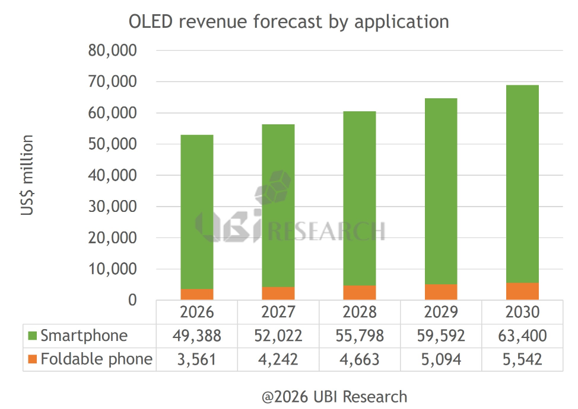
Foldable smartphones have not yet replaced traditional models, but their market seems poised for significant growth. According to UBI Research projections, shipments of foldable OLED panels could reach 39.72 million units by 2030, following several years of stagnation around 20 million units.
However, this expected boom may not benefit all manufacturers equally. Samsung Display, currently the market leader, is projected to see its market share decline significantly in favor of BOE and other Chinese competitors. This shift could reshape the industrial balance in the foldable segment, especially as Apple prepares to enter the market.
The Foldable Display Market May Finally Move Past Stagnation
UBI Research anticipates a significant acceleration in the delivery of foldable OLED panels in the coming years. The sector has remained relatively stable for about three years, with annual volumes fluctuating around the lower end of 20 million units.
From 2026 onwards, however, this dynamic is expected to change. Demand for foldable smartphones will likely begin to grow more rapidly, leading to a corresponding increase in orders for flexible displays.
By 2030, the market could reach 39.72 million units. Although this would not make foldables the majority of the global smartphone market, they would clearly start to move away from their niche status.
Samsung Remains a Leader, but Its Advantage May Wane
Currently, Samsung Display holds a particularly strong position in the foldable OLED market. UBI Research estimates its market share at about 61.9% in 2026. However, this dominance is expected to diminish. By 2030, Samsung’s share could drop to 41%. The company may still be one of the leading suppliers in the market, but it would lose the almost hegemonic control it currently enjoys.
This erosion would not come from a slowdown in Samsung’s volumes but rather from the rapid rise of Chinese competition.
BOE Could Become the Big Winner
The main beneficiary would be BOE. Its market share is projected to rise from 25.5% in 2026 to 32.8% by 2030, according to UBI Research. This progression is strategic. BOE already supplies OLED panels to several major manufacturers and has been working for years to close the technological gap with Samsung Display. Foldable displays represent precisely one area where industrial complexity is particularly high.
Producing a display that is thin enough, durable, uniform, and resistant to thousands of folding cycles requires a level of expertise far beyond that of a regular OLED. If BOE continues to improve, Samsung will not be able to rely solely on its historical lead.
Chinese Manufacturers Could Surpass 50% by 2027
The most significant change could occur even sooner. UBI Research estimates that the four major Chinese manufacturers of foldable panels may collectively exceed 50% of the market by 2027. This threshold would be highly symbolic, indicating that China would collectively become the leading production center for foldable OLED screens, surpassing Samsung Display.
This development mirrors what has already occurred in other display segments.
Chinese manufacturers have gradually closed the gap in traditional OLED, followed by massive investments in flexible displays. The foldable segment could become their next major area of expansion.
Growth Is Also Driven by New Formats
The foldable market has long struggled with compromise issues. Early models were often heavy, thick, expensive, and sometimes fragile. Recent generations have largely improved upon these shortcomings. The chassis are thinner, hinges are stronger, and screens are much better protected. However, design changes also play a crucial role.
New wider formats, sometimes described as “passport-style,” make foldable smartphones more enjoyable to use when closed. They resemble more premium smartphones capable of transforming into small tablets rather than experimental devices.
This evolution could persuade previously hesitant consumers.
Samsung Is Helping to Popularize the Format
Samsung remains a key driver of the market. The company has built most of the current visibility of foldables with its Galaxy Z Fold lineup. Recent generations have made significant strides in terms of thinness, weight, and durability.
The Galaxy Z Fold 8 is a prime example of this maturity. The device aims less to impress with its folding capability and more to provide the comfort of a traditional smartphone. This normalization is likely what will enable the market to truly grow.
When users no longer feel like they are sacrificing battery life, camera quality, or ergonomics for a foldable screen, the format becomes much easier to adopt.
Apple Could Accelerate Market Growth
However, the most dramatic factor remains the anticipated arrival of Apple. The first foldable iPhone, often dubbed the iPhone Ultra, is expected to launch in September 2026. Its impact could far exceed Apple’s own sales. Whenever Apple enters a new product category, it tends to attract more developers, suppliers, and industrial investments.
The arrival of a foldable iPhone could drive demand for flexible displays, accelerate economies of scale, and push more brands to launch their own devices.
The market would no longer rely solely on Samsung, Honor, Huawei, or Xiaomi.
Apple Could Also Disrupt the Supply Chain
Apple’s entry could have another consequence: redistributing contracts among display manufacturers. Historically, Samsung Display has been one of the main OLED suppliers for the iPhone. However, Apple frequently seeks to diversify its supply sources. Therefore, BOE could benefit directly from the development of the future foldable iPhone if its panels meet Cupertino’s standards.
This could further accelerate the rise of the Chinese manufacturer. The real challenge for Samsung is not just selling more Galaxy Folds, but also maintaining its position as a preferred supplier for other premium brands.
Foldables Are Becoming a Less Compromised Product
The anticipated market growth is also attributed to the fact that modern devices require fewer compromises. Early foldables were thick when closed, had sometimes modest batteries, photography could be inferior to traditional flagships, and the fragility of flexible screens was a constant concern. While these issues are not completely resolved, they are much less critical than they were a few years ago.
Manufacturers are now using new hinges, more durable materials, and batteries with better energy density. Thus, foldables are starting to resemble a credible premium option rather than just a technological showcase.
The Price Remains the Main Obstacle
Projected growth does not mean that everyone will quickly adopt a foldable smartphone. The price remains the primary barrier. High-end Fold models easily exceed €1,500, and some ultra-premium products go even higher. Apple’s entry could even drive prices up if its first foldable exceeds the expected $2,000.
To reach a true mass market, the sector will probably need to offer more models priced between $800 and $1,200. This is where Chinese manufacturers could play a crucial role. Increased competition in displays should gradually lower production costs.
The OLED Panel Boom Will Benefit the Entire Ecosystem
The growth of foldable displays will have consequences far beyond smartphones. Investments in materials, hinges, and flexible panels could also benefit other categories. Foldable tablets, laptops with flexible screens, or hybrid devices could leverage the same industrial supply chain. However, smartphones remain the product capable of generating the volumes necessary to reduce costs.
If UBI Research’s forecasts come to fruition, the industry will finally have the critical mass needed to accelerate innovation.
The expected decline of Samsung Display does not mean the company is losing its expertise. It remains one of the most experienced manufacturers in the market, but competition is evolving. BOE, Visionox, and other Chinese players are no longer just looking to produce at lower costs. They are developing their own hinge technologies, flexible substrates, and thinner panels. Samsung will need to continue investing to maintain an edge in quality, durability, and energy consumption.
The foldable market is gradually becoming important enough for industrial competition to be as intense as that of traditional OLED.



