

Google AI Mode Becomes A True Travel Assistant With Flight, Hotel, And Reservation Tracking
Google is pushing the boundaries of its search engine, transforming AI Mode into a tool capable of tracking flight prices, displaying trip costs in points or miles, and, in the United States, even facilitating hotel reservations directly.
The distinction between a search engine and a travel agency is becoming increasingly blurred, with Google not only sourcing information but also guiding users through the booking process.
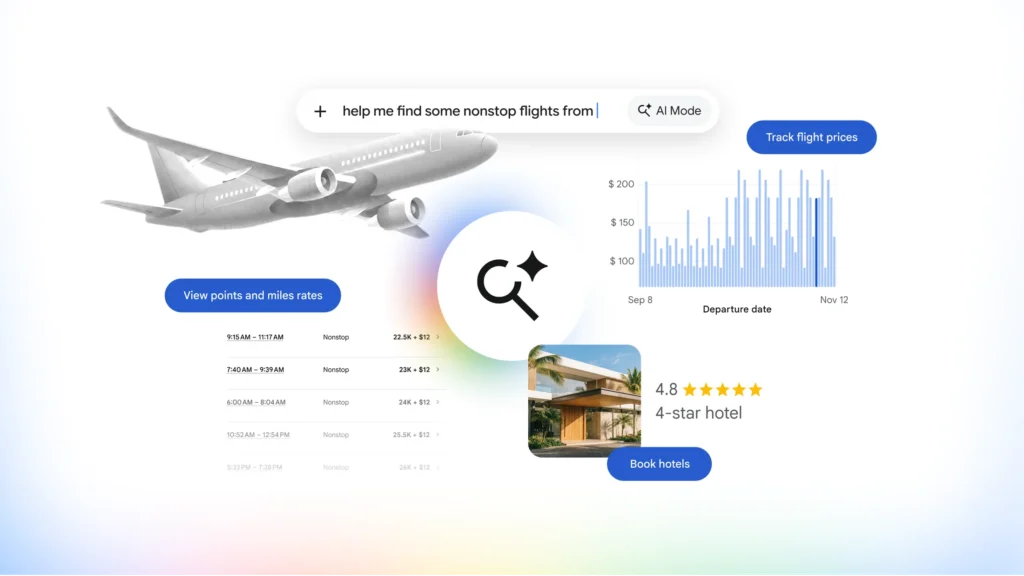
AI Mode Can Now Track Flight Prices
The first update introduces the integration of Google Flights’ price tracking into AI Mode. Users can simply describe their trip in a conversation, such as specifying their departure city, destination, dates, or preferences. AI Mode will then display the best options based on fares from over 300 airlines and travel websites.
If the price appears appealing, users can continue to build their itinerary.
If not, they can just say, “Track the price of these flights for me.” Google will then send an email when fares change for the selected dates and destination.
No Need To Leave The Conversation To Create An Alert
Google Flights has long offered price alerts, but the new feature integrates them into the conversational interface. Users no longer need to start a new search, set various filters, and manually activate tracking.
AI Mode retains the context of the conversation and directly converts requests into alerts. While this simplification may seem minor, it reflects Google’s logic to gradually minimize the number of interfaces needed to plan a trip.
The engine must understand intent and coordinate the tools in the background.
Flight Tracking Available In Over 180 Countries
Google has stated this feature is available in over 180 countries and territories where AI Mode is supported. However, there is an important caveat for Europe: some new travel-related features are not available in the countries and territories of the European Economic Area.
Deployment is therefore dependent on market, language, and local regulatory constraints.
Despite this, Google continues to rapidly expand AI Mode, which has been available in France since July 2026.
Points And Miles Comparisons Made Easier
The second significant update is that AI Mode can now display flight and hotel prices directly in points or miles. Users just need to specify their loyalty program. For instance, one can request to travel between Atlanta and Miami using American Airlines miles while stating their desired dates and preference for direct flights.
AI Mode will then display options that match the request along with the required number of miles. This feature addresses a significant challenge of modern travel: comparing money, points, and miles can often be unnecessarily complex.
Hotels Are Included Too
The functionality isn’t limited to airfare. Users can specify their destination, travel dates, and hotel loyalty program to obtain price quotes in points. Google assures that the data is sourced from the most recent information provided by its partners.
Once a user selects an offer, they will be redirected to the respective loyalty program’s website to finalize the use of their rewards.
This feature is globally available in locations where AI Mode is supported.
American Airlines, Hilton And Wyndham Among The First Partners
Google is starting with a limited set of loyalty programs, including Alaska Airlines, Hawaiian Airlines, American Airlines, Choice Hotels International, Hilton, and Wyndham Hotels & Resorts.
More partners are expected to be added in the coming weeks, including Accor, Flying Blue, Hyatt, LATAM Airlines, and Lufthansa Group. The functionality will naturally become more valuable as additional programs are connected. Ultimately, AI Mode could serve as a relatively universal interface for comparing rewards and traditional rates.
AI Mode Can Now Book A Hotel
Google is taking it a step further with hotels. In the United States, AI Mode is beginning to allow users to discover and book accommodations directly through the conversation. Users can describe their travel plans in natural language.
For instance, they might search for a quiet hotel close to downtown, suitable for families, with a good gym. AI Mode then presents various options along with photos, customer reviews, and critical comparison criteria.
“Continue On Google” Initiates The Booking
Once a hotel is selected, users can ask AI Mode to proceed with booking. When the hotel or platform is compatible, an option labeled “Continue on Google” will appear in the list of choices. The process then allows users to select a room, review cancellation policies, and verify key booking details. Payment can be made via Google Pay.
This brings search, comparison, and transaction into a single experience.
Google Is Not The Hotel Seller
This distinction is essential. Even when the booking is completed through Google’s interface, the company does not necessarily become the seller of the service. The hotel or partnering platform remains the primary retailer, managing the commercial transaction and customer service, especially in cases of modifications or cancellations.
Google essentially acts as an intermediary layer between search and the booking system, allowing it to offer a more integrated experience without having to become a hotel operator directly.
Booking.com, Expedia And Marriott Collaborate On The Launch
The hotel booking feature in AI Mode is gradually rolling out in the United States and is currently available only in English. Google is collaborating with several major industry players, including Booking.com, Choice Hotels International, Expedia, Hilton, Hotels.com, IHG Hotels & Resorts, Marriott International, Priceline, Trip.com, and Wyndham Hotels & Resorts.
The simultaneous involvement of hotel chains and online travel agencies is strategic, enabling Google to avoid dependency on a single type of intermediary and to provide multiple pathways to booking.
Google Transforms AI Mode Into A Universal Travel Layer
Google’s overarching vision is becoming clear. AI Mode can already create itineraries, compare hotels and flights, and leverage data from the web. The new functionalities now allow it to monitor prices, understand loyalty programs, and aid in reservations.
In essence, Google is progressively covering the entire travel chain: search, comparison, planning, monitoring, and transaction. This is precisely what one would expect from a digital travel agent.
The Real Advantage Of Google Lies In Real-Time Data
Artificial intelligence alone is not enough to build a competent travel assistant. A chatbot can easily suggest a destination or create a theoretical itinerary. The challenge arises when it comes to knowing the real price of a ticket at a specific moment, the availability of a room, or the exact number of miles required.
This is where Google holds a significant advantage.
Google Flights, Hotels, Maps, and Search already have the infrastructure to aggregate data from hundreds of partners. AI Mode simply acts as a new interface overlaying these services.
AI Does Not Replace Google Flights, It Gradually Absorbs It
It may be more accurate to describe this as evolution within Google Search rather than a standalone travel service. Google Flights continues to operate, and airline sites and booking platforms remain essential.
However, users increasingly do not need to understand how these services are structured. They can express what they want, and AI handles translating that intent into searches, comparisons, and actions.
This is precisely what Google aims to achieve with AI Mode across other sectors.
A Clear Threat To Comparison Sites And Online Agencies
This evolution may create tension in the travel sector. For years, Google Search primarily served as a gateway to Booking, Expedia, Tripadvisor, or airline websites.
If AI Mode begins to keep users in the Google environment longer, the relationship changes. The intermediary that controls the conversational interface can also influence the options compared and how they are presented.
For online travel agencies, this presents a paradox. They need Google to access users, but Google is gradually becoming capable of providing a significant part of the experience that previously constituted their value.
Loyalty Programs Become A New Challenge
The integration of miles and points is particularly strategic. Loyalty programs are intentionally complex, with their value varying based on destination, date, and availability. An assistant capable of automatically comparing multiple options can significantly reduce this complexity.
In the future, one might imagine a request like, “Find me the cheapest way to go to Tokyo in October, combining my miles, hotel points, and maximum budget.” Google already has a considerable portion of the infrastructure needed to respond to such requests.
AI Mode Is Gradually Shifting From Response To Action
This update highlights the broader transformation of search engines. For twenty years, Google primarily operated on a simple logic: find the pages that could contain the answer. With AI Mode, the company aims to go further. The engine understands complex intent, consults multiple sources, builds recommendations, and can now trigger certain actions.
The travel sector is particularly well-suited for this transition as it combines searching, comparing, scheduling, pricing, and booking.
Google Aims To Become The Agent That Organizes The Entire Stay
The vision now extends well beyond just a flight comparator. Google possesses Search for discovering, Maps for navigation, Gmail for retrieving confirmations, Calendar for organizing dates, Flights for comparing tickets, and Hotels for selecting accommodations.
AI Mode could gradually serve as a control layer across this entire ecosystem. The next logical step would be to allow users to express only their objective: “Organize my five days in Tokyo for less than 2,000 euros.” The rest could be automatically divided among Google services and their partners.
This scenario no longer feels like science fiction. With price tracking, loyalty programs, and hotel booking, Google has just assembled several critical building blocks.



