

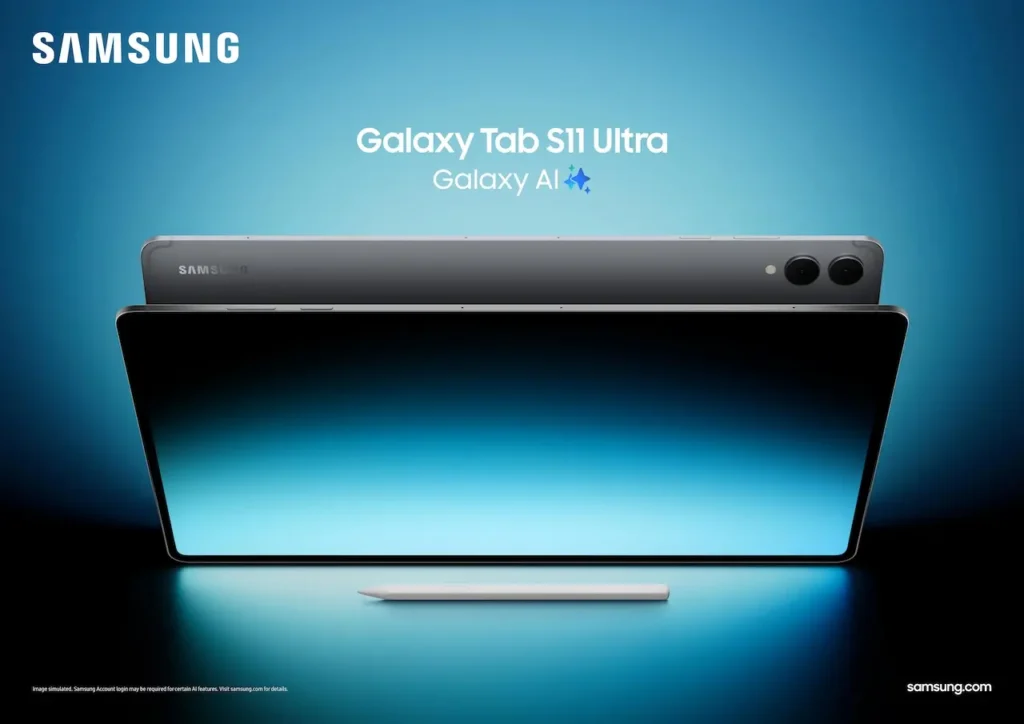
Galaxy Tab S12 Ultra: le design fuite et Samsung changerait très peu de choses
The Galaxy Tab S12 Ultra begins to reveal itself, and the first images suggest no major design changes. Samsung is expected to maintain the gigantic 14.6-inch display, very thin bezels, and even the front notch from the previous generation, while the main changes will once again be internal.
Almost identical design to the Galaxy Tab S11 Ultra
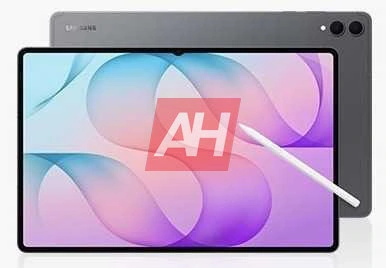
A new image claimed to be an official render of the Galaxy Tab S12 Ultra reinforces previous leaks about Samsung’s upcoming flagship tablet. The render shows the front and part of the back of the device, along with the S Pen.
At first glance, the differences are hard to spot.
Samsung is likely to keep the design of the Galaxy Tab S11 Ultra nearly unchanged, with its extremely thin bezels, angular chassis, and vertically positioned dual camera module on the back. Even the gray color seems very similar.
The notch will still be present
The most noticeable detail remains the notch located on the top edge of the display when the tablet is used in landscape mode. Initial CAD renders released in July already suggested that Samsung had no intention of removing it, and this new image supports that assumption.
This choice may come as a surprise for a 14.6-inch tablet.
With such a large display area, Samsung could theoretically integrate the front camera into a slightly thicker bezel, as some competitors do. However, the company seems to prefer maintaining extremely thin bezels, even if it means keeping this cutout in the screen.
A 14.6-inch display remains on the agenda
The Galaxy Tab S12 Ultra is set to retain a 14.6-inch Dynamic AMOLED 2X display with a 120 Hz refresh rate. This will be exactly the same size as on the Galaxy Tab S11 Ultra. Samsung has little reason to change this feature since the current model’s display is already one of its main selling points, offering ample workspace, a high refresh rate, and excellent anti-reflective treatment.
For DeX usage, multitasking, or graphic creation with the S Pen, this format remains particularly suitable.
The S Pen doesn’t seem to evolve either
The stylus visible in the new render appears very similar to the one provided with the current generation. Its overall shape seems unchanged, and a side button is still present. We will have to wait for the official presentation to know if Samsung will add new software functions or change the technology used.
However, in terms of aesthetics, the company does not seem to be aiming to reinvent its accessory. After several generations of tweaks, Samsung seems to have settled on a formula it considers sufficiently mature.
The Dimensity 9500 could be the real novelty
The main change in the Galaxy Tab S12 Ultra will likely be internal. Several leaks and benchmark entries suggest the use of the MediaTek Dimensity 9500. Samsung is thus continuing its collaboration with MediaTek for its premium tablets. The new SoC is expected to deliver a noticeable increase in CPU, GPU, and AI performance compared to the previous generation.
On a tablet of this size, the key will be to maintain these performance levels over time, thanks to a chassis that provides significantly more surface area for heat dissipation than a smartphone.
Up to 16 GB of RAM and 1 TB of storage
The highest-end configurations could offer up to 16 GB of RAM and 1 TB of internal storage. This positioning makes sense for a tablet that Samsung increasingly presents as a true productivity tool.
With Samsung DeX, advanced multitasking, and Galaxy AI features, the Ultra range has aimed for several years to come closer to a laptop than to a simple content consumption tablet.
Thus, the increase in processor power is likely to be more significant than the aesthetic changes.
The battery would remain at 11,600 mAh
Rumors also suggest a battery capacity of 11,600 mAh, the same as the Galaxy Tab S11 Ultra. Wired charging will also remain limited to 45 W. Again, Samsung seems to be prioritizing stability.
A larger battery would likely require additional thickness or weight, especially since the Tab S11 Ultra already measures only 5.1 mm thick despite its massive display size. However, battery life could improve if the Dimensity 9500 proves more efficient under equivalent usage.
The 45 W charging is starting to feel dated
The retention of 45 W charging may be harder to justify. An 11,600 mAh battery naturally takes much longer to recharge than that of a smartphone. Several Android manufacturers now offer significantly higher charging speeds on their premium tablets. Samsung has historically been cautious in this regard, both for its smartphones and tablets.
This approach probably helps limit heat and preserve the battery over several years, but it also creates a sense of stagnation for a premium product.
A generation focusing primarily on software
In the absence of major hardware redesigns, Samsung could concentrate its messaging on One UI, Galaxy AI, and DeX. The Galaxy Tab S11 Ultra already introduced several improvements to DeX to facilitate work with multiple windows and external displays.
The S12 generation is expected to continue this trend.
Tablets are particularly well-suited for new AI functions: document summarization, note-taking, transcription, image generation, or writing assistance are even more relevant on a nearly 15-inch screen. Samsung may therefore consider the current hardware to be mature enough and shift innovation toward the software experience.
Is it necessary to change a working design?
The lack of change may seem disappointing for such an expensive product, but the tablet market does not operate in the same way as the smartphone market. Users typically replace their tablets far less frequently. Few owners of a Galaxy Tab S11 Ultra will consider upgrading to the S12 Ultra just a year after their purchase.
The true target audience for this new generation will likely consist of users with a Tab S8, S9, or even older models. For them, the cumulative evolution will be significantly greater.
Apple is also following a very conservative strategy
Samsung is not the only manufacturer to maintain a similar aesthetic base for several years. The iPad Pro also evolves primarily through its processor, display, and minor internal adjustments between major redesigns.
On a tablet, the ideal form factor is quite challenging to reinvent. A large rectangular display, thin bezels, four speakers, and a stylus already comprise a formula that is difficult to improve without completely changing the product’s usage.
The question is thus less about whether the design changes and more about whether the performance, battery life, and software are advancing sufficiently.
An expected launch in September
Samsung has already indicated that its next generation of premium tablets will arrive in the second half of 2026. Various leaks now point to a presentation in September, coinciding with the IFA in Berlin.
This year, the range could focus on two models: a Galaxy Tab S12+ and the Galaxy Tab S12 Ultra. The possible absence of a standard model also suggests that Samsung is looking to reposition its S series more towards the premium end.
However, the company has not yet communicated any specific dates.
The Galaxy Tab S12 Ultra does not seem to aim to reinvent the premium Android tablet; Samsung appears convinced that its current formula is still adequate.



