

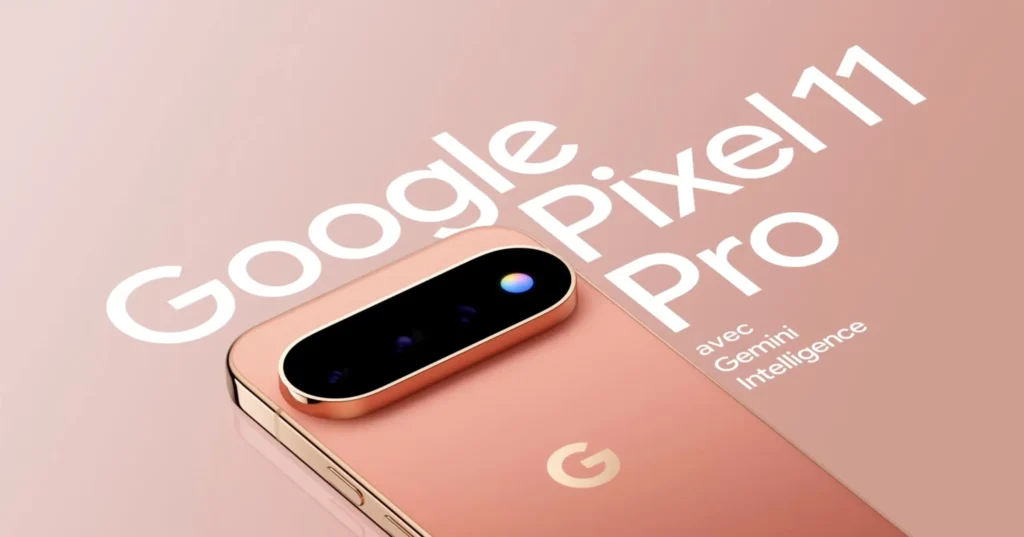
Pixel 11 Pro: Google’s new premium smartphone disappoints in European durability test
Shortly after its announcement, the Pixel 11 family is already under scrutiny through European regulatory data. The EPREL listings reveal an unexpected anomaly: while the Pixel 11, Pixel 11 Pro XL, and even the Pixel 11 Pro Foldreceive the highest drop resistance class, the Pixel 11 Pro only earns a B.
Pixel 11 Pro is the only model to receive a B
The European EPREL (European Product Registry for Energy Labelling) allows for comparison of certain durability, energy efficiency, and repairability criteria for smartphones sold within the European Union.
The results for Google’s new lineup are quite intriguing.
Based on published data, the Pixel 11 Pro survived 180 free falls in a standardized protocol, which results in a B classification. Other models performed significantly better:
| Model | Number of Drops | Durability Class |
|---|---|---|
| Pixel 11 | 270 | A |
| Pixel 11 Pro | 180 | B |
| Pixel 11 Pro XL | 270 | A |
| Pixel 11 Pro Fold | 210 | A |
The result for the Fold is particularly noteworthy. Despite the inherent mechanical complexity of a foldable smartphone, it achieves a better classification than the traditional Pixel 11 Pro. Comparatively, the previous generation also scored better, as the Pixel 10 models received an A classification.
Note: This does not mean the Pixel 11 Pro is fragile
However, it’s important to contextualize these results. The European protocol does not replicate the dramatic “drop tests” performed on concrete by some reviewers. Instead, it follows a standardized procedure designed to provide consumers with a reproducible basis for comparing different devices.
A B classification does not mean the Pixel 11 Pro will break at the first drop. It instead indicates that, under the specific conditions of the protocol, the smartphone reached its threshold for serious damage earlier than models classified as A. This is an important distinction. Actual durability is influenced by many factors: drop height, surface type, impact angle, presence of a case, and the exact point of impact on the ground.
Nevertheless, for a smartphone selling for around 1,200 euros, this difference is noteworthy enough to highlight.
Repairability and efficiency: all models receive a B
In terms of the other two criteria provided, the Pixel 11 family is much more homogeneous. All four smartphones earn a B classification for repairability, as well as a B for energy efficiency. The EPREL data also provides standardized measurements of autonomy, allowing for direct comparisons under similar conditions.
The Pixel 11 Pro XL leads with 50 hours and 10 minutes of battery life, thanks in part to its 5,000 mAh battery. The standard Pixel 11 follows closely behind with 48 hours and 50 minutes, while the Pixel 11 Pro offers 47 hours and 36 minutes.
The foldable model, as expected, comes in last.
| Model | Nominal Battery | EPREL Autonomy |
|---|---|---|
| Pixel 11 Pro XL | 5,000 mAh | 50h 10 |
| Pixel 11 | 4,840 mAh | 48h 50 |
| Pixel 11 Pro | 4,707 mAh | 47h 36 |
| Pixel 11 Pro Fold | 4,658 mAh | 45h 05 |
However, these figures should not be interpreted as a promise of true two-day battery life. They stem from a harmonized protocol primarily designed to compare devices rather than to precisely replicate each user’s daily usage.
Standard Pixel 11 appears particularly competitive
These results highlight another interesting detail: the standard Pixel 11 holds its own remarkably well against the Pro. It is cheaper, achieves the highest drop resistance class, and even boasts a slightly better standardized autonomy. Of course, this does not diminish the technical advantages of the Pro model, particularly in photography and certain premium features.
However, it strengthens the appeal of the standard model.
Google seems to have reached a point where the difference between the standard Pixel and the Pro models relies more on specific features than on a systematic superiority of the pricier variant. This is precisely why the B rating for the Pixel 11 Pro is noteworthy: a “Pro” device is generally expected to have the least compromises.
The new European labels become a valuable comparison tool
Beyond Google’s case, these results primarily demonstrate the value of the new European framework. For a long time, a smartphone’s durability was challenging to quantify before purchase. Consumers had access to IP certifications, manufacturers’ claims, and occasionally confusing independent tests.
EPREL adds a different dimension: a standardized reference allowing for comparison across multiple products according to a common methodology. While this does not replace comprehensive independent testing, it is gradually compelling manufacturers to present information that was previously much less transparent.
In the case of the Pixel 11 family, this transparency yields an ironic outcome: Google’s foldable smartphone achieves a better drop resistance classification than its conventional Pixel 11 Pro. A detail that a traditional technical specification likely would not have revealed.



