

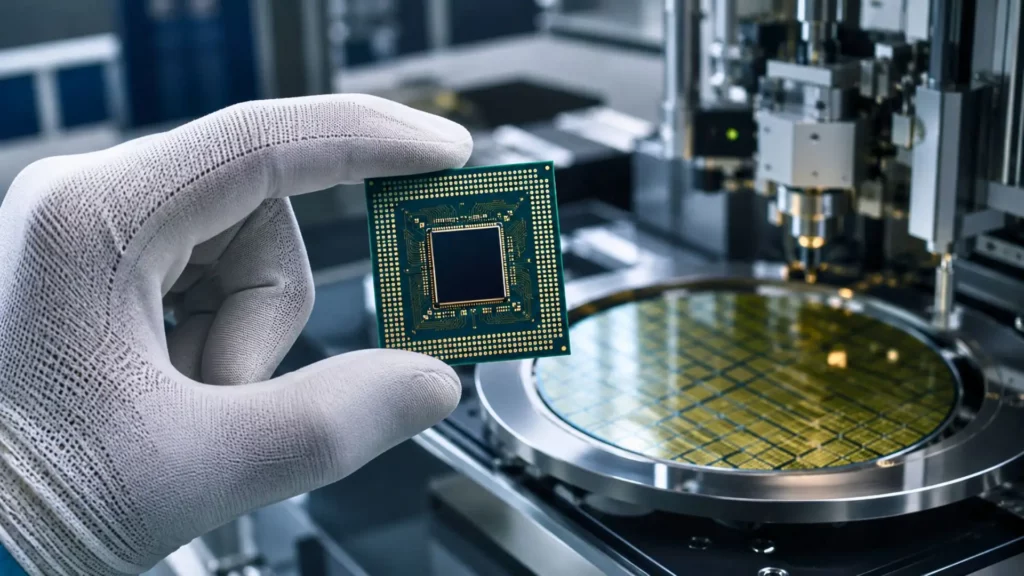
For the first time, a production chain entirely based in Europe has completed a semiconductor designed for the defense sector. This major advancement secures sensitive technologies against current geopolitical tensions.
A unique collaboration to design and assemble a defense component in Germany
On Wednesday, June 10, 2026, an industrial alliance marked a technological turning point for the continent. The Dutch designer Qualinx and the American manufacturer GlobalFoundries unveiled the creation of a highly secure integrated circuit, named QLX3xx. This project marks the beginning of a new era.
This electronic component will be produced at the factory in Dresden, Germany. It will primarily equip positioning systems, secure navigation tools, and state telecommunication networks. European satellites will also utilize this technology for their missions in orbit.
Absolute security control to prevent military data leaks outside the continent
To ensure the integrity of the process, the manufacturing adopts a specific organization. Indeed, all design-related files and all raw materials remain confined within European borders. This closed-loop operation eliminates external intermediaries.
According to officials, this airtight protocol aligns with the stringent requirements of public administrations. Defense agencies and operators of critical infrastructure thus have total assurance against industrial espionage. Tom Trill, the CEO of Qualinx, confirms the immediate effectiveness of this supply chain.
This program benefits from targeted subsidies from the European Chips Plan. This funding mechanism, also known as the European Chips Act, aims to reduce the industrial vulnerability of member states. It supports the development of infrastructures capable of competing with global giants.
A concrete response to reduce dependence on Asia in a tense international context
Until now, local defense industries purchased a significant portion of their chips from Taiwan or China. However, rising geopolitical tensions are turning this habit into a major threat to national security. A supply disruption could paralyze strategic military sectors.
The CEO of GlobalFoundries, Manfred Horstmann, declares that this success validates the feasibility of an autonomous model. Europe demonstrates its capability to control a complete logistics chain for aerospace. This regained sovereignty provides a credible alternative amid uncertainties in import markets.
A transition to mass production planned in Dresden to attract new partners
The Dresden factories are already preparing the next phase of this industrial adventure. The company plans to deploy a fully automated production system by the end of 2026. This technical modernization will optimize manufacturing rates while maintaining a high level of protection.
Starting in 2027, this technological infrastructure will open to other commercial and governmental organizations. The goal is to broaden access to these sovereign semiconductors. Many players in the security sector have already expressed interest in integrating into this reshored manufacturing network.
In the long term, GlobalFoundries hopes to attract multiple regional subcontractors into its fold to strengthen this defense ecosystem. This initial success shared with Qualinx serves as a reference model, encouraging other companies to relocate their strategic activities to the continent.



