

Samsung plans to extend its silicon-carbon batteries to the Galaxy S lineup
Following the launch of foldable smartphones, silicon-carbon batteries could soon be used in the Galaxy S models. Samsung has confirmed it is considering integrating this technology into its future traditional smartphones while providing new insights into its plans for rollable-screen devices. This advancement could finally allow the company to enhance the battery life of its devices without compromising their slim designs.
This announcement comes just days after the unveiling of the new Galaxy Z Fold 8 and Galaxy Z Flip 8, which are the first Samsung smartphones to adopt this new generation of batteries.
The Galaxy Z Fold 8 introduces silicon-carbon technology
With the Galaxy Z Fold 8, Galaxy Z Fold 8 Ultra, and Galaxy Z Flip 8, Samsung takes a significant step in the evolution of its batteries. The silicon-carbon (Si-C) cells provide a higher energy density than traditional lithium-ion batteries. This allows for greater capacity to be integrated into a smaller volume, a particularly beneficial feature for foldable smartphones where every millimeter counts.
Thanks to this technology, the Galaxy Z Fold 8 features a larger battery compared to its predecessor, while the Galaxy Z Flip 8 maintains a capacity similar to the Flip 7 but with a thinner chassis.
This initial adoption underscores Samsung’s strategy to showcase foldables as a technological flagship before considering a broader rollout.
The Galaxy S lineup might be next
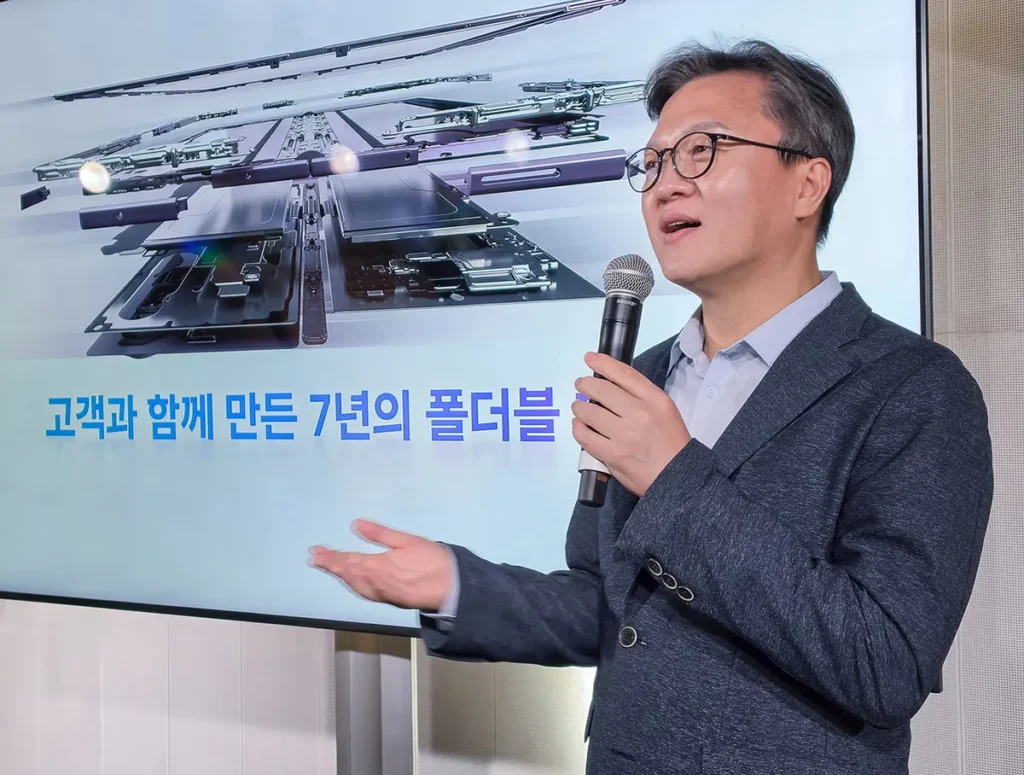
During a press event in London, Moon Sung-hoon, vice president of Hardware for Samsung’s Mobile Experience division, was asked about the arrival of these batteries in the upcoming Galaxy S lineup, particularly a potential Galaxy S27.
His answer was cautious.
According to the executive, Samsung will assess this product evolution on a case-by-case basis, depending on the real benefit to user experience. In other words, the company does not plan to automatically implement this technology across all of its high-end smartphones.
The Galaxy S27 Ultra may finally exceed 5,000 mAh
Several rumors suggest that there are ongoing developments surrounding the battery of the future Galaxy S27 Ultra. If these reports are confirmed, Samsung might aim to surpass the historical threshold of 5,000 mAh that its Ultra models have adhered to for several generations. Some estimates indicate a capacity that could reach up to 5,500 mAh, made possible through silicon-carbon cells.
This advancement could provide a significant boost in battery life without considerably increasing the thickness of the device, one of the primary advantages of this technology.
Regulatory constraints hinder Samsung’s ambitions
However, the adoption of larger batteries does not solely depend on technological advancements. Samsung, like Apple and Google, sells a large portion of its smartphones in Europe and the United States, where regulations concerning the transportation of lithium-ion batteries are particularly strict.
In these markets, a single-cell battery exceeding 20 Wh—approximately 5,200 to 5,300 mAh depending on its nominal voltage—triggers additional certification procedures and logistical costs.
One potential solution is to utilize a dual-cell architecture, which allows each cell to remain under this limit. However, this design increases manufacturing costs and takes up more space for the same capacity, a trade-off that is less favorable for smartphones, where every component must be optimized.
This is one reason why Samsung, Apple, and Google have largely stayed close to this limit for their internationally marketed models, unlike several Chinese manufacturers who have opted to accept additional logistical constraints or prioritize dual-cell batteries.
A strategic evolution to remain competitive
The introduction of silicon-carbon batteries in the Galaxy Z indicates that Samsung is ready to modernize a technology that has remained relatively stable in recent years. In the face of Chinese manufacturers who are already offering more powerful batteries in increasingly thin smartphones, the South Korean company can no longer rely on incremental improvements.
It remains to be seen whether this innovation will quickly translate to traditional smartphones. If Samsung can balance performance, regulatory constraints, and cost management, future Galaxy S models could finally deliver significantly better battery life without compromising their design. More than just a technical evolution, this transition could become one of the key differentiators for the next generation of flagship devices.



