

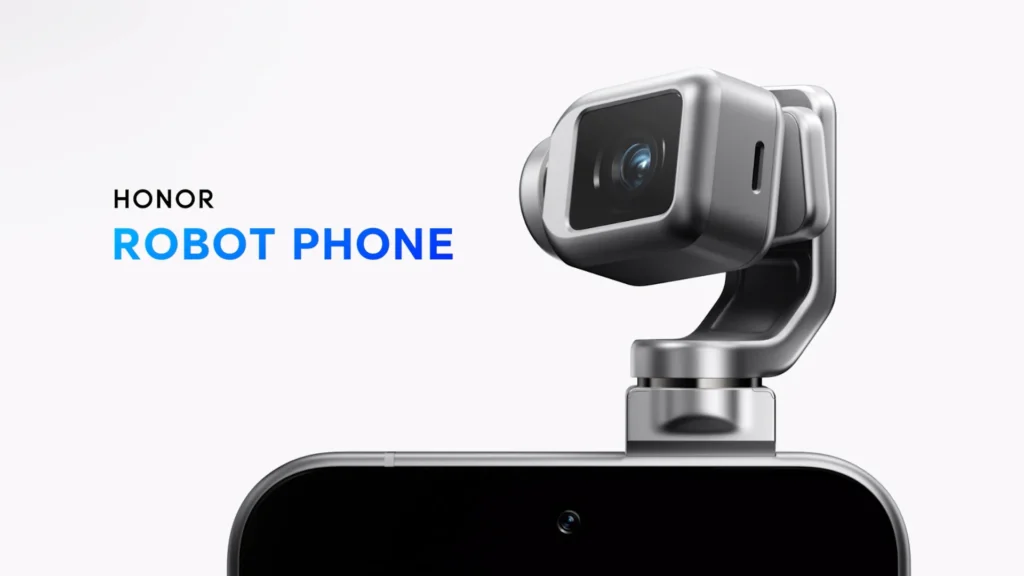
Honor Robot Phone: complete technical specifications leaked ahead of the launch on August 12
With only a few days left before its official unveiling, the Honor Robot Phone is almost entirely revealed. Following glimpses of its impressive motorized camera module and confirmations of several imaging innovations, a recent leak discloses its complete technical specifications. Featuring an ultra-bright display, a large battery, a high-end Snapdragon chip, and proprietary processors, Honor aims to create a smartphone that is more than just a technological concept.
The event is scheduled for August 12, but recent details already provide a clear picture of the manufacturer’s ambitions.
A compact yet remarkably ambitious display
According to leaker Digital Chat Station, the Honor Robot Phone will feature a 6.3-inch flat LTPO display with a resolution of 2640 × 1216 pixels. Unlike many premium smartphones that still favor curved panels, Honor opts for a completely flat screen, a choice increasingly favored by users for its usability and better resistance to accidental handling.
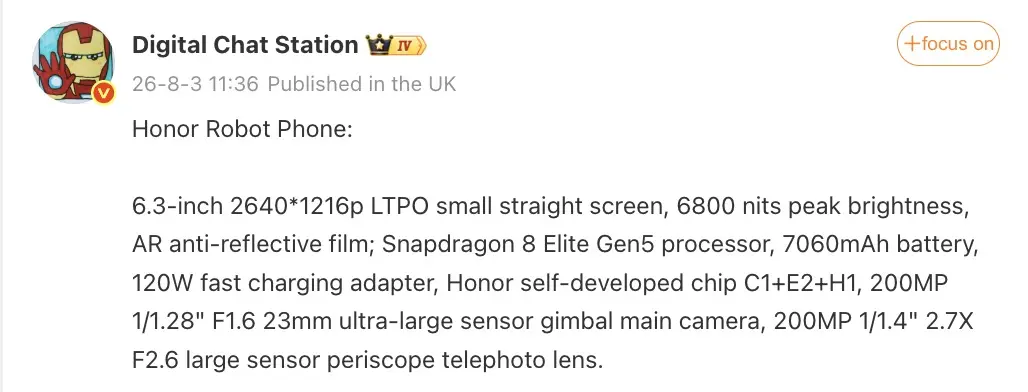
One of its key selling points will be the brightness, boasting a peak of 6,800 nits, a notably high level that should ensure excellent outdoor visibility.
Honor may also incorporate an anti-reflective (AR) coating to minimize glare in bright sunlight, a technology still relatively rare in smartphones.
High-end Snapdragon chip and large battery
Under the hood, the Robot Phone is expected to feature the Snapdragon 8 Elite Gen 5, touted as one of the most powerful Android platforms available. However, it is the battery that truly captures attention.
The leak suggests a capacity of 7,060 mAh, up from approximately 6,000 mAh mentioned in earlier reports. If confirmed, this would make Honor’s smartphone one of the most generously equipped battery-wise for a compact premium model. Fast charging will be supported by a 120 W adapter included in the box.
This combination promises an excellent balance between extended battery life and incredibly quick charging times.
Three proprietary chips to optimize every function
Honor is continuing its differentiation strategy through the development of its own components. The Robot Phone will incorporate three dedicated chips:
- C1, designed to enhance radio communication quality and network signal
- E2, responsible for energy management and consumption optimization
- H1, specialized in the image processing for the motorized camera module.
This approach is reminiscent of strategies employed by Apple, Google, and Xiaomi, which use specialized coprocessors to optimize specific tasks without overburdening the main processor.
A camera module as the true star
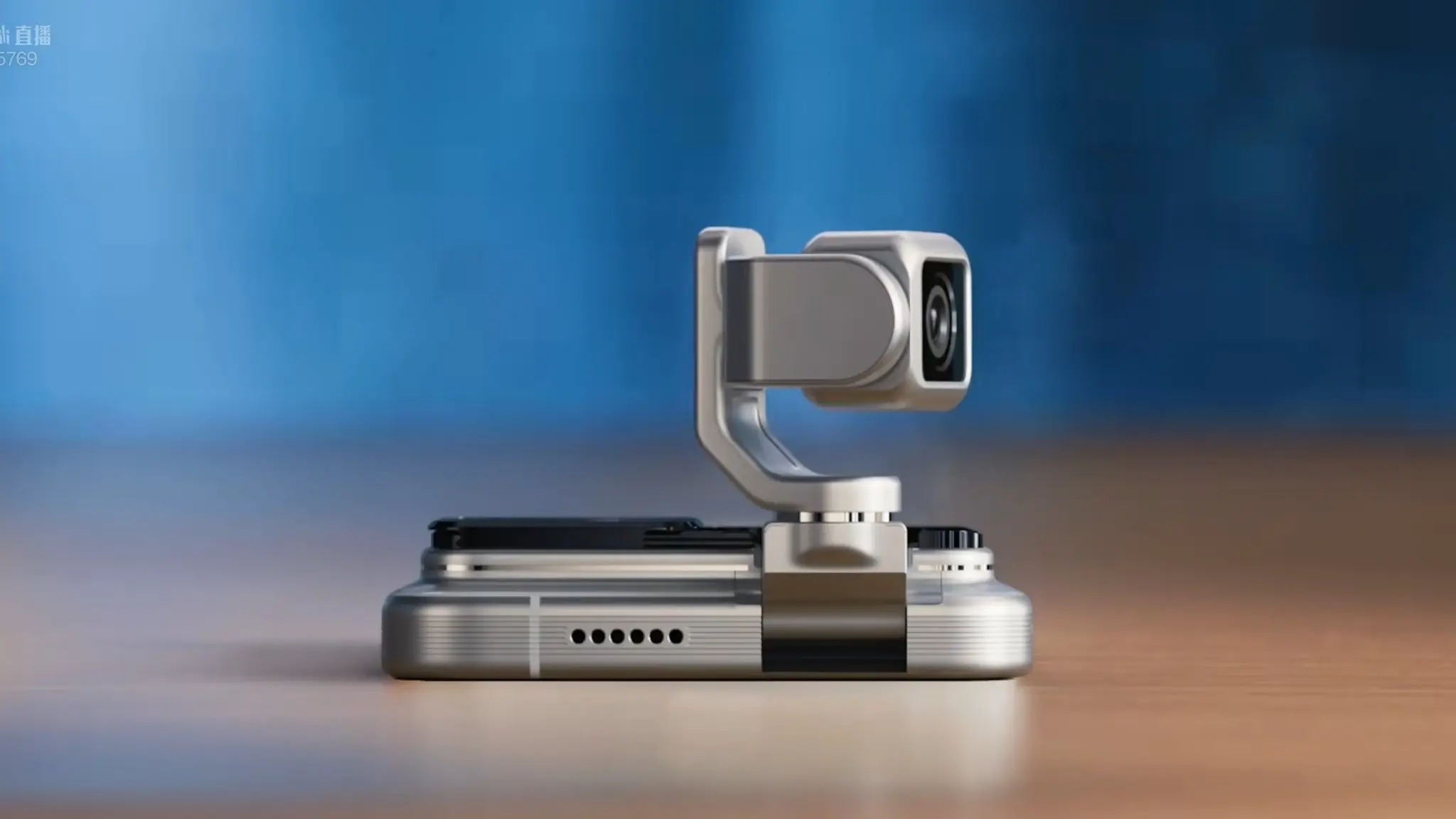
The standout feature of the Robot Phone is undoubtedly its photographic system. The main sensor will utilize a 200-megapixel sensor with a size of 1/1.28 inch, featuring an aperture of f/1.6 and an equivalent focal length of 23 mm. Its uniqueness lies in being mounted on a stabilized motorized arm, capable of physically moving the module to enhance stabilization and subject tracking.
Alongside it, there will be a second 200-megapixel sensor combined with a periscopic telephoto lens of 1/1.4 inch, with an aperture of f/2.6, offering a 2.7x optical zoom.
Honor has already indicated that it has filed over a hundred patents related to this photographic architecture, signaling that this technology is a cornerstone of its premium strategy.
Honor aims to stand out beyond just power
In a market where premium smartphones are increasingly similar, Honor seems determined to put hardware innovation back at the forefront of the conversation. The Robot Phone does not merely accumulate technical specifications; its motorized camera, proprietary chips, and notably generous battery reflect a desire to offer a distinct experience rather than a simple power upgrade.
Of course, we will have to wait for the official presentation on August 12 to confirm all this information and see the real performance of this unprecedented system.
One thing is already clear: Honor is not just trying to compete with market leaders anymore. The brand is now attempting to impose its own vision of the high-end smartphone, where hardware, artificial intelligence, and mechanical innovation work together to provide an experience that breaks from current norms.



