

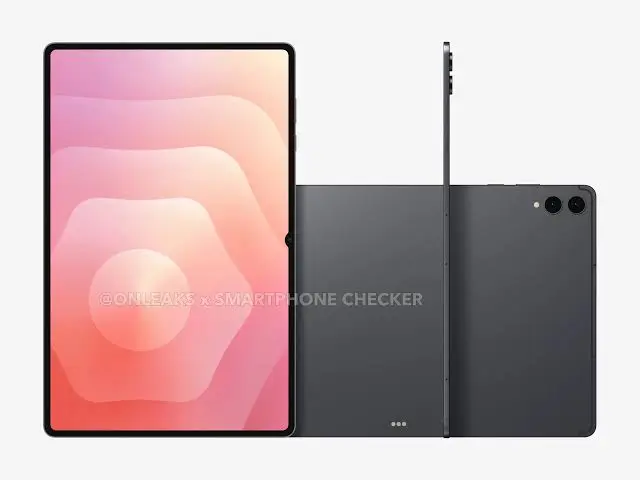
Galaxy Tab S12 Ultra: A benchmark confirms the MediaTek Dimensity 9500 ahead of its launch
Samsung appears ready to continue its partnership with MediaTek for its upcoming high-end tablet. After moving away from Qualcomm in previous Galaxy Tab Ultra models, the South Korean manufacturer might stick to this strategy with the upcoming Galaxy Tab S12 Ultra, which has been highlighted in a notable Geekbench entry revealing new technical details.
The device will feature a MediaTek Dimensity 9500 chip, Android 17, and a cautiously evolving technical specification.
A Benchmark That Confirms the MediaTek Path
A device with the reference SM-X946B, closely associated with the Galaxy Tab S11 Ultra (SM-X936B), has appeared in the Geekbench database. The processor configuration leaves little to doubt. The SoC includes a main core clocked at up to 4.21 GHz, three high-performance cores, and four energy-efficient cores.
This architecture matches the specifications of MediaTek’s Dimensity 9500, ruling out the latest high-end Snapdragon chips from Qualcomm.
Samsung would thus continue a partnership initiated with the Galaxy Tab S10 Ultra, which featured the Dimensity 9300+, and strengthened with the Galaxy Tab S11 Ultra using the Dimensity 9400+.
Performance Slightly Improved
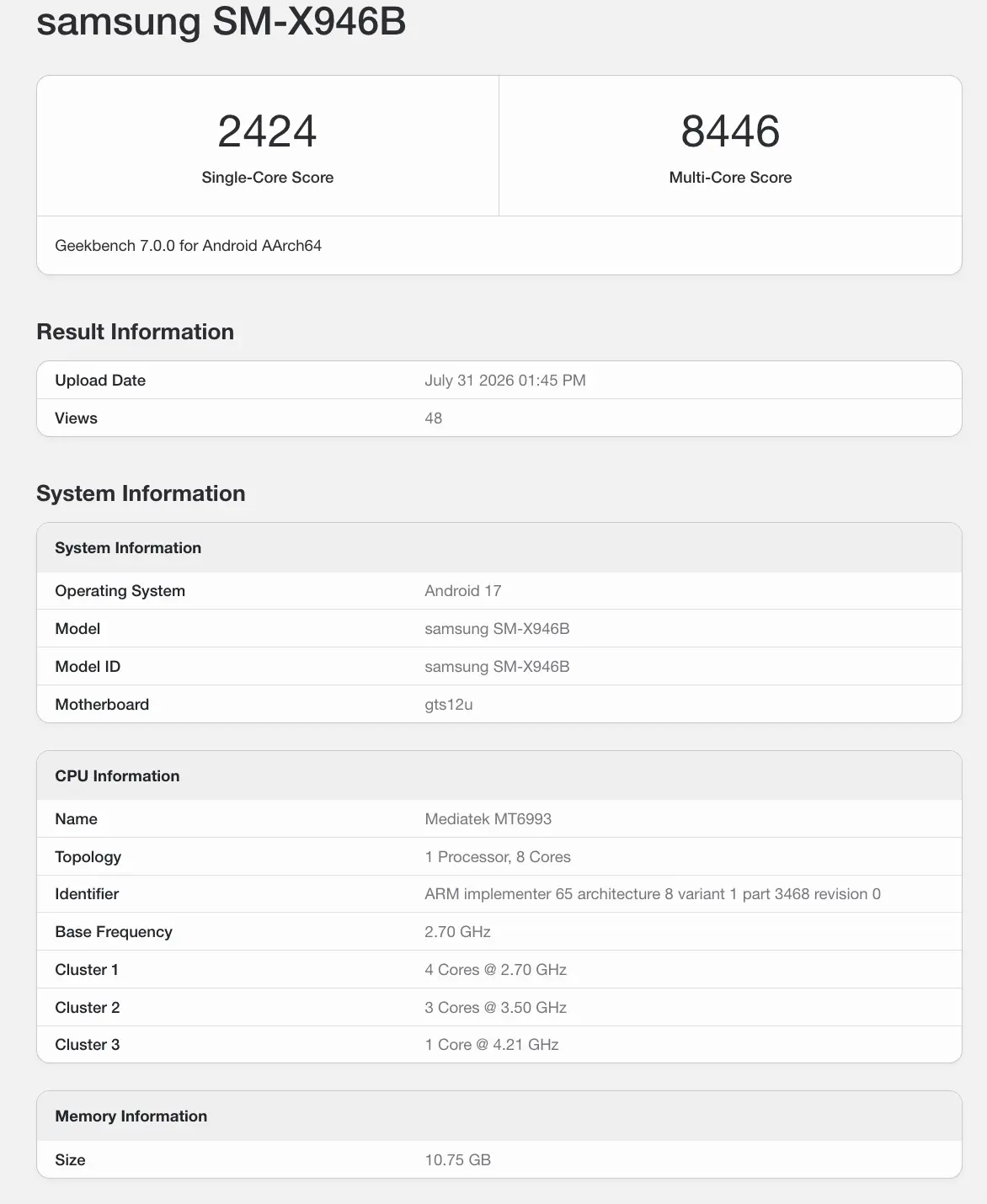
The tested prototype scored 2,424 points in single-core and 8,446 points in multi-core tests. These results show a moderate enhancement compared to the previous generation. However, it should be noted that this is likely a development device and final performance may still evolve before commercial release.
The benchmark also indicates the presence of 12 GB of RAM, matching the current entry-level configuration. Samsung could, as in the past, offer a version with 16 GB of RAM.
Why Samsung Continues to Trust MediaTek
On paper, the latest Snapdragon processors maintain a slight edge in raw power. However, Samsung’s criteria seem to extend beyond mere benchmark scores. The Dimensity 9500 is particularly valued for its superior thermal stability, sustained performance during extended sessions, dedicated AI acceleration, and improved energy efficiency.
These attributes are particularly significant for a 14-inch tablet aimed at productivity, video editing, intensive multitasking, or mobile gaming.
Samsung thus appears to prioritize a long-lasting experience over a relentless pursuit of instant performance.
A Technical Specification Very Similar to the Current Generation
Aside from the processor, there are relatively few major changes anticipated. Previous leaks suggest the retention of several features from the Galaxy Tab S11 Ultra, including a 14.6-inch Dynamic AMOLED 2X display, an 11,600 mAh battery, and 45W fast charging.
The camera setup is also expected to evolve minimally, featuring a 13-megapixel main sensor, an 8-megapixel ultra-wide sensor, and a 12-megapixel front camera.
The tablet will run on Android 17 with One UI 9, while benefiting from Samsung’s new software policy of seven years of Android updates and security patches.
A Launch Expected in September
Samsung has already confirmed that the Galaxy Tab S12 series will be launched before the end of the year. Several sources suggest a presentation as early as September, a few weeks after the new foldable smartphones.
The main point of uncertainty now lies in the pricing.
During its last financial conference, Samsung acknowledged that rising costs for memory and semiconductor components are putting significant pressure on its margins. Thus, a price increase for upcoming premium products, including the Galaxy Tab S12 Ultra, seems increasingly likely.
A Strategy Now Embraced
For a long time, high-end Android tablets relied almost exclusively on Snapdragon processors. By continuing to use MediaTek for a third consecutive generation, Samsung sends a strong message: the Taiwanese foundry is now seen as a credible alternative in the high-end market.
The question remains whether this evolution will be enough to convince users to upgrade their devices. If the Galaxy Tab S12 Ultra retains a design, display, and battery very similar to its predecessor, the new chip will need to demonstrate tangible gains in artificial intelligence, autonomy, and sustained performance to justify any potential price increase.
As the premium tablet market matures, the competition is no longer just about raw power but about achieving a balance between performance, energy efficiency, and software experience. This is precisely where Samsung seems poised to make a difference.



