

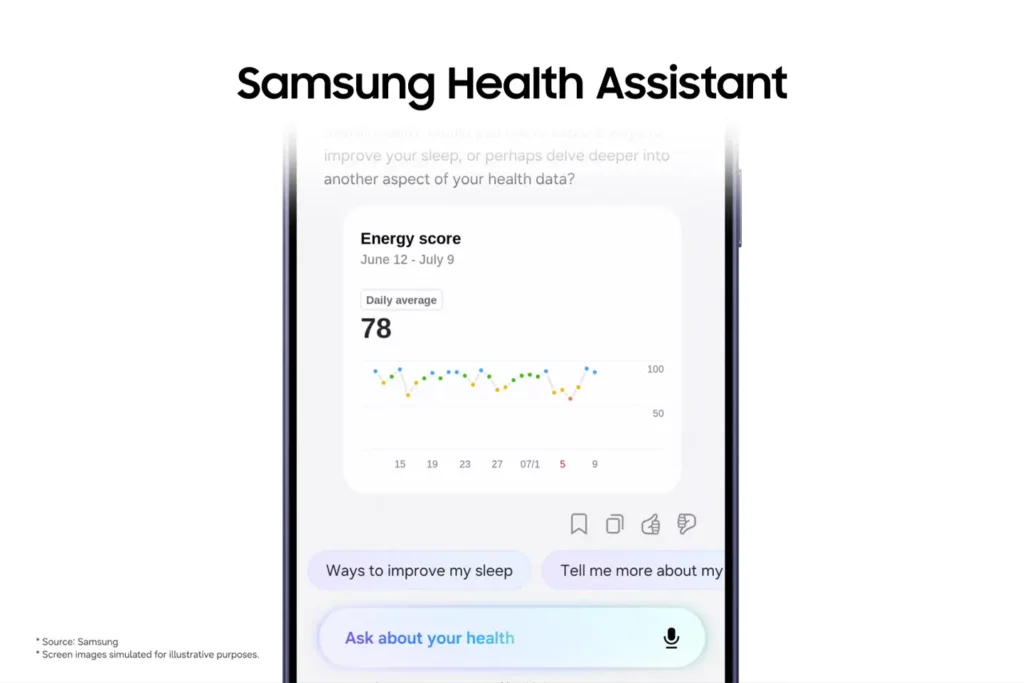
Samsung launches Health Assistant, its new AI capable of analyzing users’ health data
Artificial intelligence is becoming increasingly integrated into wellness tracking. Samsung is launching a beta version of Health Assistant, a conversational assistant built into the Samsung Health app that can interpret data collected from Galaxy devices and provide personalized answers regarding health and lifestyle habits.
With this innovation, the South Korean giant aims to transform the wealth of information generated by its smartwatches and fitness bands into more accessible and comprehensible advice.
An AI That Connects All Samsung Health Data
Health Assistant is directly integrated into Samsung Health and relies on five main areas of tracking:
- Sleep
- Physical Activity
- Nutrition
- Mindfulness
- Vital Signs
Instead of displaying these pieces of information separately, the assistant can establish connections between them to highlight certain trends. For instance, it can explain how a poor night’s sleep affects energy levels or athletic performance, or show the impact of specific dietary habits on overall well-being.
The goal is to provide a comprehensive view of the user’s health rather than a series of charts that are difficult to interpret.
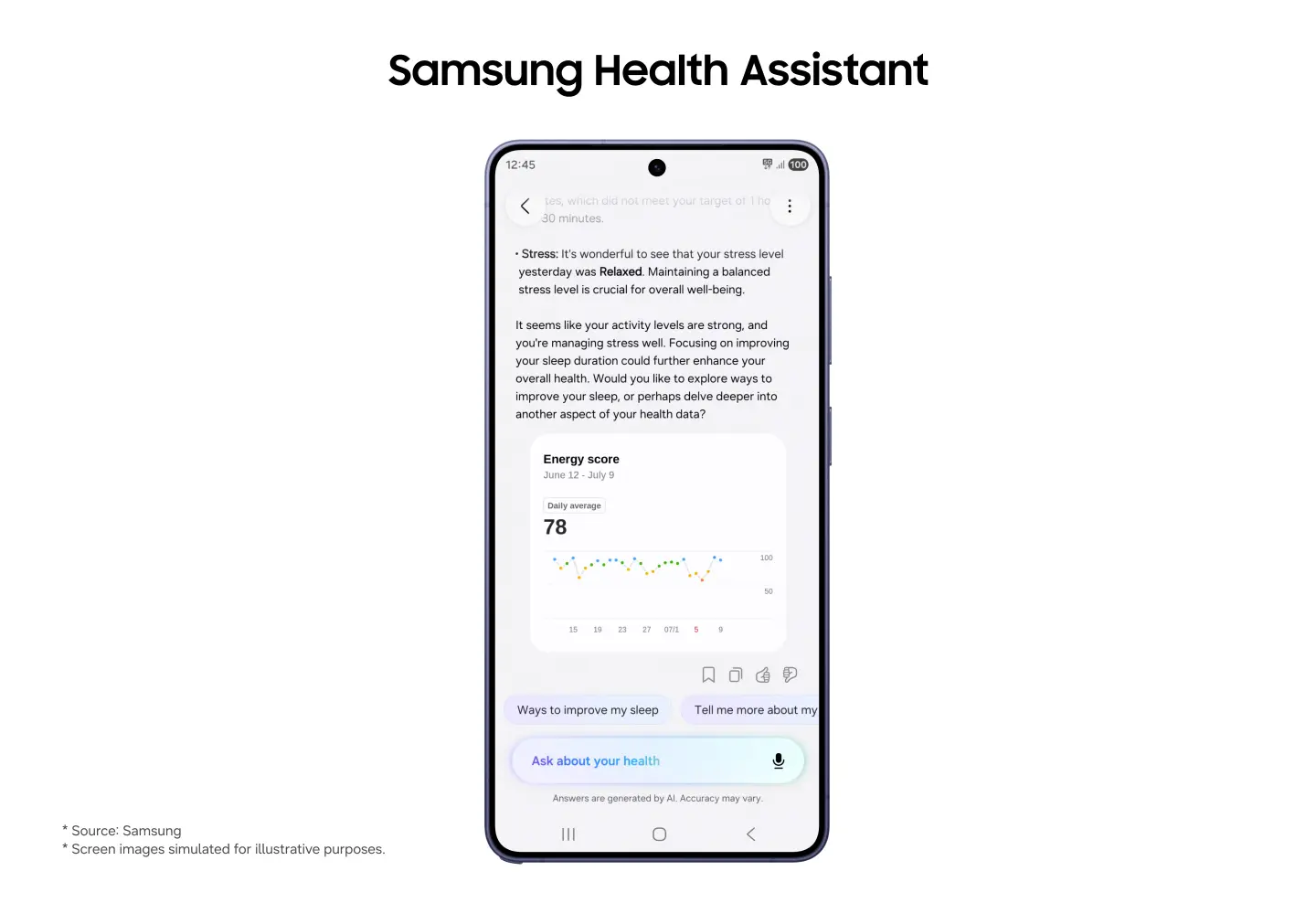
Personalized Responses Through Galaxy Devices
The assistant utilizes data collected from Galaxy Watches and the Galaxy Ring, as well as manual entries in Samsung Health. Users can ask questions in natural language and receive answers based on their complete set of personal data.
Samsung notes that recommendations made by Health Assistant have been validated by doctors and certified health coaches.
However, some features, like calculating the Energy Score, require specific measurements, particularly sleep data, physical activity, and nighttime heart rate collected by a compatible Galaxy watch or ring.
Even Greater Personalization on the Horizon
Samsung is not stopping here. The company plans to enhance its assistant using its Personal Data Engine, a platform aimed at better contextualizing recommendations.
Eventually, Health Assistant could incorporate calendar events, daily habits, and personal preferences of the user. The company is also working on coaching features focused on specific goals, such as weight management or improving certain lifestyle habits.
This evolution gradually brings Samsung Health closer to becoming a true personalized digital coach.
A New Battleground in AI for Health
With Health Assistant, Samsung enters a market that has become particularly strategic. Google already offers Health Coach, an assistant based on Gemini that can leverage data from Pixel Watch, Fitbit devices, and certain medical information. However, access to it requires a monthly subscription.
On its part, Oura Advisor analyzes biometric data collected by the Oura ring to provide personalized advice on sleep, physical activity, and recovery.
Samsung has not yet indicated whether Health Assistant will become a paid service upon its official launch. As of now, the beta version is restricted to eligible users in the United States, with no announced timeline for international rollout or comprehensive list of compatible devices.
AI as an Interpreter of Health Data
Samsung emphasizes a crucial point: Health Assistant is not intended to replace healthcare professionals. The assistant does not provide medical diagnoses or treatment recommendations. Its role is solely to facilitate the understanding of daily collected data and help users better identify trends related to their lifestyle.
This approach illustrates the current evolution of connected health apps. After increasing the number of sensors capable of measuring sleep, heart rate, or physical activity, manufacturers are now seeking to tackle another challenge: making this information genuinely actionable. In this new race for artificial intelligence, value lies not just in data collection, but in the ability to transform it into personalized, easily understandable advice adapted to each user’s daily life.



