

WhatsApp tests a folder to separate business messages from personal conversations
WhatsApp continues its transformation into a universal communication platform. As more businesses utilize the app for marketing, customer service, and notifications, Meta is experimenting with a new feature designed to enhance user experience. The simple goal is to automatically separate commercial messages from personal conversations.
This development comes at a strategic moment. Revenues generated from WhatsApp’s business services have now surpassed one billion dollars, confirming that the application has become a cornerstone of Meta’s business strategy.
A New “Offers and Updates” Folder
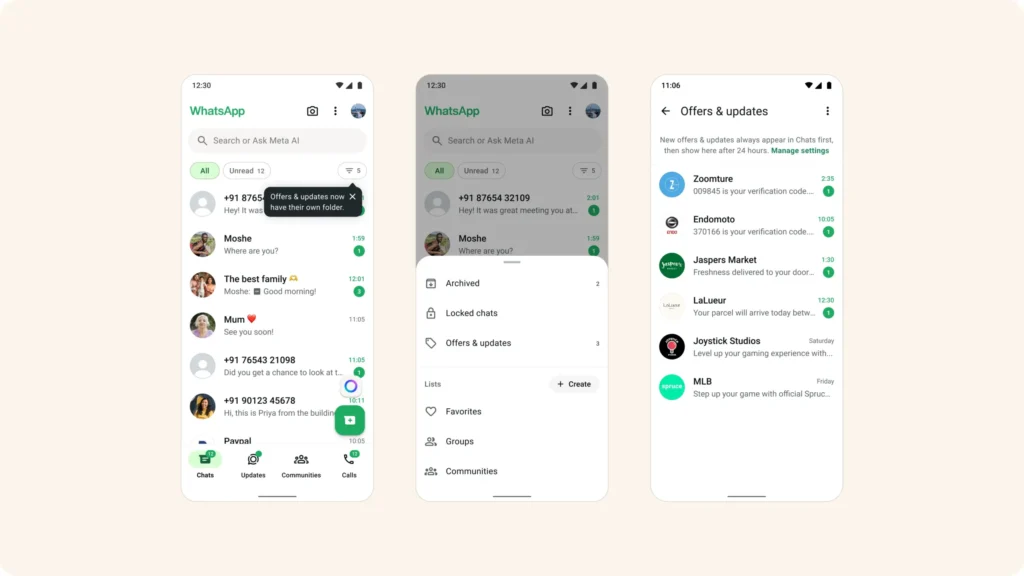
According to information obtained by TechCrunch, WhatsApp is currently testing a new folder called “Offers & Updates”. Its operation is relatively straightforward.
When a user receives a message from a large business — such as a bank, airline, or major retailer — it first appears in the main conversation list. After a set period automatically determined by WhatsApp, which can last up to 24 hours during current trials, the message is moved to this dedicated space.
The idea is to give the user time to check an important notification before it exits the main inbox.
A Less Cluttered Inbox
For Meta, this new organization offers several benefits. Personal conversations and group discussions remain easier to locate while business communications are consolidated in a specific area.
This allows users to more easily find order confirmations, delivery notifications, promotional coupons, business offers, or informational messages from large companies.
This separation responds to a criticism that is becoming more frequent: the increase in business messages eventually obscures private conversations.
Users Retain Some Control
WhatsApp clarifies that this feature is optional. Users who prefer to keep all their messages in the main thread can disable this feature. However, they will not have the ability to choose the timing for the automatic movement of conversations, which is currently determined by WhatsApp as part of the testing process.
Thus, it is more of an automation than a fully customizable sorting system.
Focus on Large Businesses First
At this stage, only large accounts using the WhatsApp Business Platform are participating in the trials. Small businesses and regular WhatsApp Business accounts are not involved.
However, Meta indicates that a gradual expansion to other categories of professionals is possible if the initial feedback proves positive.
Meta’s Ongoing Battle Against Spam
This new feature is part of a broader strategy that has been in place for several years. WhatsApp has already implemented measures to limit abuses related to marketing communications. Among the main changes are the ability to unsubscribe from promotional messages from certain brands, restrictions on the number of broadcast messages that can be sent, and limitations for companies sending numerous messages without receiving responses.
These measures have gradually reduced some forms of spam.
However, they have not completely solved the problem of conversation clutter.
Artificial Intelligence Accelerates Business Presence
This evolution also comes as Meta accelerates the rollout of its AI agents on WhatsApp. Since their global availability, over a million businesses are already using these chatbots to respond to customers, assist with purchases, automate support, and manage marketing campaigns.
During the announcement of the second quarter 2026 financial results, Mark Zuckerberg cited the example of the Brazilian car rental company Movida, which reportedly observed improved conversion rates and more effective customer request management thanks to these intelligent agents.
As these tools become more widespread, the volume of automatically generated conversations is expected to continue to rise.
WhatsApp Seeks Balance Between Messaging and Business Platform
The creation of a specific folder illustrates WhatsApp’s profound evolution. Once seen as an application exclusively for personal exchanges, the platform has now become a strategic channel for businesses to inform, sell, and provide customer service.
This transformation represents a significant economic opportunity for Meta, but it also carries a risk: gradually turning a private messaging app into a space overwhelmed with commercial solicitations. With over 3 billion users, WhatsApp cannot afford to degrade the user experience that has contributed to its success.
The new “Offers and Updates” folder appears to be an initial response to this challenge. It could enhance conversation clarity without compromising the presence of businesses on the platform. However, a crucial question remains: will users ultimately want to have genuine customizable filtering tools that allow them to choose which business messages deserve a spot in their main inbox? It is likely that the next stage of WhatsApp’s evolution will hinge on addressing this issue.



