

Cloudflare opens OAuth 2.0 to all developers and prepares for the arrival of AI agents
After several years reserved for a select group of partners, Cloudflare has finally opened up OAuth 2.0 client creation to all developers.
This announcement goes beyond a mere technical update; it marks a strategic evolution that prepares the web infrastructure for the rise of SaaS applications and autonomous AI agents.
Cloudflare Finally Democratizes OAuth
Previously, only a few privileged partners could integrate OAuth directly with Cloudflare services. Other developers had to rely on traditional API tokens—an effective method, but not in line with modern security standards.
Now, any developer can create an OAuth client directly from the Cloudflare dashboard.
This change enables users to authorize an application via a consent screen, precisely select the permissions granted, and revoke access at any time without sharing sensitive credentials.
Why OAuth Is a Game Changer
OAuth addresses a fundamental issue in modern web applications: allowing an app to act on a user’s behalf without requesting passwords or full access to their account. As a result, an application can now request only the permissions it actually needs.
For example, it can modify DNS records, deploy Workers, manage a web application firewall, or view specific statistics. Each permission is clearly displayed prior to confirmation and can be revoked at any time through the Cloudflare account.
In contrast, the API tokens previously used provided much less transparency and complicated access management.
AI Agents Accelerate This Transition
Cloudflare’s decision to open OAuth to everyone is timely and strategic. The rise of AI agents is one of the main drivers behind this move. An autonomous agent can deploy an application, modify DNS settings, update infrastructure, or analyze a network without continuous human intervention.
To perform these actions securely, it needs temporary, limited, and easily revocable permissions. OAuth is specifically designed for such scenarios.
This evolution also accompanies the rise of the Model Context Protocol (MCP), which allows AI assistants to directly interact with third-party services.
A Complex Technical Migration
Opening up OAuth wasn’t just a simple toggle. Cloudflare used this opportunity to completely modernize its authentication infrastructure based on Ory Hydra, an open-source OAuth engine widely adopted in the industry.
The operation was a significant technical challenge.
The migration included over 132 million lines being updated, nearly 115 million new lines created, and about 137 GB of temporary data processed during the procedure.
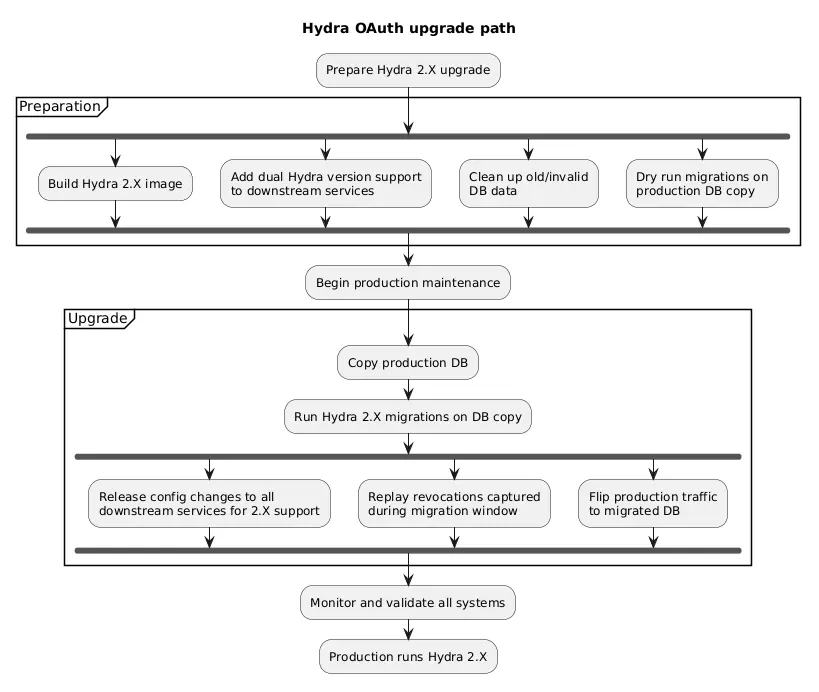
The goal was ambitious: execute this migration without causing any service interruptions. To achieve this, engineers adopted a blue-green deployment strategy, preparing a fully migrated new database before gradually shifting traffic.
During this period, a queuing system logged all access revocations to ensure that no permission removed by a user was accidentally restored after migration.
A Roadmap for the Entire Industry
The significance of this migration extends far beyond Cloudflare. Many companies also utilize Ory Hydra as their OAuth engine. By publicly detailing the challenges faced and the solutions implemented, Cloudflare offers a valuable technical guide for organizations looking to make a similar transition.
Development teams now have concrete examples to ensure a migration without service interruption, to avoid PostgreSQL-related blocks, to manage refresh tokens properly, and to keep user permissions intact during a complex migration.
An Important Step for the Future of Cloud
This announcement signifies a deeper transformation in software development. As applications become more interconnected and AI agents gain autonomy, authorization mechanisms become just as crucial as the AI models themselves.
Cloudflare is not just adding a new feature to its platform; the company is preparing its infrastructure for a new generation of services capable of automatically interacting with cloud resources while adhering to the principle of least privilege.
For developers, this means simpler, more secure integrations in line with modern web standards. For users, it provides greater control over the access granted to their applications and future AI assistants.



