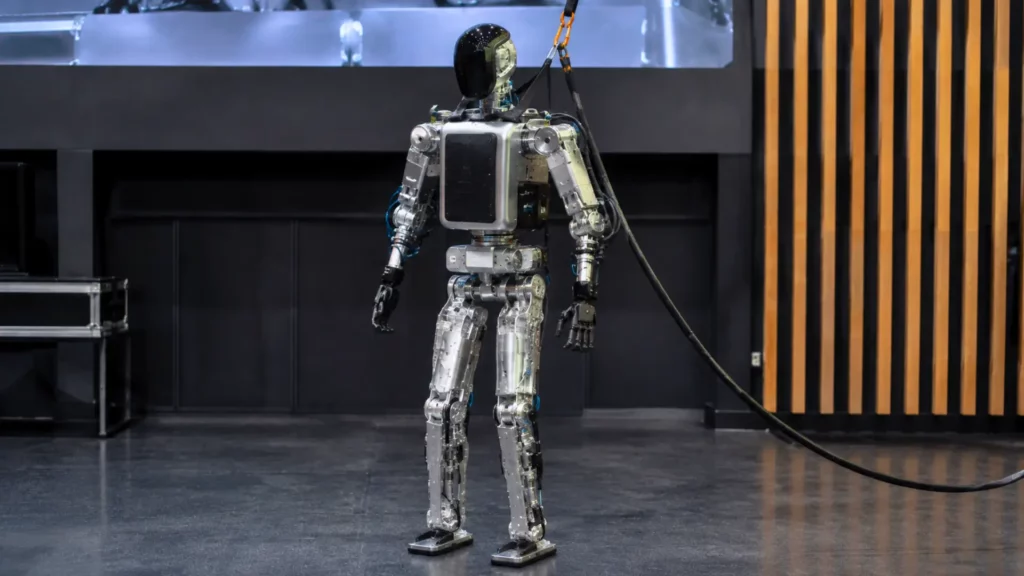
In just nine months, a Parisian team has built a humanoid robot capable of withstanding pushes and learning specific gestures. Still tethered to a cable, Northstar appears delicate. However, behind this metallic exterior lies an especially ambitious industrial project.
A Humanoid Prototype Developed in Nine Months Despite Visible Technical Constraints
On stage, Northstar does not resemble the elegant robot depicted in computer-generated imagery. Its mechanics are visible, its power is supplied through a thick black cable, and a safety strap prevents it from collapsing. Yet, when pushed, the prototype adjusts its posture to regain balance. This small movement conveys a great deal.
The robot was unveiled on July 7, 2026, at the Machina Summit held at Station F in Paris. The startup UMA had only been in existence for nine months. The rapid development of a functional humanoid, even if incomplete, represents a remarkable achievement in a field where progress is usually measured in years.
An Experienced Team from Global Leaders in AI and Robotics
This acceleration is no accident. Rémi Cadène, co-founder and CEO of UMA, previously worked on Tesla Autopilot’s AI, followed by the Optimus program. He later contributed to the development of LeRobot at Hugging Face, an open platform that has become a benchmark for experimenting with robotic arms and models.
He is joined by Pierre Sermanet, former researcher at Google DeepMind, AI specialist Simon Alibert, and robotic hand designer Rob Knight. This team aims to control the entire technical chain, from the mechanical body to the neural networks responsible for perceiving the environment and deciding the next action.
The second demonstration was less spectacular but perhaps more significant. Two robotic arms sorted different objects using artificial vision, adapting their movements based on their observations and continuing their tasks despite interruptions. UMA describes this method as real-time learning, which could replace a part of traditional programming.
A Robotic Approach Based on Adaptive Learning and Human Observation
Classic industrial robots often repeat a precise trajectory in a perfectly organized space. Northstar aims for more flexible behavior. It is designed to observe a person, replicate their gesture, and improve through repetition. This principle resembles an apprentice learning to grasp a piece, open a container, or organize an item rather than a machine tool.
However, this promise remains to be validated outside of the lab. Competitors are already testing their humanoids in factories, while Northstar still relies on external power and a fall-prevention device. Nonetheless, UMA plans several pilot programs in 2026, particularly in logistics and manufacturing, claiming to be in discussions with around fifty potential clients.
A Business Model Based on Leasing and an Evolving Industrial Vision
Instead of immediately selling its machines, UMA plans to offer them as a service. Companies could lease robots to temporarily bolster a team, handle a surge in orders, or perform repetitive tasks. The same humanoid could be trained for multiple successive roles without the need to reconstruct an entire automated chain.
The initial missions would likely focus on warehouses and workshops. In the long term, Northstar could assist in equipment assembly, solar panel installation, or maintenance operations. Therefore, the issue goes beyond simply replacing a human gesture. It seeks to make production more adaptable in times when the workforce is scarce or demand suddenly surges.
Rémi Cadène even envisions a dizzying loop where each generation of robots would contribute to manufacturing the next. Such progression remains highly speculative, but it indicates the scale of the project. Northstar is currently tethered by cables. The real question is what will happen when those cables are no longer needed.