

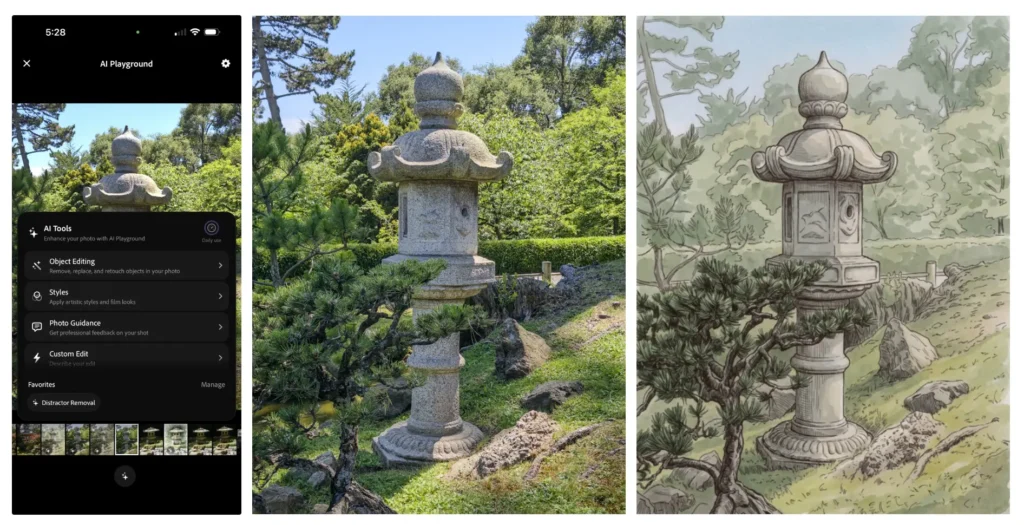
Adobe tests AI Playground in Project Indigo: a new AI-boosted photo experience on iPhone
Adobe is expanding the ambitions of Project Indigo. Originally launched as a photo application for demanding iPhone users, it has quickly distinguished itself with its more natural approach to mobile photography, prioritizing manual settings and a rendering akin to hybrid cameras rather than the aggressive software processing found in many applications.
With AI Playground, Adobe is now taking a new step: making Project Indigo a platform that combines photography with generative artificial intelligence.
An AI-Powered Toolbox
AI Playground includes several new experimental features designed to enhance photo editing. Among the proposed tools are intelligent removal of unwanted elements from images, simulated depth of field effects, artistic transformations applied to photos, and image editing based on natural language instructions.

The goal is to allow users to modify their photos simply by describing the desired outcome, an approach that has been widely adopted by major players in generative artificial intelligence.
A Critiquing Assistant for Your Photos
One of the most unique new features is called Photo Critique. Instead of just correcting an image, this tool analyzes the composition, exposure, and cropping of a photograph to suggest improvement ideas. Depending on the circumstances, the assistant might recommend retaking the photo immediately or suggesting edits to be made in post-production.
This way, Adobe aims to transform the app into a true photographic assistant, capable of accompanying the user both during the shooting and editing processes.

Google Powers AI Features
During this initial testing phase, Adobe relies on the Nano Banana model developed by Google. All processing is done in the cloud, meaning an active internet connection is necessary to use AI Playground. In order to minimize computation times, the generated or modified images are currently limited to a resolution of 2K.
Adobe also notes that this architecture is expected to evolve.
Eventually, AI Playground is set to incorporate several artificial intelligence models, including Firefly models developed internally by Adobe. The company also states that users who repeatedly trigger the model’s security filters through their images or requests could lose access to the test program.
A Very Limited Launch
AI Playground is not yet available to all users of Project Indigo. Adobe is rolling out this experiment to a small percentage of people using version 1.1 of the application. This testing phase will last only a few weeks.
The publisher has not yet clarified whether these features will become freely available to all or if they will be included in a paid offering in the future.
Adobe Accelerates the Convergence of Photography and AI
With AI Playground, Adobe confirms an underlying trend that is currently sweeping through the entire image sector. Photo applications are no longer solely focused on improving photo quality; they are progressively becoming AI-assisted creative spaces.
The integration of generative models, natural language commands, and tools capable of analyzing scene composition illustrates this evolution towards increasingly intelligent photographic assistants.
For Adobe, the challenge is also strategic. In the face of Apple, Google, and specialized mobile photography publishers, Project Indigo stands out with an approach that combines advanced manual control and creative AI. If AI Playground eventually moves out of its experimental phase, the application could become more than just a simple alternative to the native iPhone camera—it could be a true laboratory where traditional photography and artificial intelligence complement rather than oppose each other.



