

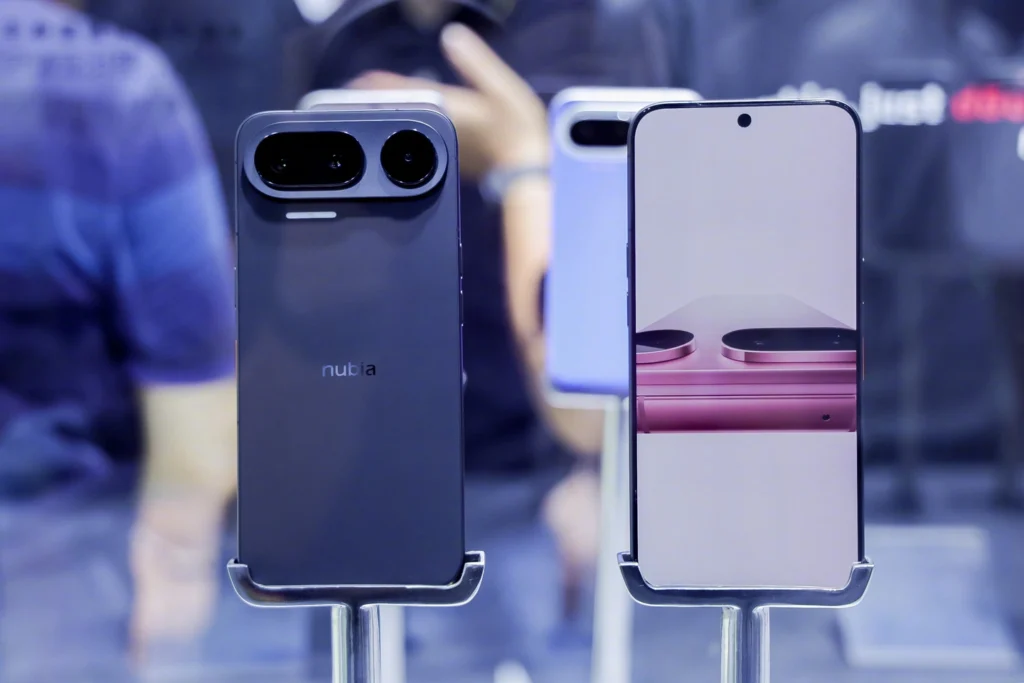
Nubia NaviX Ultra: The ‘AI Agent’ Smartphone is Official with Doubao and Local AI Execution
After several days of teasing, Nubia has officially unveiled the NaviX Ultra during the World Artificial Intelligence Conference (WAIC) 2026 in Shanghai. The company presents its new flagship as the world’s first “AI Agent” smartphone, a claim that is already sparking debate, as other Chinese manufacturers have announced devices based on a similar concept.
Beyond this marketing battle, the NaviX Ultra represents a new generation of smartphones where artificial intelligence goes beyond merely responding to users to actively taking action on their behalf.
A Close Collaboration with Doubao
The heart of the NaviX Ultra is powered by Doubao, the artificial intelligence assistant developed by ByteDance, the parent company of TikTok. During the presentation, Ni Fei, senior vice president of ZTE and president of Nubia, explained that Doubao brings capabilities related to large language models and intelligent agents, while Nubia handled the hardware and software integration as well as optimizing the user experience.
According to the executive, the development of the NaviX Ultra reflects the culmination of several generations of research and testing conducted in partnership between the two companies.
An AI Capable of Acting through Multiple Applications
The primary ambition of the NaviX Ultra is to surpass traditional voice assistants. The integrated artificial intelligence is designed to understand instructions given in natural language and execute complex scenarios involving multiple applications.
Among the usages mentioned by Nubia are automatic price comparison before a purchase, placing an order, organizing a complete trip, and carrying out successive tasks without constant user intervention.
In other words, the smartphone is no longer just about providing answers; it is now capable of performing complete actions.
An AI Executed Directly on the Smartphone
Another key highlight from Nubia is that a significant portion of the artificial intelligence processing occurs locally on the device. This approach reduces reliance on the cloud and aims to enhance the privacy of personal data. The manufacturer also indicates that its system has received the required official permissions for the exploitation of generative AI technologies in China, with the goal of minimizing the risks of sensitive data leaks.
In terms of design, the NaviX Ultra retains a relatively minimalist identity.
The smartphone will be offered in four colors: Blue, Dream, Obsidian Black, and Snowfield. The Dream version features a uniform pink finish that covers both the chassis and the camera module. At the back, Nubia has moved away from the bulky circular modules adopted by many competitors in favor of a horizontal camera block that includes three sensors, one of which is a periscopic telephoto lens.
On the front, the flat display features symmetrical borders and houses a front camera in a discreet centered punch-hole. The chassis also includes a physical orange button specifically designed for the instant activation of the AI assistant.
A New Battle Unfolds in AI Smartphones
The NaviX Ultra arrives at a time when manufacturers are seeking to evolve artificial intelligence beyond simple conversational functions. Google is progressively developing Gemini as an agent capable of interacting with Android. OpenAI is working on autonomous assistants capable of managing entire projects. Apple is preparing a major overhaul of Siri with Apple Intelligence, while Samsung continually enhances Galaxy AI.
With the NaviX Ultra, Nubia adopts an even bolder approach by placing the AI agent at the center of the user experience.
The Era of Autonomous Smartphones Begins
For now, Nubia has not disclosed the price or release date of its new flagship. However, beyond its technical features, the NaviX Ultra signifies a major shift in the market. After the race for megapixels, processors, and screens, manufacturers are now looking to differentiate their devices based on the level of autonomy of their artificial intelligence.
It remains to be seen whether these “AI Agents” will live up to their promises in daily use. The true revolution will not lie in a smartphone’s ability to converse with its user but in its capacity to reliably and securely perform complex tasks on their behalf.



