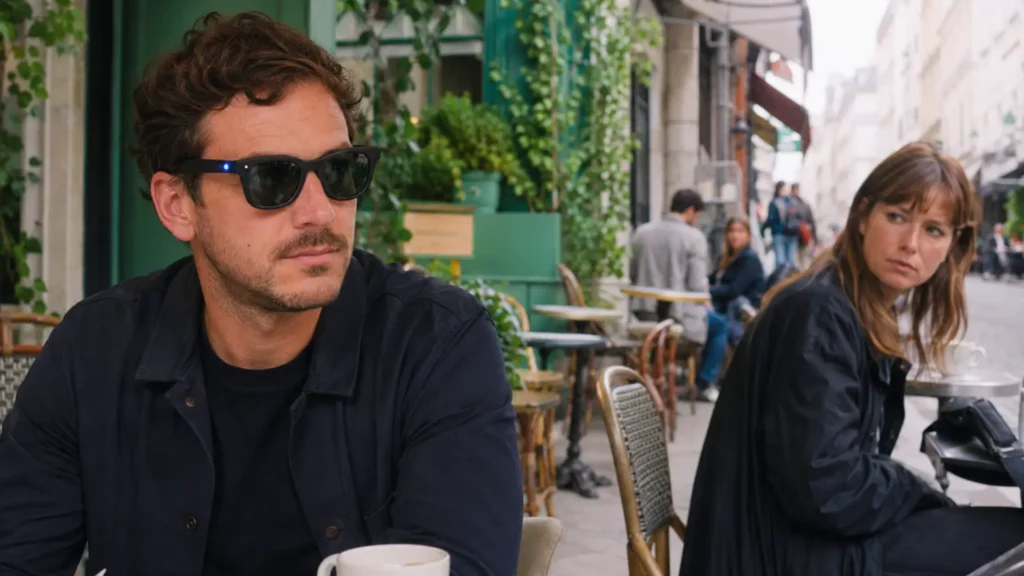
They may look like simple sunglasses, but they can take photos, record conversations, or stream live video. In the face of these nearly invisible cameras, how can one recognize a recording, react without overreacting, and enforce their privacy rights? The answer is less straightforward than it seems.
Connected glasses subtly transform the gaze into a recording tool
Imagine the scene in a café, a subway car, or a waiting room. A person simply turns their head in your direction. No smartphone raised, no imposing lens. Yet, their glasses may contain a miniature camera, microphones, and a connection to a mobile app.
This discretion profoundly disrupts social norms. Taking a photo with a phone typically requires an identifiable gesture. The connected glasses, however, capture exactly what their owner is looking at. A voice command or an almost imperceptible touch may suffice to initiate recording without altering their demeanor.
The CNIL believes this technology enables “quasi-invisible” image and voice capturing. A survey conducted in January 2026 with 2,128 adults reveals that 67% of the French respondents view these devices as a risk to privacy.
The indicator lights on smart glasses are useful but imperfect clues
On the Ray-Ban Meta, a white light located at the front of the frame illuminates during a photo or video recording. It is positioned on the side opposite the camera when observing the glasses from the front. This capture light remains today the easiest signal to recognize.
However, this signal does not provide guaranteed certainty. The light becomes difficult to discern in bright sunlight, and each manufacturer adopts its own lighting codes. Meta indicates that its glasses require the light to be visible. The brand also recommends that the wearer clearly announce recordings, proving that the light alone is insufficient.
French law protects image rights and strictly regulates video dissemination
In France, context is as important as the camera. In a private space, filming a recognizable person without their consent constitutes an invasion of privacy. The law sanctions this with penalties of up to one year in prison and a €45,000 fine, according to the official Service-Public.fr portal.
In public spaces, the situation becomes more nuanced. A street scene or group can be filmed under certain circumstances, particularly for informative purposes. However, broadcasting the image of an isolated and recognizable individual typically requires their permission, except for exceptions related to current events, artistic freedom, or the right to information.
A person may consent to recording at the time of filming without allowing for its dissemination. The authorization must specify the medium, purpose, and duration of use. Subsequently publishing the footage on a social network, monetizing it, or using it to ridicule someone can thus give rise to new legal disputes.
Essential reflexes to respond to discreet or non-consensual recording
The first reflex should be to calmly ask whether the glasses are recording. One must demand the cessation of the capturing and clearly state their refusal to appear in any publication. In a medical office, restrooms, locker room, or home, vigilance should be heightened, as the expected intimacy remains particularly significant in these spaces.
If someone disseminates images, retaining screenshots, the publication address, the date, and any exchanges becomes essential. The victim can request removal from the account holder or the platform, and then pursue legal action or file a complaint. Technology may become more discreet, but consent should never vanish.
As cameras blend into clothing and accessories, the real challenge may no longer be spotting every lens. It will be about collectively deciding what remains acceptable when anyone can become, without uniform or warning sign, an ambulant camera among others.