

Waze integrates Gemini: personalized navigation, voice commands, and new motorcycle mode
Google continues to integrate Gemini into its ecosystem, and Waze is benefiting from it. The community navigation app receives a significant update on iOS and Android that goes beyond just guiding drivers: it aims to anticipate their habits, simplify their routes, and make reporting more intuitive through artificial intelligence.
Among the updates: personalized navigation, enhanced voice commands, a quieter mode for long journeys, and even a feature designed specifically for motorcyclists.
Gemini personalizes your routes on Waze
The main highlight of this update is the introduction of personalized navigation powered by Gemini. Previously, Waze primarily calculated routes based on real-time traffic. Now, the app also considers your driving habits to offer routes better suited to your preferences.
For instance, if you typically favor highways over secondary roads with many stops, Waze will automatically prioritize that type of route when appropriate. This level of personalization also relies on local traffic condition analysis for an optimal balance between speed and driving comfort.
Users who prefer traditional navigation can still disable this feature in the settings or select an alternative route at any time.
The rollout is currently taking place worldwide on both Android and iOS.
A new “Less Chatty” mode for enjoying your music

Another welcomed feature is the Less Chatty Mode. Designed for drivers who enjoy music, podcasts, or audiobooks, this mode significantly reduces the frequency of voice announcements during the journey. Essential information — such as direction changes, highway exits, lanes to take, or road hazards — will still be communicated but in a more concise and less frequent manner.
The simple goal is to minimize interruptions for a more enjoyable long trip.
This feature is available now on both Android and iOS versions of Waze.
Reporting becomes conversational thanks to Gemini
Google is also expanding the capabilities of Conversational Reporting, a feature already supported by Gemini. Users can now report map changes simply by describing them aloud.

A simple phrase like “The road is closed here” is enough for Waze to automatically relay the information to local map editors. After verification, they update the data so that the entire community benefits from more accurate information.
The system also supports other modifications, such as address changes or new traffic restrictions. This evolution perfectly illustrates Google’s strategy of replacing complex interfaces with natural language interactions.
Search for a destination using natural speech
Gemini also enhances the search functionality in Waze. Instead of entering a precise address or name, users can now conduct conversational searches. For example, they can ask, “Find me an open café right now,” “Where can I refuel nearby?” or “Search for a fast charging station.” Waze will then display the corresponding establishments before initiating the voice-guided navigation.
This feature is currently being rolled out to beta program members on Android and iOS.
A more intelligent motorcycle mode
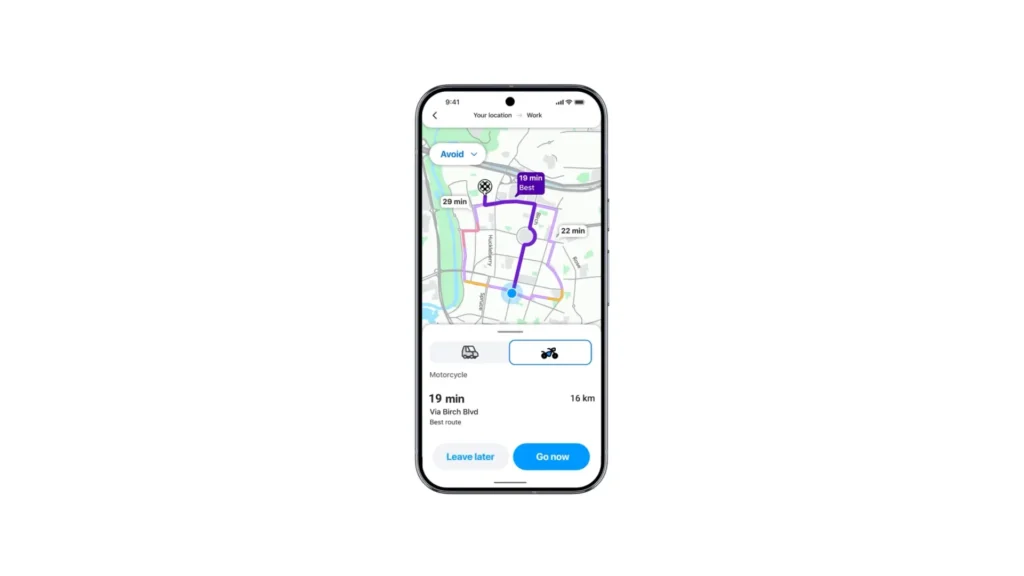
The two-wheeled vehicles also benefit from significant upgrades. The new motorcycle mode leverages artificial intelligence as well as data specific to motorcyclists to calculate more suitable routes.
The application takes into account motorcycle-specific restrictions and various hazards often overlooked by traditional GPS devices: speed bumps, potholes, elevated crosswalks, disappearing shoulders, or narrow bridges. This information comes from a dedicated community of mappers specializing in motorcycle routes.
The motorcycle mode is already available in several countries, including Argentina, Brazil, Colombia, Mexico, Peru, Malaysia, and the Philippines. Google plans to gradually expand its availability to other regions.
Waze becomes a true intelligent co-pilot
This update marks a significant evolution for Waze. Long recognized as a collaborative GPS capable of reporting traffic jams, police checks, or accidents in real time, the service is now seeking to become a smart driving assistant that learns the habits of each user.
With Gemini at the heart of this transformation, Waze no longer just shows the fastest route; it starts to understand how each driver prefers to travel. This evolution brings the app closer to Google’s broader vision, where artificial intelligence personalizes the entire user experience well beyond simple navigation.



