

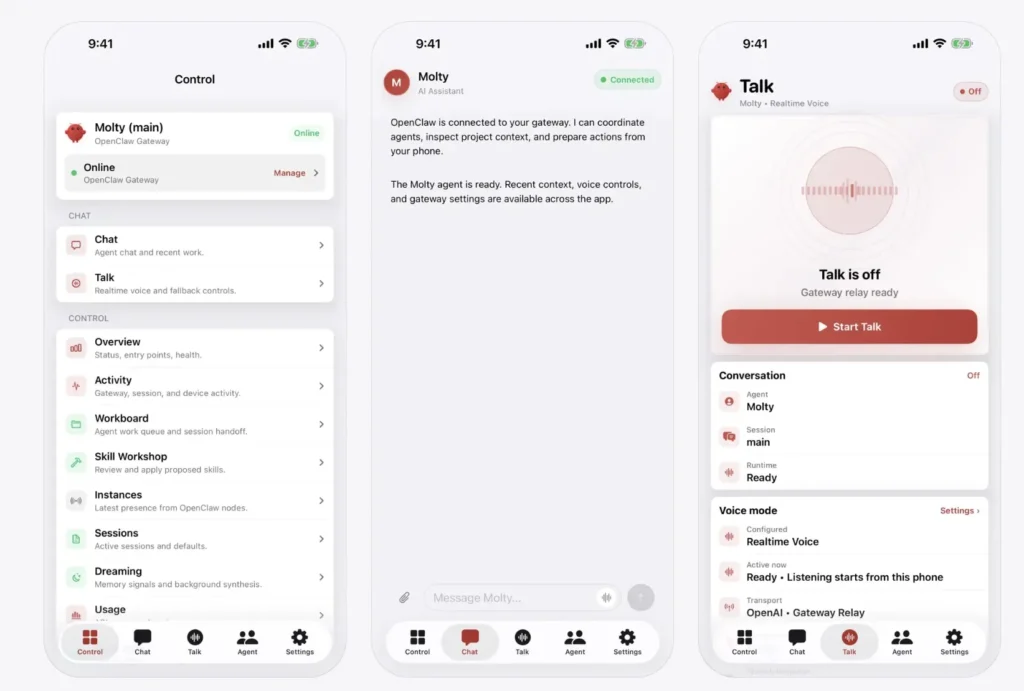
OpenClaw Debuts on Android and iPhone: The Open Source AI Agent That Keeps Your Data Local
Artificial intelligence is no longer confined to the cloud services of tech giants. With the launch of OpenClaw on Android and iOS, one of the most promising open source AI agents takes a significant step forward by allowing users to control their personal assistant directly from their smartphone while keeping data processing on their own machines.
OpenClaw Focuses on Local AI Rather than Cloud Solutions
Unlike traditional AI applications, OpenClaw does not run models directly on the phone.
The mobile application acts as a secure remote control that connects to a private gateway installed on a Windows PC, Mac, or Linux machine. Thus, all computing power remains hosted locally, while the smartphone serves as the remote control interface.
Configuration is quick and easy, using either a QR code or an association code, taking only a few minutes before accessing the full range of the agent’s functions.
This architecture addresses a growing concern: maintaining control over personal data while benefiting from AI capabilities.
OpenClaw is now on iOS + Android 🦞
📱 Native mobile apps, finally
💬 Agents in your pocket
🔔 Channels, tasks, replies on the goRun agents from wherever your thumbs are.
iOS: https://t.co/7LHHc9htgM
Android: https://t.co/X0Wuh2uA8w— OpenClaw🦞 (@openclaw) June 29, 2026
An AI That Can Act, Yet Remains Under Control
Once connected, OpenClaw enables users to interact with their assistant through standard conversation or real-time voice mode. A key feature of the project is its validation system: every action the agent wishes to perform on the computer must be explicitly approved by the user.
This approach significantly mitigates the risks associated with autonomous agents while preserving their ability to automate certain tasks.
From the smartphone, it also becomes possible to instantly share text, links, images, or other content with OpenClaw so it can be processed on the remote machine.
Controlled Access to Smartphone Functions
The Android and iOS applications can also access various device functions with the user’s permission. OpenClaw can use the camera, location services, photos, contacts, calendar, reminders, and screen sharing. Notifications allow users to track task progress even when the application runs in the background.
The goal is to transform the smartphone into a true personal command center rather than just a conversational interface.
Open Source as the Main Selling Point
Where OpenClaw truly stands out is in its development model. The project is entirely open source, meaning its code can be viewed, audited, or modified by the community.
In contrast, assistants like ChatGPT, Gemini, or Claude are built on proprietary infrastructures, rendering their internal workings inaccessible. This transparency is particularly appealing to developers, businesses, and privacy-conscious users who can verify exactly how their data is handled.
Android and iPhone: Two Distinct Experiences
Both applications offer the same core functionalities, but their levels of polish differ. On iPhone, OpenClaw requires iOS 18 or later and presents itself as a productivity app. According to its App Store profile, it does not collect any user data.
The Android version works from Android 12, but initial reviews indicate an interface that is still in need of improvement compared to its iOS counterpart.
However, this is an evolving project, and improvements are expected to arrive rapidly thanks to its open-source community.
Personal AI Agents Step Up Their Game
The arrival of OpenClaw on mobile illustrates an ongoing trend that extends far beyond this single application. After several years dominated by cloud-hosted conversational assistants, a new generation of AI agents seeks to return control to users. By combining local processing, code transparency, and systematic validation of sensitive actions, OpenClaw offers a radically different vision of intelligent assistance.
This approach has already attracted industry attention. Several rumors suggest that Google is also developing a personal agent capable of continuous operation, indicating that the next battle in artificial intelligence may be fought less over models themselves and more over how they integrate into our daily digital environments.



