

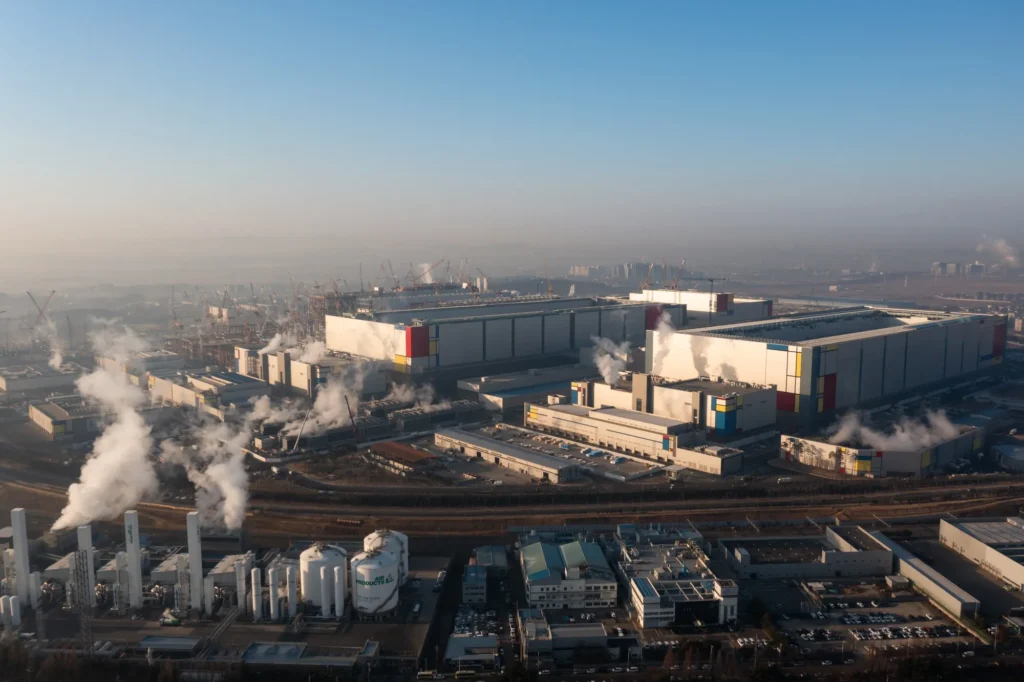
TSMC takes a jab at Samsung, asserting dominance in the AI chip race
As the semiconductor industry experiences one of its most pivotal periods thanks to artificial intelligence, the CEO of TSMC claims that the gap with its competitors remains significant.
This statement seems targeted at Samsung.
During a Q&A session with shareholders, TSMC’s CEO, C. C. Wei, made light of the repeated promises from a rival asserting for decades its intention to catch up to the global leader in foundry services. “Twenty years ago, our competitor said they would catch up to TSMC in ten years. Ten years ago, they claimed they still needed ten years. And recently, they again stated it would take them ten years,” he remarked.
Without explicitly naming Samsung, the implication was clear.
AI Further Strengthens TSMC’s Dominance
This comment comes amid unprecedented demand for chips designed for artificial intelligence. Tech giants are investing heavily in AI accelerators, next-generation GPUs, and cloud infrastructures. And at the heart of this value chain is TSMC.
According to industry estimates, the Taiwanese company controls nearly 70% of the global independent foundry market. In comparison, Samsung Electronics accounts for about 7% of the market.
This is a considerable disparity despite the tens of billions of dollars invested by the Korean giant in recent years.
TSMC Chairman Wei Zhejia just shut down talks of Samsung catching up in semiconductors.
At today’s shareholder meeting, he said: “Dream on about catching us.”
He believes Samsung can’t easily close the gap because Taiwan’s full semiconductor ecosystem is too strong and hard to… pic.twitter.com/8akZwDoJ5t
— Semiconductor Insider (@SemiconductorsX) June 4, 2026
The Real Advantage of TSMC Goes Beyond Process Technology
For a long time, competition among foundries was primarily focused on process technology. Today, the equation is much more complex. TSMC enjoys not only advanced processes like the upcoming 2nm process but also a significant edge in advanced packaging, particularly due to its CoWoS technology.
This expertise has become essential for AI players.
Companies like NVIDIA require solutions that can efficiently assemble processors, memory, and high-speed interconnects. In this realm, packaging is now almost as crucial as the raw power of the chips themselves.
Samsung Still Holds a Strategic Advantage
However, a complete analysis would be lacking without addressing the strengths of the Korean company. Samsung remains one of the world’s leading memory producers and retains a dominant position in High Bandwidth Memory (HBM), which has become critical for AI infrastructure.
This technology is now featured in most high-end AI accelerators on the market.
C.C. Wei himself has publicly acknowledged Samsung’s strength in this segment. Yet, being a leader in memory does not necessarily ensure a corresponding position in foundry services.
The Difference Lies in Execution
What truly distinguishes TSMC today is likely less about technology and more about execution capability. The company has built an industrial ecosystem over several decades that is extremely difficult to replicate:
- High yields
- Stable production
- Long-standing relationships with major global clients
- Massive investment capability
- Optimized supply chain
In the semiconductor industry, every additional yield point can represent billions of dollars. It is precisely this operational advantage that Samsung is still striving to bridge.
A Battle That Extends Beyond the Smartphone Market
For years, the rivalry between Samsung and TSMC was primarily viewed through the lens of the smartphone market. The rise of artificial intelligence has changed the rules of the game.
Now, the battle encompasses the entire global digital infrastructure: data centers, supercomputers, AI cloud services, and future autonomous agents.
In this context, TSMC’s dominance takes on even greater strategic significance.
The message conveyed by C.C. Wei is ultimately quite clear: announcing a potential catch-up is easy. Building a technological, industrial, and commercial lead capable of enduring for decades is an entirely different challenge.
Currently, the Taiwanese giant seems confident that no competitor has yet found the formula to close this gap.



