

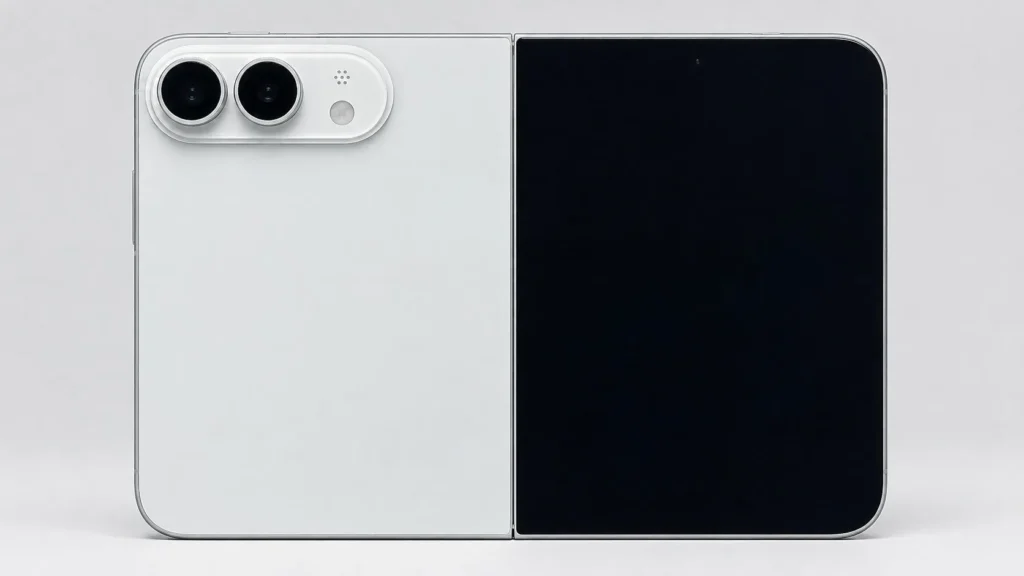
iPhone Ultra: Apple Could Delay Its First Foldable iPhone to 2027 to Compete Better with Samsung
As the foldable smartphone industry is currently dominated by experienced players like Samsung Electronics, Apple appears to be fine-tuning its entrance into this market. According to new information from the Asian supply chain, the highly anticipated iPhone Ultra, Apple’s first foldable iPhone, may be launched in early 2027 instead of the fall of 2026.
This delay might not necessarily indicate major difficulties but could reflect a more calculated strategy from the California-based company.
Apple Overcomes Several Obstacles… Before a New Setback
According to the Taiwanese media UDN, Apple has reportedly resolved several key issues related to the development of its foldable smartphone, including production cost negotiations, hinge design, material selection, and optimization of SMT (Surface Mount Technology) assembly processes.
Despite these advancements, a new unspecified issue has slowed the project timeline.
Strategic suppliers for Apple, including TSMC, Foxconn, and Largan Precision, have indicated that their production lines will remain heavily utilized until the first quarter of 2027, an unusual timeframe for traditional iPhone launches.
Presentation in September, Later Commercial Launch?
Current rumors suggest that Apple may still unveil the iPhone Ultra alongside the upcoming iPhone 18 models during its September 2026 keynote. The difference would be in the commercial release: classic and Pro models would hit stores in the fall, while the iPhone Ultra would wait until early the following year.
This strategy would allow Apple to create two distinct media cycles rather than concentrating all the attention on a single launch.
A Direct Duel with the Galaxy S27 Ultra
The proposed timeline is not insignificant. A launch in early 2027 would position the iPhone Ultra against the upcoming Samsung Galaxy S27 Ultra models, expected around the same period.
This timing could enable Apple to take advantage of the Lunar New Year sales in China, the annual refresh of premium smartphones, and a direct confrontation with the leading player in the foldable market.
It would also help to prevent the foldable from immediately diverting sales from the future iPhone 18 Pro models.
A Foldable Market Waiting for Apple
Despite the significant lead held by Samsung, Huawei, Honor, and Vivo, Apple’s arrival is still viewed as a potentially transformative event for the segment. Analysts predict that the first foldable iPhone could capture a considerable market share within its first year of release.
Some estimates even suggest capturing up to 30% of global foldable smartphone sales, with about 11 million units sold in the first year, surpassing the forecasts currently assigned to Samsung for 2027.
However, these projections remain speculative and will heavily depend on the final price, global availability, and Apple’s ability to offer a truly distinctive experience.
Apple Prioritizes Maturity Over Speed
Unlike Samsung, which has gradually improved its foldable devices over several generations, Apple benefits from a unique advantage: arriving late.
The company can observe its competitors’ mistakes, identify user expectations, and avoid certain trade-offs that have hindered foldable adoption, such as the visibility of the central crease, durability of hinges, battery life, and device thickness.
This approach likely explains why Apple seems willing to accept additional delays. The company likely prefers to launch a polished product rather than an experimental device.
The history of the iPhone also indicates that the company often values technological maturity over haste. If the iPhone Ultra indeed arrives in early 2027, it could mark not just Apple’s entry into the foldable realm but also the beginning of a new phase of competition in the most premium segment of the mobile market.



