

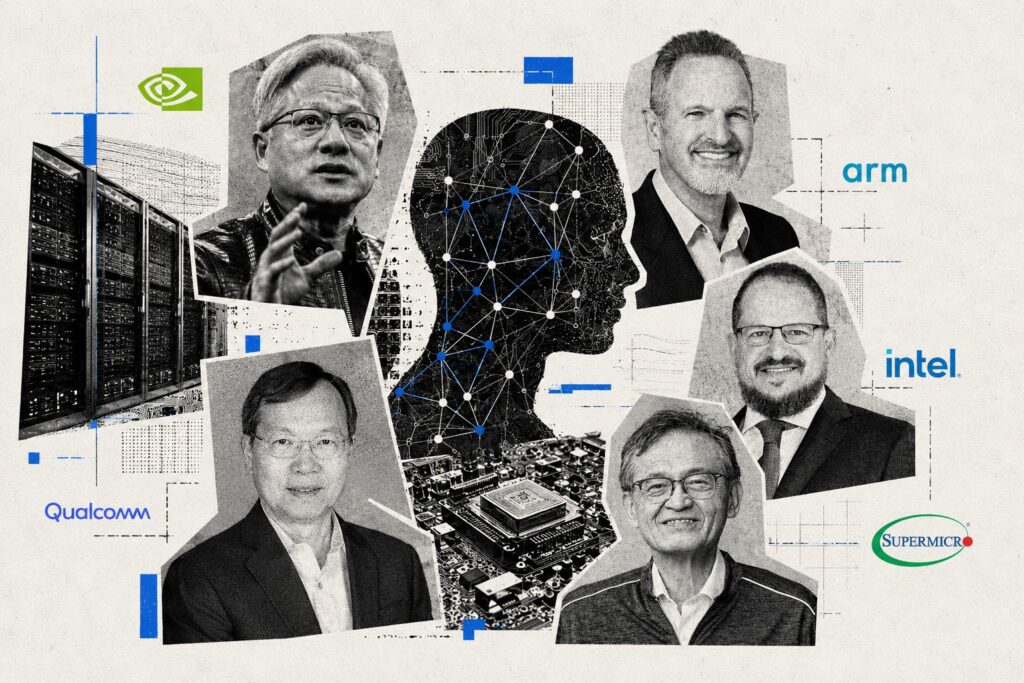
In a series of influential keynote speeches at Computex and GTC Taipei 2026, leaders from Nvidia, ARM, Intel, Qualcomm, and Supermicro converged on a common theme: the emergence of agentic AI as a new computing paradigm. While they share a diagnosis, each company emphasizes different aspects of value creation, from host processors to workstations, framing energy constraints as key arguments for performance and pricing.
Trade shows primarily serve as a barometer for industry trends, allowing voices of major market architects to articulate their visions. The coincidences of top processor and computing architecture designers speaking in the same week and city provide insights not only into their announcements but also into the competitive landscape. This year’s Computex and GTC Taipei brought together five distinct perspectives, collectively mapping out the industry’s intentions for the next three years.
The shared diagnosis can be distilled into a single idea, echoed in various forms by all five leaders: AI has evolved from a conversational interface, where humans input requests and receive responses, to autonomous agents that continuously call upon and create tools without interruption. This shift also brings with it a shared economic consequence: the tokens generated by these agents have become a profitable unit of measurement, shifting demand for computing from curiosity-driven to profit-driven. Yet, their diverging paths reveal distinctive strategies.
### Nvidia Shifts Product Definition to the Computing Factory
Jensen Huang offered the most aggressive conceptual pitch, stating, “We can say that agentic AI has arrived; useful AI is here.” He introduced a comprehensive AI factory, anchored by the Vera Rubin chip, which is now in full production. Huang described the outdated paradigm of individual GPUs and systems, presenting a holistic design framework called DSX. This framework integrates chips, racks, networking, power, and cooling as a single system, simulated in a digital twin before any physical components are introduced. “Designing the chip, the rack, the network, and the cooling must be done end-to-end, because computing is about revenue,” Huang asserted, challenging the industry to recognize the shift toward integrated infrastructure.
Huang’s narrative directly targets central processors. Nvidia’s Vera, an ARM-based chip boasting 88 cores, is heralded as capable of performing agentic tasks 1.8 times faster than comparable x86 processors. “All past processors were built for humans. This processor is built for agents,” Huang emphasized. This argument continues the transition of host layers explored in a recent report, elevating it to the core of computing nodes. Huang further extends the agentic computing model from data centers to workstations, collaborating with Microsoft on the RTX Spark and even reaching vehicles and robotics. Nvidia aims to dominate this universal agentic computing trend.
### ARM Reestablishes the Central Processor’s Importance
Rene Haas offered a sharp narrative focused on a specific point: the return of the central processor to the forefront. “Agents, unlike humans, do not sleep, and they continually spawn agents,” Haas pointed out. His reasoning rests on the continuous generation of agents, with the central processor handling distribution, orchestration, and the delivery of tokens produced by accelerators, rather than the accelerators themselves. Earlier this year, he projected a need for “four times more processor cores within the same power envelope,” forecasting a data center processor market to surpass $100 billion in five years. Building on its mobile heritage, ARM positions itself as a champion of energy efficiency as deployment constraints tighten due to available gigawatts.
Haas cited major cloud operators—such as AWS, Google, and Microsoft—who have developed their own ARM processors like Graviton, Axion, and Cobalt. He highlighted Google’s strategic shift from x86 to Axion in their host processor, signaling a shift that is already underway among market leaders. With a comprehensive offering from intellectual property blocks to complete subsystems, ARM aims to serve clients designing custom silicon as well as those who prefer ready-made processors.
### Intel Defends x86 and Bets on Custom Silicon and Foundry Services
“Fundamentally, Intel is an engineering company,” remarked Lip-Bu Tan, just over a year into his tenure, while outlining a recovery centered on execution and the 18A manufacturing process. He maintained that Intel is not constrained by its past and is flipping the narrative to its advantage. During a demonstration, he illustrated how AI workloads can transition from a seven-to-one advantage for accelerators to near parity when it enters an agentic chain, asserting that agentic AI revalidates the central processor and, by extension, the Xeon range. “For agentic AI, it’s the central processor orchestrating the show,” claimed one executive, highlighting how these solutions improve the utilization rates of costly GPUs. Unlike his counterparts, Tan defended a well-established position rather than attacking others.
The definitive shift for Intel lies in its proactive entrance into the custom silicon and foundry market for third parties. Announcing an infrastructure processing unit delivered to Google and a partnership with Ericsson on telecom infrastructure silicon, Intel is positioning itself to manufacture chips not just for its own use but for others as well, engaging in a space where Taiwanese suppliers still hold a significant lead. This strategy complements its defense of the x86 architecture while diversifying into production, where advanced capabilities are becoming a strategic asset.
### Qualcomm Centers Value on Agents and Returns Focus to Endpoints
Cristiano Amon provided a sophisticated analysis of the role of agents in computing. “2026 is the year of agents,” he declared, turning traditional hierarchies on their heads. “These agents become the core of your digital experience,” with devices ranging from smartphones to vehicles and workstations acting as portals to these agents. This perspective suggests that the balance between cloud and endpoint computing should now be viewed through the lens of economic orchestration. “What needs to run in the cloud will run in the cloud; what needs to be on the endpoint will stay there,” he summarized, framing tokens as “the currency of AI.” His analysis highlighted the impact of smartly distributed inference between cloud and endpoints, which cuts token use and costs by 30% to 60% for the same output.
Qualcomm leverages its historic advantage in performance per watt gained from mobile technology onto vehicles, robotics, and the next wave of networks. Amon showcased 6G as the first generation designed for the AI era, engineered to treat each radio link as a sensor feeding context to agents executing on devices. The company also confirmed its entrance into the data center market with its Dragonfly brand, broadening a portfolio that now spans components to complete systems.
### Supermicro Pitches Speed to Market Over Doctrine
Charles Liang took a markedly different approach, focusing less on theoretical frameworks and more on practical outcomes. “Time is money,” he reiterated, warning that “any day your systems and data center remain inactive directly harms your bottom line.” His proposition revolves around pre-assembled, validated building blocks, promising a gigawatt data center delivered in three months—an out-of-the-box solution that eliminates lengthy on-site integration. For operators investing billions, every month of delay in bringing production online translates directly to lost profits, and Supermicro capitalizes on this sense of urgency.
The strategic significance of Liang’s message lies in his publicly acknowledged partnership with ARM, involving a range of server systems based on the British designer’s architecture. This collaboration indicates that the ARM server ecosystem now has a volume integrator capable of rapidly turning roadmaps into deliverable products. Supermicro is positioned as a market accelerator for architectures beyond x86, making it a crucial yet understated player in the ongoing reshaping of the host processor landscape.
### A Unifying Thread Amid Diverging Discourses
A common thread runs through these five keynotes, all emphasizing gigawatts, performance per watt, and tokens per watt. However, it’s essential to recognize that the unit for measuring computing performance remains tokens per cycle, per second, or per query, while the real bottleneck in agentic workloads hinges on data movement between chips and memory, not on power consumption. Energy serves as an industrial capacity constraint that caps the amount of computing an installation can accommodate and its operational cost, but it does not factor into the calculations per se and only impacts outcomes in the event of shortages or outages.
By converting performance into tokens per watt, vendors effectively shift an energy efficiency metric into a performance argument, justifying their roadmaps and access pricing. It’s critical to retain this nuance for accuracy. Given fixed electrical budgets for any specific site, improved energy efficiency does indeed result in a higher token throughput across the entire site without altering the individual quality or cost of each token. Energy bounds capacity but does not enter into calculations, providing a crucial distinction for interpreting roadmaps without yielding to commercial rhetoric.
For CIOs, CTOs, and infrastructure directors, the practical implications are twofold: the renewed competition in host processors between x86 and ARM revitalizes the strategic significance of architectural choices that had waned, necessitating foresight into enduring heterogeneity in computing environments. Additionally, as AI workloads concentrate on vertically integrated chains—where a single supplier designs the accelerator, host processor, network, and software stack—questions of dependency and reversibility arise, transcending mere technical discussions.



