

Mistral Secures Priority Access to 3GW AI Computing Capacity with Bpifrance-MGX Consortium
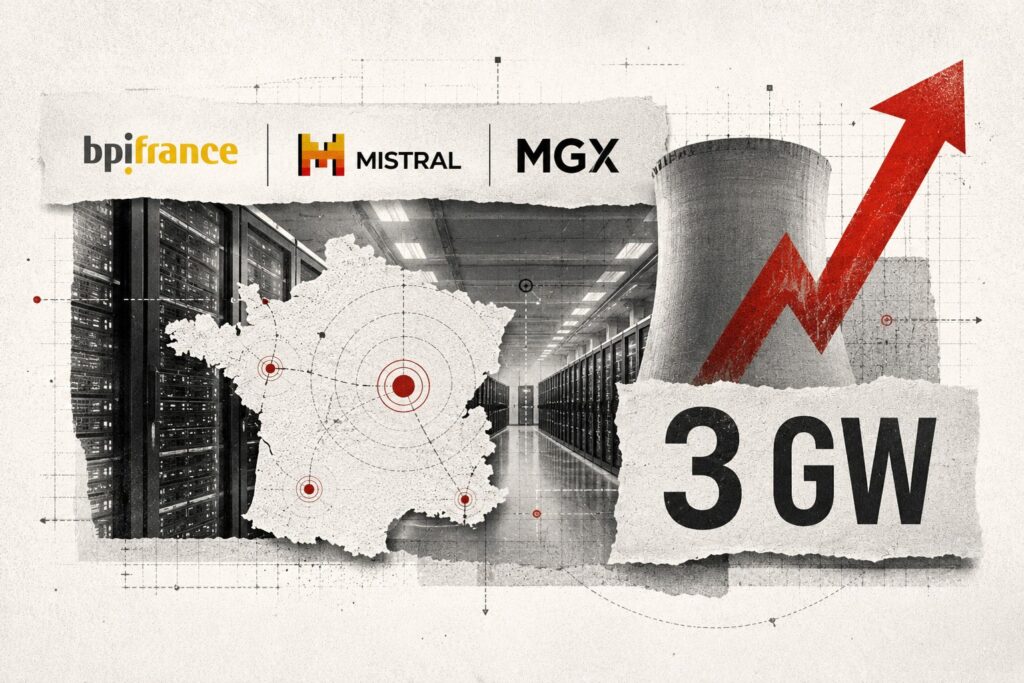
Mistral, the French AI company, has secured priority access to 200 megawatts of computing power at the Fouju site, as part of a bold initiative with the Bpifrance-MGX consortium that aims to ramp up capacity to a staggering 3 gigawatts. This development was announced on June 1 during the Choose France summit, marking a significant step towards bolstering the French AI ecosystem. Mistral, known for its foundational models like Le Chat and the Mistral Large family, is poised to leverage this critical resource, positioning itself to outpace competitors in the rapidly evolving realm of generative AI.
The Campus AI initiative brings together four major stakeholders: Bpifrance, France’s public investment bank; Mistral, a developer of foundational AI models; MGX, an Emirati investment firm specializing in AI and advanced technologies; and Nvidia, the leading provider of accelerated computing solutions. The original campus, located in Fouju, Seine-et-Marne, has already seen Mistral commit to 96 megawatts of capacity, with plans to expand this figure to 200 megawatts. The newly announced expansion extends beyond this flagship site, reflecting the ambitious goals of the consortium.
Ensuring Long-Term Computational Resources
For a foundational model developer, access to computational power directly influences the pace of model training, the scale of achievable architectures, and the business flexibility in inference. Mistral’s ability to train and deploy models in a competitive landscape—where availability of accelerators and access to well-connected electrical sites are critical—will be significantly enhanced by locking in priority access to this substantial infrastructure designed to reach 3 gigawatts. This move alleviates reliance on ad-hoc capacity rentals from hyperscale cloud providers.
Mistral’s expansion from 96 to 200 megawatts at the Fouju site underscores its commitment to this infrastructure. To put this into perspective, such capacity classifies Mistral among a group of computing consumers typically dominated by major American players. The campus is slated to become operational by early 2028, embedding this resource within a structured industrial timeline rather than a purely promotional narrative. For technical leaders relying on Mistral’s models, this clarity on computing capacity signals stable, medium-term service continuity.
A Sustainable, Water-Free Campus Model
The Fouju site features a waterless cooling system and energy-efficient design, powered by France’s largely decarbonized electricity mix. This setup addresses a growing concern for high-performance computing infrastructures: the consumption of water and the carbon footprint of data centers. The consortium emphasizes a cooling method that eliminates the use of freshwater alongside a modular construction approach tailored to real demand—key factors that are now crucial for the local acceptance of AI factory projects.
This environmental commitment carries weight for Mistral’s clients, who are subject to non-financial reporting obligations. Using models that are trained and served on decarbonized, water-efficient infrastructure significantly alters the environmental impact associated with generative AI usage. France’s energy mix, relying on nuclear and renewable sources, offers a competitive advantage that few counterparts with US-based infrastructures can match.
Compliance Through Multiple Perspectives
The concept of sovereign computing capacity invites a multi-faceted approach to compliance. The consortium includes a shareholder, MGX, from the UAE and an American graphics processor supplier, Nvidia. While the sovereignty claimed pertains to the physical location of the sites, energy, and scaling access for a French champion, it does not extend to independence in the underlying computing layer itself.
For information system executives considering Mistral’s models, this distinction shapes risk analysis. The French anchorage of computing capacity mitigates jurisdictional exposure concerning the location of processing activities but does not eliminate dependency on a concentrated hardware supply chain. Thibaud Desfossés, President of Campus AI, underscores a local value-add criterion: “Each gigawatt must generate value in France, not simply pass through.” The project’s true success will be evaluated by the tangible contribution of French suppliers within its industrial value chain.
The imminent selection of a second site is set to double the consortium’s initial investment. For the French AI ecosystem, solidifying accessible computing capacity for a national developer represents a rare advantage. As deployment progresses, it will be crucial to ensure that Mistral’s priority access translates into real availability of accelerators and an increased involvement of French industry suppliers in the assembly and operation of the facilities.



