

Duckduckgo Launches “No AI” Extensions and Seizes on Google’s AI Shift
As Google accelerates its transformation into an AI-focused search engine, a historical web player is taking the opposite approach. DuckDuckGo has just unveiled new extensions for Chrome and Firefox that allow users to automatically set their “no AI” search experience as the default option.
This positioning responds to a broader trend: some internet users seem to be seeking a return to a more traditional search experience, centered around links rather than responses generated by AI models.
Duckduckgo Strengthens Its “No AI” Search Mode
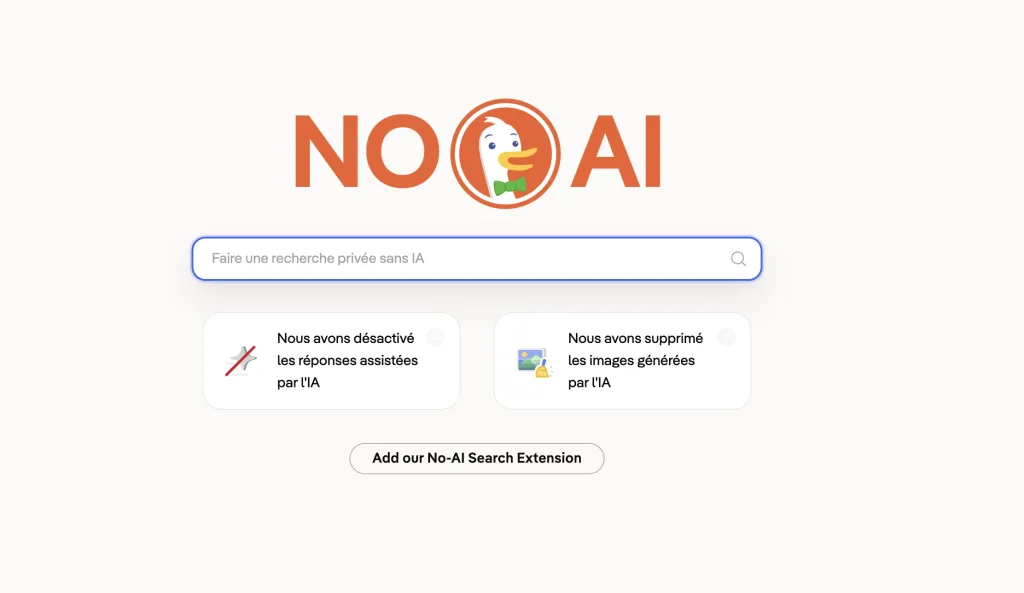
With these new extensions, users are automatically redirected to noai.duckduckgo.com, a version of the search engine that removes several elements that have become ubiquitous on the web.
According to DuckDuckGo, this experience eliminates AI-assisted responses, removes prompts to chat with a chatbot, and reduces the presence of artificially generated images in the results. The goal is clear: to ensure a consistent experience for those who wish to conduct their searches without generative AI intervention.
DuckDuckGo browser users already enjoyed this feature thanks to preferences related to AI being maintained even after browsing history was cleared. The new extensions now extend this capability to the major browsers on the market.
A Favorable Context After Google’s Major Overhaul
The launch comes a few weeks after Google announced its largest overhaul of its search engine in over twenty-five years during its developers’ conference in May 2026.
Now, traditional results give way to AI Overviews, AI-generated summaries capable of producing charts, visualizations, tables, or even mini-applications based on queries. Follow-up questions then direct users to a conversational mode called AI Mode.
In this new architecture, the famous “blue links” that have defined the search engine’s identity for decades occupy a significantly less central role.
This evolution marks a major strategic shift: Google is no longer solely focused on organizing information but rather on synthesizing and presenting it directly to the user.
Spectacular Growth for Duckduckgo
This repositioning seems to be benefiting DuckDuckGo. The company reports that visits to its “no AI” search page increased by nearly 30% in just one week. Meanwhile, installations of its app in the United States rose by 18.1%, with a notable spike on iOS, where weekly growth reached almost 70%.
Even more telling, traffic to the “no AI” version of the engine saw a threefold increase on May 28, 2026, setting a new record since Google’s changes were announced.
DuckDuckGo also emphasizes that this surge does not appear to be a mere media effect. Average visits would be sustained at a level 84% higher than usual, suggesting a potential long-term change in search habits.
An Anti-Saturation AI Strategy, Not Anti-Artificial Intelligence
Despite this focus on “no AI” searches, DuckDuckGo does not position itself as an opponent of artificial intelligence.
The company continues to invest in the sector and already offers its own conversational assistant providing access to multiple popular models. It also markets a premium offer that includes various services such as a VPN, tools for removing personal information, and identity restoration services after a data breach.
This approach illustrates an emerging trend in the industry: to provide users with more control over the presence of AI in their digital tools rather than imposing it systematically.
The Return of Choice in the Age of AI
The rise of generative tools has profoundly changed how platforms design access to information. However, the massive adoption of these technologies does not mean that all users want to abandon traditional search methods.
By focusing on a deliberately streamlined experience, DuckDuckGo is carving out an increasingly visible niche: that of internet users who still prioritize direct exploration of sources over their interpretation by artificial intelligence. This strategy could transform a simple alternative positioning into a genuine competitive advantage as AI becomes the norm.



