

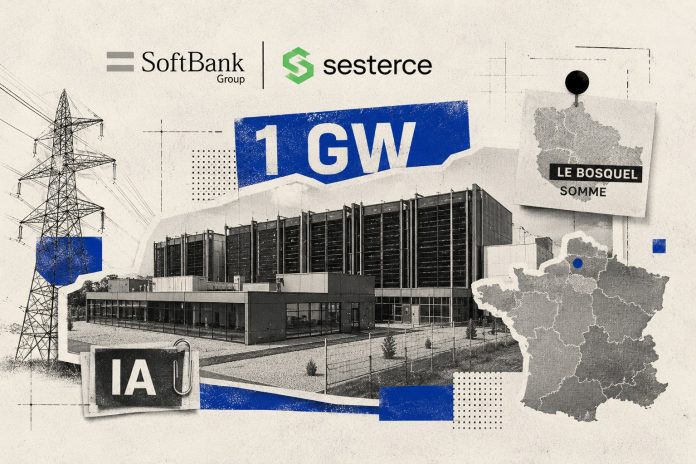
SoftBank Group and Sesterce have been selected to develop and operate a dedicated data center campus for artificial intelligence with a capacity of 1 GW in Bosquel, Somme. This initiative, driven by a joint venture primarily owned by the Japanese group, is a key component of SoftBank’s commitment to building 5 GW of computing capacity in France. The project is expected to create 400 skilled jobs and establish a regional endowment fund of €10 million, co-managed with the Hauts-de-France region.
The landscape of major computing infrastructure in Europe is rapidly evolving with a flurry of investment announcements, and Hauts-de-France has become a focal point for some of the continent’s most significant projects. In this context, SoftBank Group and Sesterce have announced their selection to develop and operate a 1 GW campus in Bosquel, in the Somme department. Sesterce, a French operator specializing in AI and high-performance computing infrastructure, was founded in 2018 by Anthony Tchakerian and Youssef El Manssouri.
This joint venture combines SoftBank’s global AI infrastructure platform with Sesterce’s data center capabilities. Situated in Hauts-de-France, at a strategic crossroads (with easy access to Paris, Brussels, Amsterdam, London, and Frankfurt), the campus aims to deliver low-latency AI workloads to key European markets. This selection followed a call for expressions of interest issued by the Somme Sud-Ouest Community of Municipalities.
A Cornerstone of SoftBank’s 5 GW Initiative in France
The Bosquel campus is part of SoftBank’s commitment to develop 5 GW of computing capacity in France, announced during the Choose France 2026 summit. This initiative, expected to cost up to €75 billion, marks the group’s largest investment in AI infrastructure in Europe. The first phase, estimated at €45 billion, aims to reach 3.1 GW of capacity by 2031, distributed across three sites in Hauts-de-France: Dunkirk, Bosquel, and Bouchain.
The Bosquel project will also rely on other industrial partnerships that SoftBank has established in the area. The group is collaborating with EDF at the Bouchain site and with Schneider Electric on an industrial hub at the Dunkirk port, focused on producing enclosures and integrating power modules for data centers. These alliances are creating a local supply chain that extends beyond the mere operation of computing facilities.
“Artificial intelligence will shape the next era of technology, industry, and human progress, and this future will demand a new generation of infrastructure,” said Masayoshi Son, CEO of SoftBank Group. He views Bosquel as a crucial step in the company’s efforts to build this foundation in France and support European AI ecosystems.
Four Hundred Jobs and a Regional Endowment Fund
The construction of the campus will engage a wide range of companies, subcontractors, and service providers, with expected benefits for the regional economy. Once operational, the site will employ 400 individuals in skilled and sustainable positions related to data center operations, energy systems, security, maintenance, and infrastructure management. The joint venture highlights France’s advantages for AI infrastructure, including an advanced electrical network, engineering expertise, available industrial land, and a growing national ecosystem.
In collaboration with the Hauts-de-France region, the prefecture, and the Somme Sud-Ouest Community of Municipalities, the joint venture plans to establish a €10 million endowment fund, co-managed with the region, to promote the use of artificial intelligence among local businesses, schools, universities, and associations. Designed by the architectural firm Patriarche, the campus plan includes a community center accessible to residents, local businesses, students, and public stakeholders.
“This AI facility in Bosquel represents a major industrial investment with significant economic and social benefits for the area, not only in terms of permanent on-site jobs but also by its support for research, innovation, and knowledge,” stated Rollon Mouchel-Blaisot, prefect of the Somme. State services were actively involved throughout the call for expressions of interest to provide rigorous and independent expertise.
A High-Performance Computing Offering
Sesterce develops and operates high-density AI factories in Europe and internationally, integrating energy, data center infrastructure, and clusters of graphics processors. The company claims to offer sovereign, large-scale computing solutions for enterprises, model designers, and hyperscalers. “This partnership with SoftBank represents a pivotal moment for Sesterce and the future of sovereign AI infrastructure in Europe,” said Youssef El Manssouri, CEO and co-founder, alongside Anthony Tchakerian, Deputy CEO and co-founder of Sesterce.
The claim of sovereignty warrants careful consideration given the operational structure. The joint venture is predominantly owned by SoftBank Group, a Japanese-listed entity, which means that capital control resides with a non-European entity. Consequently, the infrastructure falls outside the purview of a European actor as defined by the ANSSI’s SecNumCloud qualification, the only recognized framework in France ensuring sovereignty for public sector entities and those of vital importance. Merely locating the facilities in France does not automatically fulfill the foreign legal immunity required by this qualification, which relies on architecture and governance.
For CIOs and CISOs evaluating the offering, the distinction between hosting on French soil and legal control within Europe remains crucial. The Bosquel project brings computing capacity planted in France with a local industrial presence, yet it does not inherently meet the sovereignty criteria of resource prioritization, governance, and legal immunity. Its sovereign scope will depend on contractual commitments and qualifications obtained, rather than solely geographical placement. Furthermore, the operation bolsters Hauts-de-France’s position as a leading European computing infrastructure hub and broadens the range of providers available to technical teams grappling with resource scarcity.



