

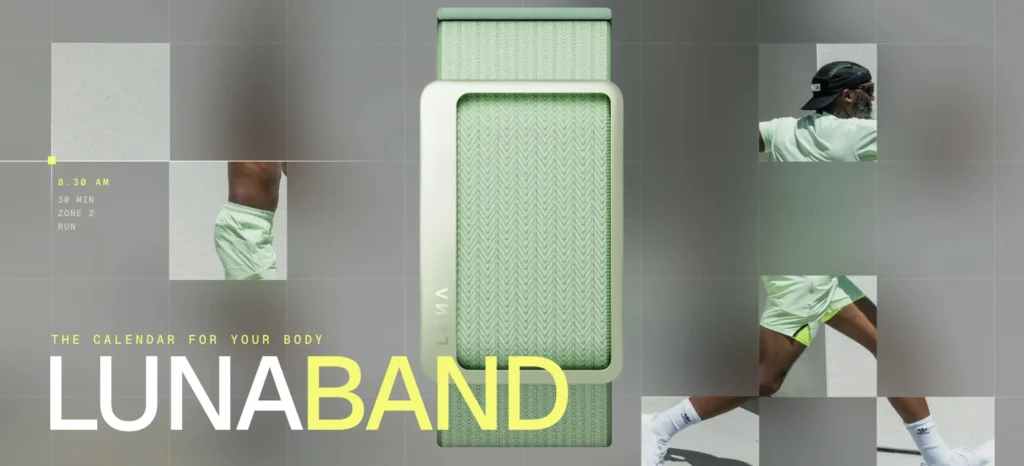
Luna Band: An AI Bracelet That Transforms Health Data Into Personalized Advice
The wearable market is entering a new phase. After years focused on tracking steps, calories, and sleep patterns, new companies are now aiming to transform connected bracelets into true smart health assistants.
This is exactly the promise of the Luna Band, the first product from Luna, which has officially launched its waiting list.
Luna Band: A Bracelet Designed Around AI Rather Than Fitness
The Luna Band is not intended to be just an activity tracker. The product relies on a platform called “LifeOS,” described as an intelligence layer capable of transforming biometric data into contextualized recommendations throughout the day.
Instead of opening an app filled with curves and statistics, users will have access to a much more proactive “Today” view: recovery advice, nutritional recommendations, optimal focus periods, stress management tips, and reminders related to caffeine and sleep.
The idea is simple: move from passive tracking to behavioral support.

Health Becomes Conversational
One of the most interesting aspects of the product is its voice approach. The Luna Band allows users to record meals, describe habits, or signal activities simply by speaking. This focus shows an emerging trend in the connected health world: reducing the friction associated with tracking.
This is because the main issue with health apps is often not the lack of data, but user fatigue. Few people continue manually entering their information for several months.
Therefore, Luna aims to make tracking far more natural and conversational.
An AI That Attempts to Explain Causes
The platform also aims to go beyond simple metrics. Instead of just indicating a poor night’s sleep, LifeOS could explain that a late coffee reduced the duration of deep sleep.

This “cause and effect” logic is becoming the new battleground for AI wearables. Users no longer just want to see data; they want to understand why their energy decreases, why their recovery slows, or why their stress rises.
The Wearable Becomes a Constant Coach
Luna also integrates several micro-apps focused on stress, training, nutrition, supplements, and productivity. This convergence is revealing.
Wearables are no longer just trying to measure the body; they are now also seeking to directly influence daily behaviors.
With the rise of generative AI, manufacturers hope to transform these devices into permanent personal coaches capable of interpreting biological signals in real-time.
An Increasingly Competitive Market
The Luna Band will debut in an already crowded environment:
- Apple is pushing health through the Apple Watch
- Whoop focuses on recovery
- Oura dominates the connected ring market
- Google offers a powerful coach with its Fitbit Air
- and numerous AI health startups are emerging rapidly
Therefore, Luna is trying to differentiate itself not just through hardware, but through the software and contextual experience.
A Limited Release to Create Exclusivity

The first wave, called “Drop 1,” will be distributed by invitation only, with deliveries planned by the end of July 2026. The price remains unknown.
However, behind this discreet launch may lie something more significant: the next generation of wearables will not only measure our activity but will seek to understand our habits and influence them continuously.



