

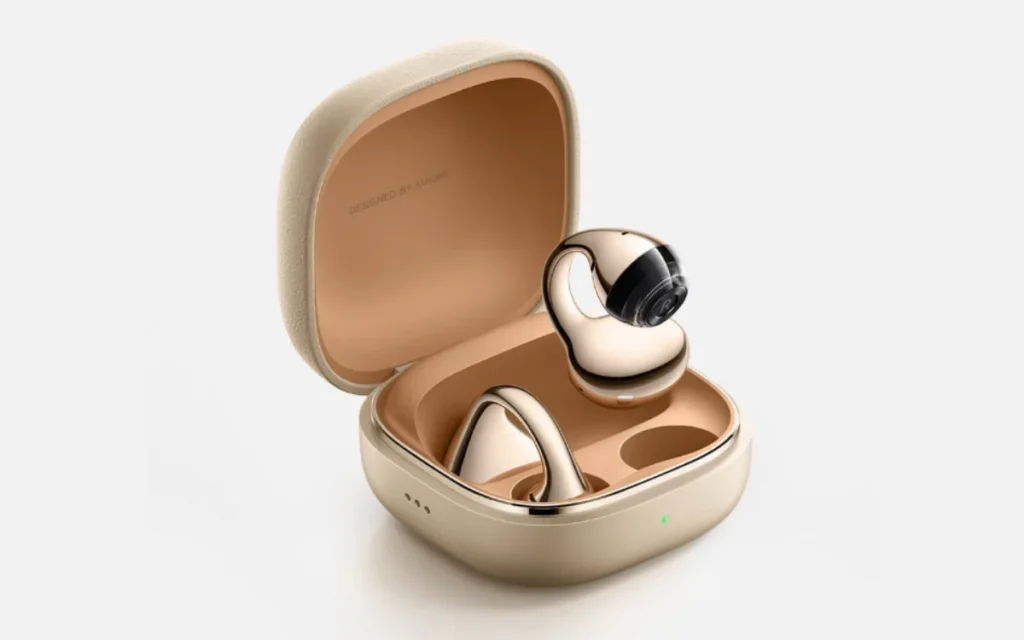
Xiaomi Clip-On launches its first open-ear earbuds: open audio between comfort, AI, and style
Xiaomi joins the race for open-ear earbuds. Unveiled in China, their first clip-on earbuds adopt a “cuff” style that clings to the ear without entering the ear canal, designed for those who want to listen to music without disconnecting from their surroundings.
A lightweight design to forget about in-ear tips
Each earbud weighs just 5.5 g and is supported by a titanium memory form bridge, with a pressure distance of 3.4 mm. The goal is clear: to provide a stable fit without the pressure sensation often associated with in-ear headphones.

Xiaomi also pays attention to aesthetics. With a semi-transparent glossy finish, a leather-like texture case, and four colors — black, white, gold, and purple — the brand aims to position these earbuds as both a tech accessory and a lifestyle item.
Hi-Res, LHDC 5.0, and sound leakage prevention
Inside, they feature an 11 mm dynamic driver, compatible with LHDC 5.0 and certified Hi-Res Audio. As always with open-ear designs, the real challenge is not just sound quality but also audio privacy. Xiaomi employs directional transmission and inverse wave technology to minimize sound leakage.
For calls, the company combines three microphones with a bone conduction sensor and AI noise reduction.

Headphones aiming to become AI assistants
Xiaomi introduces features that have become almost essential in 2026: real-time translation in 21 languages, live transcription, and summaries generated via XiaoAI. These capabilities may appeal to travelers and professionals, although their effectiveness will heavily depend on software quality and availability outside of China.
The HyperOS integration also allows audio sharing, while compatibility with the Apple Find My network opens doors for iPhone users, a clever move to extend beyond the Xiaomi ecosystem.
Xiaomi enters a highly competitive market
With a launch price of 849 yuan (approximately 110 euros), temporarily reduced to 799 yuan, Xiaomi positions itself in a segment currently occupied by Huawei, Bose, Shokz, and Nothing. Its potential advantage could lie in the balance between comfort, AI features, and cross-platform compatibility.
It remains to be seen whether these promises will hold up in everyday use. In open audio, technical specifications are never enough: the real test involves fit, call clarity, and how enjoyable they feel after several hours of wear.



