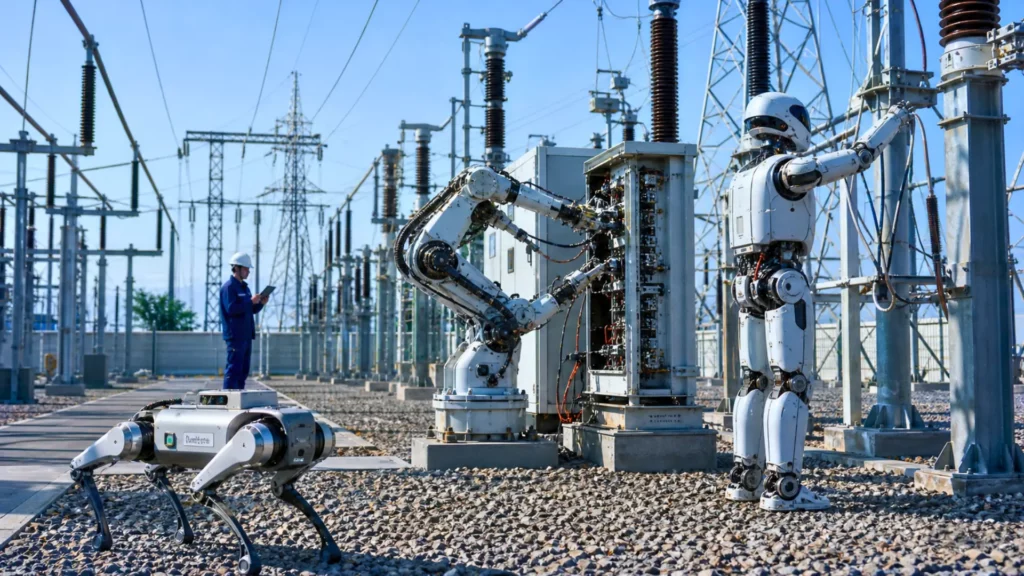
What if the future of the global electrical network depended on machines that can walk, climb, and manipulate like humans? In China, a colossal project mobilizes thousands of robots to transform the maintenance of vital infrastructure, with promises that are as fascinating as they are unsettling.
An army of 8,500 robots to modernize the largest electrical network in the world
Founded in 2002, the State Grid Corporation of China is now regarded as the largest utility company in the world. Managing a gigantic electrical network with over 1.7 million employees, this organization is undergoing a subtle transformation behind its immense human power.
In April 2026, the South China Morning Post reported a significant investment of 6.8 billion yuan aimed at modernizing its operations. The goal is to integrate 8,500 robots that will be capable of inspecting, repairing, and monitoring installations that are sometimes difficult to access. These robots will operate in places where even technicians are hesitant to go.
Quadrupeds, dual-arm robots, and humanoids: robots for extreme terrains and precision tasks
First, 5,000 quadruped robots are set to traverse rugged terrains. They will operate in mountainous regions and isolated substations, showcasing their extreme adaptability. These robots can withstand intense cold and unstable environments.
Next, the 3,000 dual-arm robots represent another advancement. With their precise manipulators, they will engage directly with equipment for technical adjustments and repairs. This shift reduces the need for human intervention in high-risk areas.
Lastly, 500 humanoid robots complete this ecosystem. Their surgical precision makes them ideal for tasks on high-voltage lines, where any mistake can be fatal. Their design is reminiscent of the technicians they assist, raising intriguing questions about their role.
Enhanced safety, accelerated inspections, and reduced costs: the announced concrete gains
The ambition is impressive, aiming to reduce maintenance-related accidents by 80%. Given that interventions often occur at height or under voltage, this safety revolution could save many lives.
Moreover, inspections could become five times faster, and response times to outages could decrease by 60%. This efficiency also leads to significant labor savings, estimated between €60,000 and €100,000 per year.
However, these figures raise a critical question: what will happen to human technicians in this new system? As robots gradually take over, the transformation promises gains but also reshapes the labor landscape.
Unitree, UBTech, Deep Robotics: Chinese companies at the heart of the robotic race
While exact models remain undisclosed, several Chinese companies are already expected to play a key role. Unitree, known for its agile quadruped robots, is at the forefront. Meanwhile, UBTech and AgiBot are developing humanoid robots as part of this robotic innovation race.
Additionally, Deep Robotics specializes in challenging environments, while Fourier Intelligence, originally from the exoskeleton sector, is now making strides in humanoid robotics as well. This diversity illustrates the growing power of the Chinese technological ecosystem.
Finally, China Southern Power Grid is already conducting experiments with robots that perform complex inspections using advanced sensors and efficient analysis algorithms. Thus, the robotization of the energy sector is just beginning and could soon reshape how electricity is monitored.