

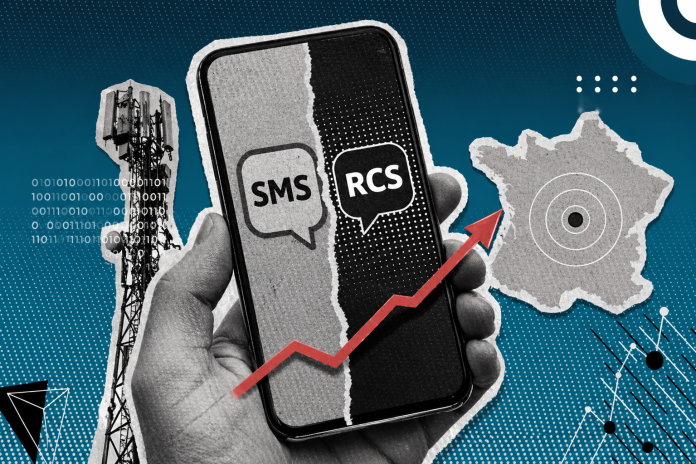
While SMS continues to be the cornerstone of mass communication between brands and customers, the format has seen little change over the past three decades. The recent rollout of RCS (Rich Communication Services) support on iOS by all four major carriers in France marks a significant shift. The percentage of compatible devices in France has surged to 60%, reflecting a 35% increase from October 2024 to February 2025, according to data from af2m, an association comprising mobile operators and messaging aggregators.
RCS is the GSMA-standardized successor to SMS, enhancing messaging with multimedia elements like images, videos, interactive carousels, action buttons, and verified sender identification—all accessible through a native messaging app without requiring additional applications or accounts. It functions alongside SMS in the same inbox, automatically enabling its advanced features when both sender and recipient are compatible. This compatibility has now been established for iPhone users on networks like Orange, Bouygues, Free, and SFR, following Apple’s activation of the Universal Profile and its rollout across European operators.
This transition changes the value proposition of the communication channel for marketing and customer relationship management teams. A2P SMS (Application-to-Person messaging), operating for the past 30 years on a plain text format lacking rich formatting and enhanced authentication, now faces competition from RCS Business Messaging, which adds brand traceability, multimedia richness, and conversational interactivity. These enhancements align user experiences more closely with those found in WhatsApp Business and Apple Business Messages. Consequently, advertisers are pivoting from focusing on message volume to prioritizing engagement rates and the qualification of interactions.
The iOS Trigger and a Path to 85% Compatibility by Late 2025
The introduction of RCS on iOS is a key factor driving this shift. Prior to this change, the French ecosystem was divided between Android, where RCS had been enabled by default for several years, and iOS, which still relied on SMS and iMessage depending on the recipient. Removing this barrier means iPhone users on all four national carriers can now achieve uniform compatibility with the European mobile standard.
The compatible device base has jumped from 28.3 million to 38.1 million between October 2024 and February 2025, adding nearly ten million devices in under six months. At this expansion rate, af2m projects that 85% of French devices will support RCS by the end of 2025, although this estimate relies on the pace of device renewals and the effective deployment of the Universal Profile by OS vendors.
For marketing departments, this change alters the addressable base for RCS campaigns without requiring adjustments to technical infrastructure. CPaaS platforms such as Sinch, Twilio, and Infobip automatically switch messages to RCS when the device is compatible, reverting to SMS otherwise. This fallback logic diminishes the reliance on penetration thresholds for channel investment.
Nearly 270 Active Brands, with Retail Leading at 25%
The adoption of RCS among advertisers mirrors the increasing device coverage. From March 2024 to February 2025, 267 brands launched RCS campaigns in France, reflecting an increase of around 100 new brands and a 55% rise from previous measurements. af2m attributes this acceleration to the availability of RCS on iOS across all four carriers.
Sector-wise, the data shows a clear concentration. Retail leads with 25% of engaged brands, followed by services—spanning education, transportation, and beauty—at 16%. The automotive sector rounds out the top three at 9%. These three sectors account for half of all advertisers using the channel. Retail’s prominence can be explained by its use cases, such as loyalty programs, conditional vouchers, in-store pickup confirmations, and cart abandonment follow-ups—all scenarios that benefit from RCS’s enhanced visual and interactive capabilities.
The limited presence of banks, insurance, and healthcare sectors indicates varying levels of maturity. These industries, which heavily rely on sender ID traceability and authentication, are waiting for stabilization in verification protocols before scaling up their deployments. The potential for expanding RCS into these sectors is recognized as a key leverage point for future growth by the ecosystem.
A Measure from an Ecosystem Invested in the Shift
af2m comprises operators and aggregators that commercially exploit the RCS channel. Its member list includes Orange, Bouygues Telecom, SFR, Iliad under the Free brand, Worldline, Digital Virgo, Netcom, Remmedia, Tel-On, and several players specializing in A2P messaging. These operators and aggregators directly receive revenue from every sent RCS Business message, benefiting from the enhanced price structure of the richer format compared to standard SMS.
The publication of penetration and adoption figures serves both as a market indicator and a sector advocacy tool. The measured volumes remain technically verifiable, as the compatible device count is reported by the operators themselves. However, the projection of 85% compatibility and the qualitative assessment of brand engagement rely on insights provided by the ecosystem.
“Recently, RCS has seen impressive growth in France. With the availability of RCS on iOS for subscribers of the four operators, nearly 10 million additional smartphones have become compatible. In response to this momentum, more brands are incorporating RCS into their campaigns to fully leverage the activation potential this technology offers to their marketing strategies,” says Renan Abgrall, president of af2m.
The shift from SMS to RCS is part of a broader reconfiguration of brand-customer communication channels across Europe. Apple Business Messages, WhatsApp Business Platform, and RCS Business Messaging are advancing simultaneously, but with distinct business models and architectures. For IT and marketing departments, the focus is shifting from merely choosing a channel to orchestrating a multichannel approach and effectively harnessing the unique signals presented by each format to measure performance.



