

Infineon Joins Forces in European Quantum Pilot Lines
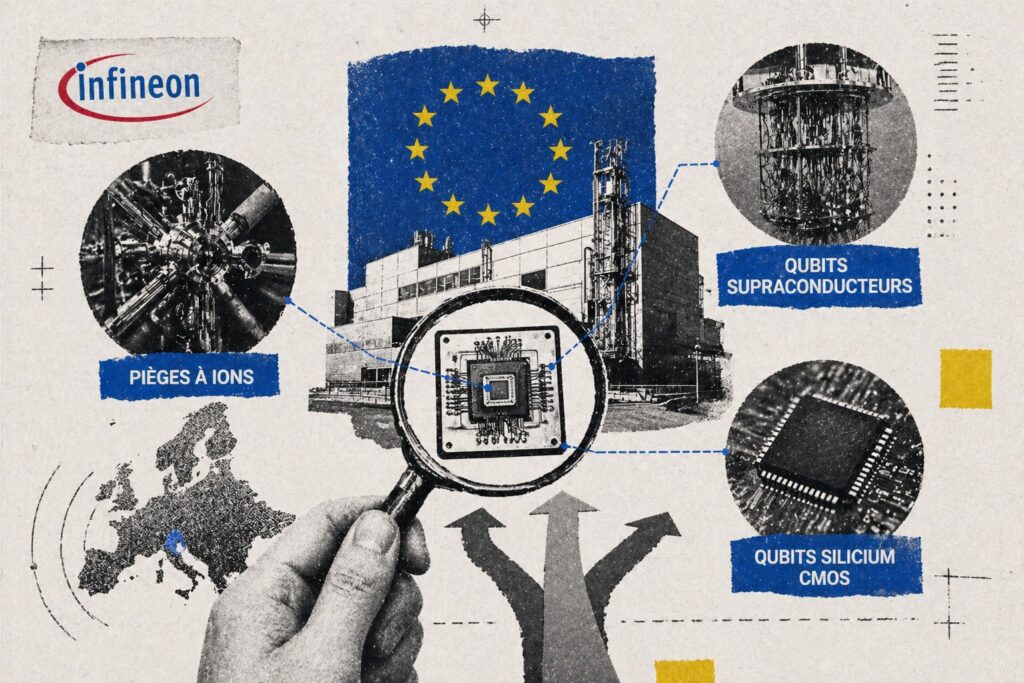
Infineon Technologies has announced its involvement in three of the six pilot quantum lines selected as part of the Chips for Europe Initiative and the Chips Joint Undertaking. The German semiconductor manufacturer will contribute to CHAMP-ION, focusing on ion traps; SUPREME, centered around superconducting qubits; and SPINS, which works on silicon qubits utilizing standard CMOS technology. This initiative aims to translate fundamental research into a sovereign industrial capacity for Europe, while simultaneously refraining from prematurely favoring any one of the three competing hardware platforms, which remain at varying stages of maturity.
This announcement comes during a critical period for Europe’s semiconductor and quantum sovereignty. The six selected projects span seven years and are jointly funded by the European Union and participating member states through the Chips JU. The Chips Act’s explicit goal is to double Europe’s global share of semiconductor production by 2030. Quantum technology represents a significant facet of this ambition, following advanced nodes in conventional logic. These pilot lines will provide shared industrial access to startups, SMEs, and research organizations, modeled on the pilot foundries of the U.S. CHIPS and Science Act.
Infineon’s engagement across three pilot lines reflects a multi-platform technological strategy. CHAMP-ION, led by Silicon Austria Labs alongside 21 partners from six countries, aims to establish Europe’s first advanced manufacturing chain for ion traps, integrating electronics and photonics onto a single chip. SUPREME, guided by Finland’s VTT and 23 partners from eight countries, targets the industrialization of superconducting qubits, with a central milestone being the development of a 3D module containing 200 qubits. Meanwhile, SPINS, coordinated by Belgian imec and 25 partners from nine countries, exploits silicon and silicon-germanium structures in widely standardized CMOS fabrication, allowing the reuse of existing foundries and the introduction of quantum design kits for multi-project wafer runs.
Three Hardware Platforms, Three Distinct Technological Bets
Infineon’s multi-platform bet invites analysis as it highlights Europe’s industrial posture in the face of an unresolved technological fork. Ion traps promise high computational fidelity and gradual scalability, yet they impose demanding optical and photonic constraints. Superconducting qubits offer short gate times and benefit from established semiconductor processes, albeit at the cost of extreme cryogenic conditions and stability challenges beyond a few hundred qubits. On the other hand, silicon-doped qubits promise the most immediate integration with conventional CMOS chains, presenting the most realistic trajectory for long-term industrialization, although their operational maturity lags behind the other two platforms.
By opting not to commit to a single technology, Infineon operates dedicated laboratories for each platform, closely linked to semiconductor production. This approach contrasts with American players where IBM focuses on superconductors, IonQ on ion traps, and Intel on silicon doping, creating a competitive market shaped by differing paradigms. The European strategy resembles an industrial risk coverage model, maintaining three parallel paths until operational milestones identify a clear leader. The downside of this cautious approach is the potential dilution of investments, hinging on the consortiums’ ability to rapidly converge on shared manufacturing standards.
Quantum Processing Units as a Critical Component of Sovereignty Strategy
The industrial focus is on Quantum Processing Units (QPUs), which serve as the functional core of a quantum computer, akin to the CPU chip in a traditional computer. Mastery of QPUs determines the technological autonomy of an economic region throughout the entire chain, from design to testing and microfabrication. Without sovereign production capabilities for QPUs, European end-users—ranging from banks requiring financial calculations to pharmaceutical labs involved in drug discovery and energy network managers optimizing flows—become reliant on foreign suppliers and expose themselves to the same extraterritorial risks currently affecting cloud services.
“The goal is very clear: to develop and manufacture quantum computers in Europe. This significantly contributes to the objectives of the European Chips Act and the digital sovereignty over this key technology,” stated Sabine Herlitschka, Head of Strategic Funding Management at Infineon Technologies. Her comments explicitly link industrialization efforts to the regulatory goals of the European Commission, signifying a substantive alignment rather than mere rhetoric. Chips JU funding is part of the dual strategies of the Cyber Resilience Act and the Critical Raw Materials Act, which aim to rebuild a European supply chain for strategic components.
A Seven-Year Industrialization Window Amid Accelerated Competition
The seven-year timeline established by the pilot lines creates a narrow strategic window. Studies cited by Infineon project a global quantum market worth $97 billion by 2035, with European players’ success relying on their ability to industrialize within this timeframe. The competition is relentless, as the United States invests over $5.3 billion in the National Quantum Initiative, and China significantly backs initiatives through the Beijing National Laboratory for Condensed Matter Physics and the Jiuzhang project. Meanwhile, Japan’s Q-LEAP program is allocating an annual budget of 22 billion yen. The European industrialization window is closing as American and Chinese entities transition from demonstration to commercial deployment.
For European CIOs and CISOs, Infineon’s industrialization effort intersects with another regulatory challenge: post-quantum cryptography (PQC). The NIST has finalized its first three PQC standards, FIPS 203, 204, and 205, while the ANSSI has released its migration roadmap. The strategic coherence necessitates that Europe simultaneously master defenses against adversarial quantum attacks through PQC deployed on traditional infrastructures and pursue industrial production of sovereign QPUs. Organizations aligning their roadmaps with this dual dynamic will maintain their capacity to leverage quantum technology when the time comes, without depending on a foreign supply chain.
The most significant uncertainty lies in the successful completion of operational milestones. The 200-qubit 3D module promised by SUPREME, the ion traps from CHAMP-ION, and the design kits from SPINS still need to demonstrate their industrial reproducibility. No specific timeline has been communicated for delivering these solutions to European end-users. The true extent of European digital sovereignty over quantum technology will hinge on these consortiums’ ability to produce their first qualified products within the upcoming decade—by which point American players will likely have crossed the threshold for fault-tolerant quantum computing with industrial workloads.



