

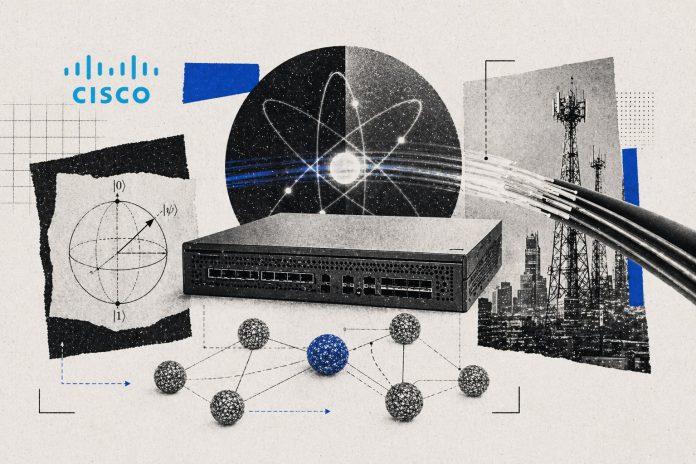
Quantum computing has been impeded for years by a fundamental structural challenge: no matter how powerful individual quantum computers may be, they can only communicate with systems that adhere to the same encoding conventions. Cisco aims to eliminate this constraint with its universal quantum switch, a research prototype designed to route quantum information across heterogeneous systems, convert all leading encoding modes, and operate at room temperature using standard telecom fibers.
As advancements shape the future of quantum networking, the implications for distributed architectures, security, and infrastructure governance are beginning to emerge. Top quantum system providers anticipate reaching between 1,000 and tens of thousands of physical qubits within the next three years, but these figures remain far lower than the millions of qubits necessary for quantum computing to deliver practical results in fields such as healthcare, financial modeling, or cybersecurity. The solution to this limitation doesn’t solely lie in building ever-larger machines; it also involves their interconnection. A distributed network of quantum processors, linked by an appropriate communication infrastructure, could combine their capabilities without waiting for a single system to reach the critical threshold. This model facilitated the emergence of the internet for classical computing, and it’s what quantum computing currently lacks — an equivalent to the network switch.
Quantum computers encode information using various physical modalities, such as light wave polarization, time-bin, frequency-bin, or spatial trajectory. A signal entering one format cannot be transmitted to a system expecting another without a conversion mechanism that preserves its quantum state. Any device attempting to read the signal for retransmission destroys the information simply by measuring it, a fundamental constraint of quantum mechanics. Cisco’s universal switch circumvents this limitation through a patented conversion engine that translates encoding modes without ever measuring the quantum state.
A Conversion Engine That Transmits Without Measurement
The switch operates on a principle similar to that of classical switches but adapted to quantum constraints. When a quantum computer sends a signal, the switch receives it in its original format, translates it into a common neutral format for routing, and then outputs it in the expected format for the receiving system. This output format can be the same as or different from the input format. Crucially, the operation occurs without measuring the quantum state at any point, ensuring the coherence required for effective network operation.
This architecture eliminates the need for direct point-to-point connections between every system pair. Fully interconnecting a 1,000-node quantum data center through direct links would necessitate around 500,000 distinct physical connections. A switching layer simplifies this complexity into a shared and scalable network, akin to what the internet accomplished for classical systems. The switch operates at room temperature without cryogenic cooling and utilizes standard telecom frequencies, making it compatible with existing fiber-optic infrastructures.
Experimental Results Support the Concept
Validation experiments conducted by Cisco’s researchers, using in-house developed entangled light sources and single-photon detectors, yield three key metrics. The degradation of encoding fidelity and entanglement remains below 4%, preserving the coherence necessary for quantum networks. Electro-optic switching occurs in less than one nanosecond, and the device consumes less than one milliwatt of energy. The complete results will be published in a scientific article on ArXiv.
Currently, the experimental validation focuses on the polarization mode, with the time-bin and frequency-bin modes integrated into the switch’s design and representing the next steps in the validation process. “We’ve long recognized that connecting quantum systems is key to their scalability. While this is a significant advancement, it’s just the beginning. The road ahead is long, but the impact of what we’re building will be considerable,” said Vijoy Pandey, SVP/GM of Outshift, Cisco’s Emerging Technologies and Incubation group.
A Comprehensive Stack Built Layer by Layer
The universal switch is part of a broader portfolio that Cisco is developing at its Santa Monica labs. This stack includes a quantum entanglement chip, a network-aware quantum compiler that optimizes circuits based on network constraints, and two applications: Quantum Sync and Quantum Alert. Partnerships with IBM, Qunnect, and Atom Computing complement the ecosystem. This comprehensive approach embodies a strategic conviction: practical quantum computing will emerge through distributed networks of interconnected systems, rather than the continuous scaling of a single machine.
The comparison to the internet shapes Cisco’s entire vision. Directly connecting billions of devices with dedicated cables was never scalable. The internet thrived because classical switches enabled a shared and scalable network. The universal quantum switch applies this reasoning to the quantum realm, allowing systems from different providers, built on different physics, to collaboratively form a cohesive infrastructure. For example, a neutral atom processor can communicate with a trapped ion processor, which itself is connected to a photonic sensor, all through the same equipment.
As a research prototype, the universal quantum switch is expected to see operational deployment within the next few years, according to Cisco’s estimates. For CIOs and infrastructure managers, this timeline calls for a stance of anticipation rather than immediate action. Critical questions are already on the table, such as what data governance frameworks will apply to information flows whose physical nature makes interception detectable yet not necessarily impossible.
In this regard, Cisco is simultaneously rolling out NIST’s post-quantum cryptography (PQC) standards on its conventional equipment. This initiative is relevant for CIOs and CISOs today, as data encrypted now may eventually be decrypted by sufficiently powerful quantum systems in the future. Securing existing infrastructures against the looming quantum threat is an urgent task that stands independent of any internal quantum deployment.



