Google Fitbit Air: A Fitness Bracelet Without Screen Takes Shape Ahead Of Google I/O 2026
Google appears ready to return to the essence of fitness tracking: a discreet, lightweight, and nearly invisible device. According to multiple recent reports, the company is working on a new bracelet named Fitbit Air, a wearable without a screen designed for continuous health and activity tracking, aiming to be closer to Whoop than traditional smartwatches.
Fitbit Air: A Screenless Bracelet, Probably Not Just by Chance
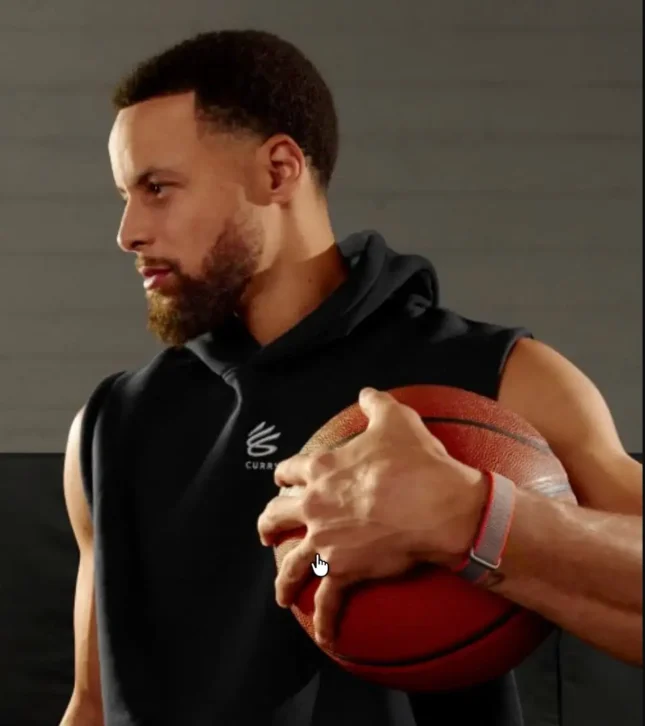
Credible sightings of the product date back to late March, when Stephen Curry—ambassador for Google/Fitbit—began appearing with an unfamiliar bracelet in promotional content. 9to5Google noted that it was a screenless bracelet, and Curry has publicly worn it for several months, which strongly resembles a carefully orchestrated teaser campaign rather than a simple accidental leak.
This design choice is intriguing. While the smartwatch market has become crowded, the “screenless” wearable segment is gaining momentum, driven by a simple promise: fewer distractions, more data, and an object that is easily forgotten on the wrist.
If Google is moving in this direction, the name “Air” makes sense, although it remains speculative at this stage and has not been officially confirmed by the company.
A Repositioning More Google Than Fitbit
Another intriguing detail: in the initial teasers, only the “G” logo of Google was visible, without the usual Fitbit branding. Several media outlets interpret this as a sign of a broader shift in the company’s branding strategy. While caution is warranted, this interpretation aligns with how Google is gradually unifying its health services and devices under its own umbrella.
Furthermore, Google has recently continued to enrich the Fitbit ecosystem with new features for its Personal Health Coach and an expansion of this experience to more regions and users. This indicates that beyond hardware, the company is already working on a more structured health software layer.
However, the renaming of Fitbit Premium to Google Health or Personal Health Coach to Google Health Coach has not yet been officially announced by Google; this remains speculative.
Why It Matters: Google Aims for Less Watch, More Continuous Monitoring
If confirmed, this screenless Fitbit would directly compete with products like Whoop, which focus on continuous analysis of recovery, sleep, and physical load rather than display and notifications.
This positioning is significant. It suggests that Google may stop seeing Fitbit solely as a lightweight alternative to the Pixel Watch and instead use it as a complementary product: less “smartwatch,” more “permanent health sensor.” This could provide a more coherent identity for Fitbit, which has been somewhat lost since Google’s acquisition.
A Possible Launch at Google I/O, But Nothing Official
No launch date has been confirmed yet for this wearable. However, Google has officially announced that Google I/O 2026 will take place on May 19 and 20, 2026, making it a plausible window for an announcement, although no public agenda currently mentions this bracelet.
In other words, there are two levels of information: on one hand, the existence of a screenless Fitbit bracelet is now supported by multiple consistent reports and Curry’s repeated appearances; on the other hand, its exact name, timeline, and the scope of Google’s health rebranding remain to be confirmed.
A Wearable Strategy That Could Finally Become Clear
This project represents something deeper than the arrival of a new bracelet. Google seems to be testing a new distribution of roles: Pixel Watch for comprehensive smartwatch experiences, Fitbit for the most discreet health and fitness tracking, and an increasingly central Google software layer to connect everything.
Therefore, Google is likely not just trying to launch a new tracker. The company may be seeking to reestablish a meaningful presence for Fitbit in a market where simplicity, recovery, and invisibility are becoming more desirable than the screen itself.