

Chrome AI Mode: The AI Can Now ‘Read’ All Your Open Tabs
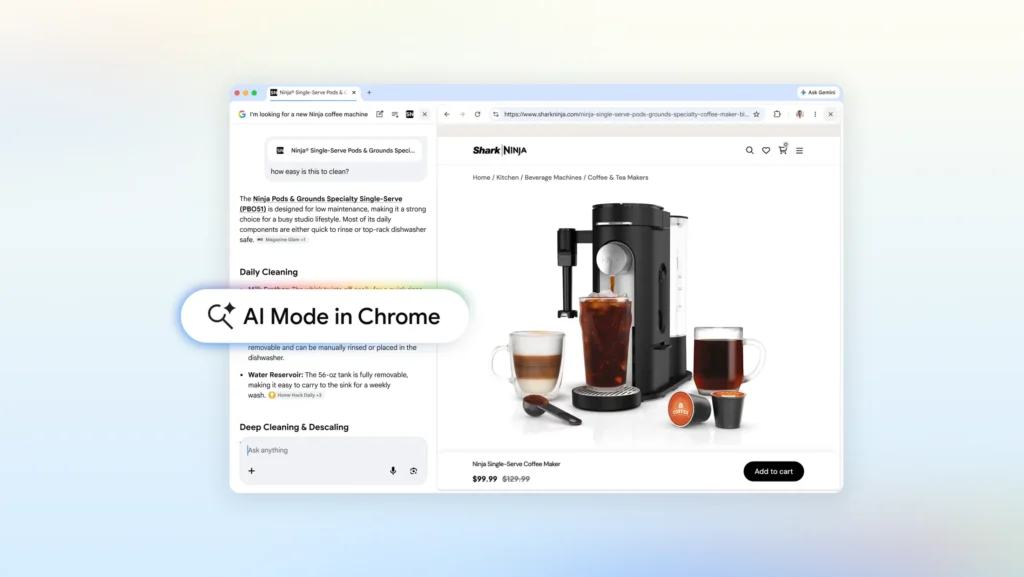
Google is continually reshaping the way its search engine interacts with the web. The company is rolling out a new evolution of AI Mode in Chrome that now allows users to open source links side by side with the conversation instead of automatically sending them to a new tab.
The concept is straightforward yet strategically significant: view a page without leaving the interaction with the AI, and then immediately ask follow-up questions about what you just read.
A subtle but significant change
Previously, clicking on a source in AI Mode disrupted the experience: the link would open in a new tab, forcing users to switch between the viewed page and the chat interface. With this update, Google keeps AI Mode visible while the site is displayed alongside it.
This is not just about comfort; it’s a way to keep users engaged in a continuous research environment, resembling a control center more than a simple search results page.
Another notable update relates to context. On both the desktop and mobile versions of Chrome, AI Mode can now reference recent tabs selected by the user via the “more” menu in the search bar or within AI Mode itself. Google notes that users can add multiple tabs, as well as images and files like PDFs, to enrich the questions posed to the AI.
This evolution shifts the logic of the product. Users are no longer merely submitting textual queries; they are directly incorporating their browsing environment into the conversation. In examples provided by Google, this can be helpful for comparing various hiking trail websites or cross-referencing lecture notes, slides, and academic articles for a more tailored explanation.
Another piece in Chrome’s AI strategy
These announcements are part of a broader movement. Google has already integrated AI Mode into Chrome on macOS and Windows via the new tab page and the omnibox, subsequently expanding it to Android and iOS. Chrome Enterprise release notes also indicate that Google has been preparing to enable content sharing of tabs with AI Mode for several versions, suggesting this direction is well thought out.
In other words, Google no longer treats AI Mode as a simple experiment linked to Search. The company is steadily embedding it at the very core of the browser, where usage, searches, comparisons, and daily hesitations begin. This marks a significant shift: search is no longer just a destination; it becomes a persistent layer over navigation.
An indirect response to web traffic criticism
The timing is also noteworthy. Google has recently made links to sources more visible in AI Mode, while criticisms about the impact of generative search functionalities on the traffic of publishers and websites have been growing. By keeping sources accessible in a side-by-side view, Google attempts to demonstrate that AI does not completely erase the open web, even as it increasingly frames it.
This brings about a certain ambiguity in the move. On one hand, Google facilitates access to source content. On the other, it strengthens an environment where users have less reason to leave the proprietary interface. The openness is tangible, yet remains orchestrated.
Availability: initially in the USA
Google states that these new features are now available for AI Mode users in the USA, with international expansion announced for “soon”. At this stage, no more specific global date has been provided.
Ultimately, this update reflects a very clear ambition. Google no longer merely wants to answer questions; it aims to reduce the cognitive load of navigation itself. Less back-and-forth between tabs, more context injected into queries, and greater continuity between reading, comparing, and synthesizing: AI Mode is evolving into a permanent research assistant, embedded in the workflow.
The real question now is no longer whether AI will enter the browser. It’s about how far the browser itself will become a conversational interface.



