

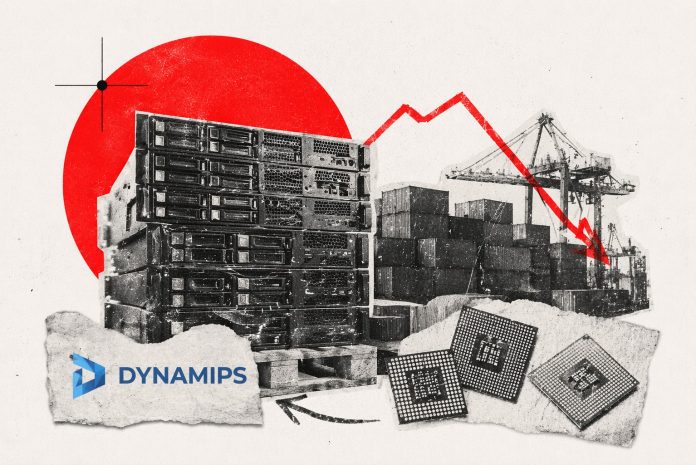
Dynamips, a Western France-based IT services company specializing in small and medium-sized enterprises (SMEs), intermediate-sized enterprises (ETIs), and local authorities, is stepping up with four concrete alternatives to ensure the continuity of its clients’ infrastructure projects. The ongoing shortage of IT components is transforming infrastructure management into a strategic decision-making process.
Since the end of 2025, the global market for IT equipment has been facing an unprecedented supply crisis. The purchase prices of servers have surged, tripling for certain models, delivery times have stretched beyond six months, and it is estimated that between 50% and 70% of orders may not be fulfilled on schedule. This tension stems from structural factors; four manufacturers dominate global production capacity, which is now largely occupied by giants in digital services and artificial intelligence, who inherently offer the highest profit margins. The impact is widespread, affecting not just servers but also workstations, networking equipment, and storage solutions. The prices of PCs have doubled, while servers have seen increases of up to three times for some models, with lead times extending beyond six months, compared to a few weeks under normal circumstances.
“The situation is more severe and volatile than during Covid. A server’s price can fluctuate right up until it leaves the factory. This level of volatility is unprecedented,” states Sébastien Vigeant, Purchasing Director at Dynamips. Industry analysts do not expect a market correction before at least 2027. The global IT component market is primarily controlled by four major players, and their production capacity is significantly consumed by hyperscalers and AI companies. Additionally, wholesalers are experiencing disruptions in shipping routes and geopolitical blockages affecting specific components, further undermining reliability in delivery timelines. Unlike previous sector-specific crises, no single brand or manufacturer is immune; the pressure is universal and detached from individual commercial strategies.
Doubling Buffer Stock and Six-Month Advance Orders
To mitigate the effects of the crisis, Dynamips has doubled its buffer stock for infrastructure materials and workstations, and extended its ordering cycles to six months ahead, up from just a few weeks previously. However, this proactive approach is still insufficient to meet overall demand. “Our goal is to smooth out the crisis for our clients and maintain the continuity of their infrastructure projects,” explains Sébastien Vigeant.
When new hardware remains unavailable within acceptable timelines, Dynamips implements four operational alternatives: utilizing professionally refurbished equipment, maintaining existing infrastructure, migrating to cloud or hybrid environments, and hardware leasing.
Professionally Refurbished Equipment and Operational Maintenance
Professionally refurbished equipment serves as the primary operational response, offering greater availability than new hardware in today’s climate and potential cost savings of up to 40%, along with tailored warranty extensions. Dynamips has been advocating this approach for years as part of a strategy to extend the lifecycle of existing equipment; now, the crisis has transformed this sustainable initiative into an immediate strategic lever.
The second approach, Operational Maintenance, aims to extend the lifespan of existing infrastructures while upholding their security and performance standards. Dynamips emphasizes that this strategy requires careful management of risks associated with cybersecurity and the potential failures of aging equipment. The acceptable level of risk must align with the client’s business constraints, with an integrated assessment from the outset of the Operational Maintenance plan.
Cloud Migration and Leasing: Rethinking Infrastructure
The supply shortage also acts as a catalyst for migration, prompting organizations to re-evaluate their architectures due to the unavailability of physical servers. Dynamips supports this transition to cloud and hybrid environments, though it identifies three structural barriers that hinder these shifts. Technical constraints related to performance and latency, particularly in industrial machines, often necessitate a partial retention of local infrastructure. Data sovereignty issues introduce uncertainty regarding target architectures. Moreover, IT cycles extending five to ten years demand long-term support and specific education initiatives. “Some clients remain hesitant about cloud solutions due to misunderstanding or concerns over data security. Our role is to be transparent, raise awareness, and collaboratively develop the most suitable solution, be it cloud or hybrid,” states Nicolas Kaiser, Innovation Director at Dynamips.
Leasing equipment represents the fourth lever: it allows for cost smoothing over time, eliminates investment spikes, and facilitates regular updates without the risk of obsolescence. Dynamips collaborates with specialized financing companies to offer purchasing options suitable for both SMEs and large corporations.
“Our role as strategic advisors is more critical than ever. If the targeted new hardware isn’t available, we must reassess the need, adapt architectures, and expedite transitions that might have otherwise been postponed,” explains Nicolas Kaiser. For IT managers of SMEs and ETIs, the IT component crisis necessitates a reevaluation of project sequencing and the integration of supply constraints as a permanent variable in investment planning, at least until 2027.



