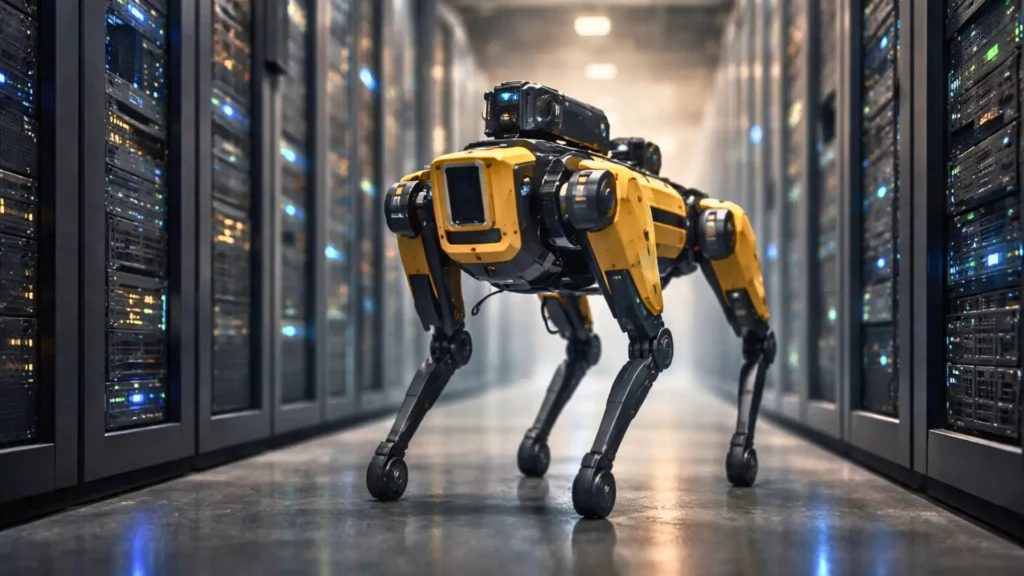
In data centers, robotic dogs are no longer just serving as guards. They patrol, listen to machines, and detect anomalies before failures occur. Driven by the rise of AI, this automation also addresses a labor shortage on-site.
In Data Centers, Robotic Dogs No Longer Just Guard the Gates, They Track Weak Signals
In these vast and noisy sites, autonomous quadrupeds conduct fixed patrols, both day and night. They inspect fences, check seldom-visited areas, and transmit live images. Their continuous surveillance fills in costly blind spots.
However, their utility goes beyond security. With their sensors, these robots can detect a weak fan, an unusual whistling sound, or thermal variations. This listening to machines enables teams to intervene earlier, before more significant disruptions occur.
Why Operators Are Equipping So Fast: Labor Shortages, Hostile Sites, and Faster ROI
Data centers remain isolated, hot, and often deafening environments. Recruiting for these settings is no easy task. Thus, robots provide a stable presence in an already high-turnover situation. For operators, it is a response to the on-ground challenges.
Moreover, these machines reduce wasted time during inspections. Detecting a defect early sometimes prevents more expensive downtime. Several operators report a measurable return, especially since the machines can patrol without breaks and alert immediately.
At some U.S. operators, these robots already serve as a link between security and maintenance. They do not replace all human presence but rather take on repetitive tasks, allowing technicians to focus on complex diagnostics. This time-saving aspect is significant.
What Spot Can Do on the Ground: Navigate Anywhere, Carry Sensors, and Communicate with Teams
Spot remains the showcase of the industry. The robot moves at over 5 km/h and can carry up to 14 kilograms. It also operates under challenging temperatures. With an IP54 rating, it withstands dust and water splashes.
Boston Dynamics has enhanced its platform with an arm, multiple cameras, and more flexible software tools. Additionally, a prototype connected to ChatGPT has demonstrated a voice interface that could be useful, although these uses still require a precise framework.
From the U.S. to Asia, the Race Expands, but the Rise of Robotic Dogs Progresses with Limits
The movement extends beyond Boston Dynamics. Ghost Robotics is pushing its Vision 60 into security markets. In Europe, ANYbotics defends autonomous inspection. In Asia, Unitree is accelerating industrial applications. This global competition is changing the landscape.
Research is progressing as well. In South Korea, KAIST has already tested a quadruped in a university data center. The principle remains the same: observe, alert, document. This real-world laboratory shows that the concept goes beyond a mere trend.
However, there is a very tangible limitation: cost, integration, and on-site acceptance. Not all employees welcome these machines with the same enthusiasm. Nevertheless, as data centers continue to grow, predictive maintenance on four legs will likely keep attracting interest.