

Aluminium OS: The leak that confirms the new face of Android on PC
At first glance, a leak of wallpapers might not seem significant. However, in the case of Aluminium OS, it hints at something larger. Behind these neon and abstract visuals may lie the first aesthetic finish of a more ambitious project: the convergence of Android and ChromeOS, now openly acknowledged by Google.
More bold wallpapers than ChromeOS of old
According to Android Authority, a leaker on Telegram has shared what appear to be wallpapers for Aluminium OS, categorized into two themes: “Adaptive” and “Chromebook”, featuring light and dark variants. The visuals showcase highly saturated colors—magenta, deep blue, orange, turquoise—promoting a more atmospheric aesthetic than the typically subdued designs associated with Chromebooks.
However, it’s important to note that these images do not come from an official Google source.
This is what makes the leak noteworthy. The wallpapers do not alone confirm the final interface, but they resemble production assets, suggesting substantial internal progress toward a product. This small hint aligns with other recent signals around Aluminium OS.
What we know: Google is already linking ChromeOS and Android
The most concrete point isn’t derived from this leak. In June 2024, Google officially announced that ChromeOS would be developed with significant components of the Android stack, including the Android Linux kernel and Android frameworks, to expedite the integration of AI features and new software capabilities. In other words, the merging is no longer theoretical; it is already under technical implementation.
A few months later, Sameer Samat, President of the Android Ecosystem at Google, confirmed that the company is working to combine ChromeOS and Android into a single platform.
Aluminium OS: More than just a ChromeOS replacement
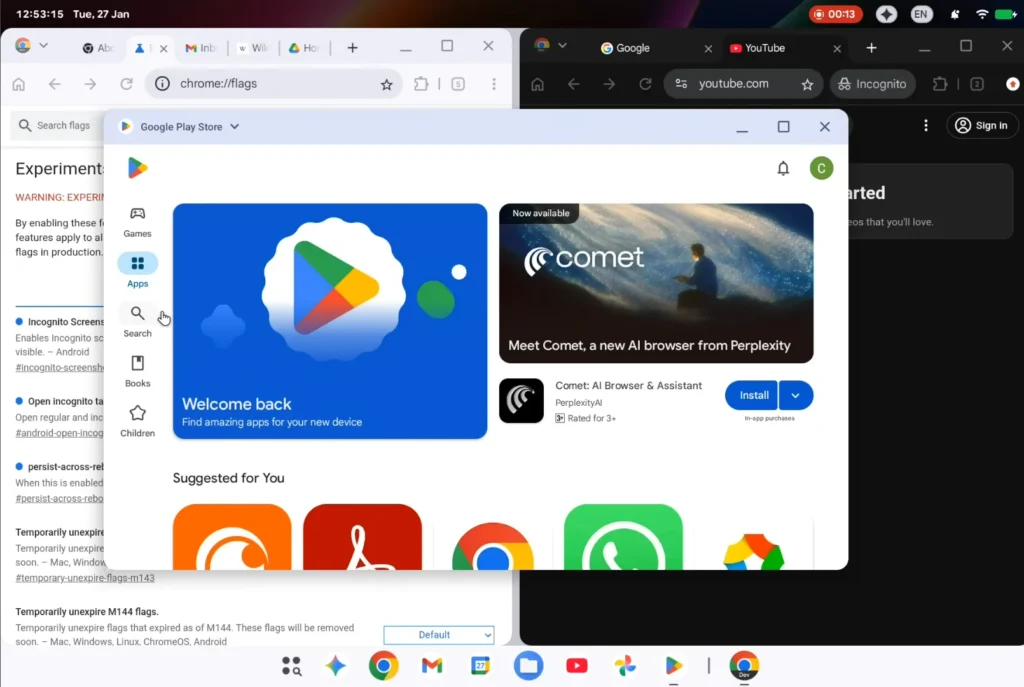
This is where the situation becomes strategic. Aluminium OS is not just seen as a mere “ChromeOS 2.0”, but rather a move to mature Android within a PC environment. The idea, derived from various leaks and expert analyses, is to create an Android base optimized for laptops, featuring enhanced window management, multitasking capabilities, large screen support, and, of course, Gemini at its core.
It’s crucial to distinguish between what is confirmed and what is assumed: the Android/ChromeOS merger is acknowledged; however, the name “Aluminium OS,” its exact packaging, and final commercial form are yet to be officially confirmed by Google.
This distinction is important because many narratives surrounding Aluminium OS may jump ahead of the facts. Google has confirmed the convergence, but it has not yet publicly presented the final version of the system, its marketing name, or the precise way in which ChromeOS and Android will coexist during the transition.
Why these visuals matter despite everything
In the industry, visual identity leaks rarely emerge by chance. Wallpapers, icons, and themes often arise when a project transitions from the lab to a presentable form. While this does not prove an imminent launch, it suggests a higher level of maturity than a mere technical prototype. This interpretation is still a conjecture, but it resonates with the nature of the leak and the publicly available status of the Android/ChromeOS initiative.
Android Authority also notes that the first version of Aluminium OS is still aimed for 2026, despite earlier documents raising doubts about the timeline. Once again, it’s better to frame this as a reported objective rather than a definitive deadline.
Google is preparing not just an OS but a repositioning of PC
Ultimately, the crucial information is not aesthetic but industrial. For years, ChromeOS has occupied a useful yet limited niche: excellent for education, relevant for light office tasks, but rarely seen as a premium platform. By merging its logic with Android, Google is potentially aiming to break free from this deadlock and offer a more credible alternative to Windows, macOS, and even iPadOS.
It is also a way to unify its software efforts. Instead of advancing Android on mobile and ChromeOS on PC separately, Google could consolidate its resources around a single base, leading to a more coherent application ecosystem, more uniform AI, and stronger continuity between phone, tablet, and computer. Once again, this conclusion stems from analyzing the official decision to base ChromeOS on Android components and the public confirmation of a common platform.
In summary, these wallpapers alone won’t shift the market. However, they provide a provisional face to an ambition that Google is no longer hiding: to evolve Android beyond a mobile OS and finally transform its vision of the PC into a cohesive product.



