Ubuntu MATE in search of a new direction: Martin Wimpress passes the torch
There was no drama, no controversy, no theatrical exit. Martin Wimpress, the founder of Ubuntu MATE, simply announced that he was stepping back and was looking for successors who could take over. In his message posted on March 27, 2026, he explained that he lacked both the time and motivation to continue leading the project as he once did.
For Ubuntu MATE, this news transcends a mere change of ownership. It raises a far more fundamental question: what happens to a well-regarded distribution when the person who has led it for over a decade decides, very humanly, that they can no longer shoulder it alone?
Ubuntu MATE: A Popular Project with a Strong Personal Legacy
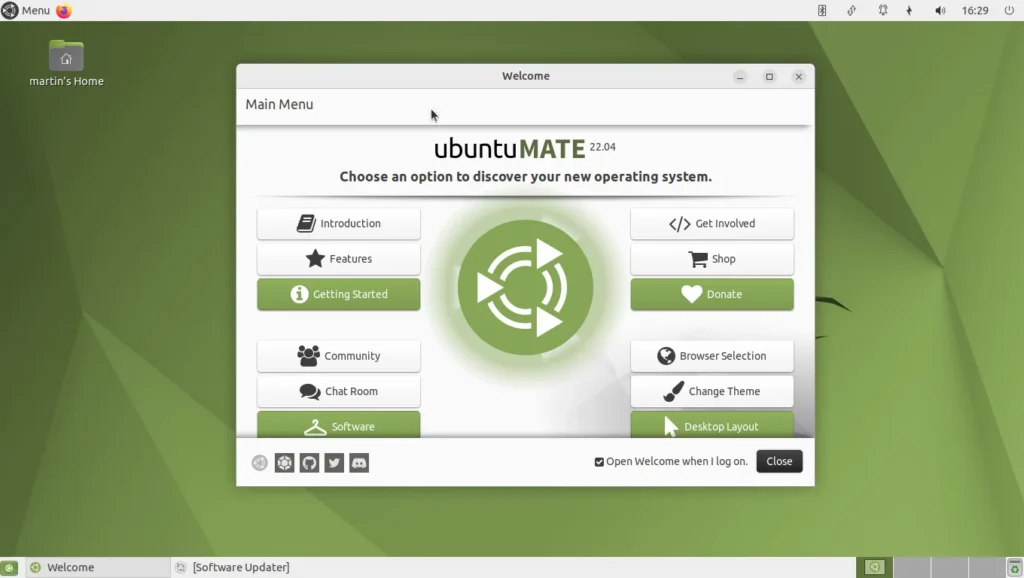
Ubuntu MATE is not a fringe distribution that emerged on the outskirts of the Linux world. Canonical still presents it as one of the official Ubuntu variants—community-driven variants backed by the Ubuntu archive but developed by community members. Furthermore, the Ubuntu MATE website continues to promote a clear proposition: a stable, easy-to-use, customizable system, particularly suited for modest machines and users who prefer a more traditional desktop experience.
The project’s history is well documented. Wimpress himself recalls creating Ubuntu MATE in 2014, and the project’s archives confirm that it achieved official variant status starting from Ubuntu 15.04.
This is precisely what makes the situation so sensitive. Ubuntu MATE was not only maintained by Martin Wimpress; it was, to a large extent, structured around him. His departure does not simply create an operational void; it exposes an organizational dependency that many suspected without fully realizing how central it was.
The Message from Wimpress: Straightforward and to the Point
The most striking aspect of this transition is its tone. There are no open crises, no public disagreements, no political ruptures. Wimpress states that he no longer has the “time” he once had, and that he also lacks the “passion” for Ubuntu MATE that he used to feel. He is looking for experienced Ubuntu contributors with a background in package maintenance to take the reins.
This sobriety makes the announcement even heavier. It reminds us of a less glamorous but foundational truth in open source: many projects thrive not because of ideal governance but due to the prolonged endurance of a few highly dedicated individuals. As long as those people are around, the structure seems stable. When they take a step back, the underlying fragility suddenly becomes apparent. This observation stems from Wimpress’s situation and underscores the pressing need for Ubuntu MATE to find new maintainers.
The Timing Is Unfortunate, and the Context of 26.04 Makes Matters More Delicate
The timing adds another layer of concern. Ubuntu 26.04 LTS is still in development, with its final release scheduled for April 23, 2026. Canonical has emphasized that it is a long-term support variant.
However, it’s important to highlight a crucial nuance: contrary to what one might assume, Ubuntu MATE 26.04 was already not guaranteed to be an LTS variant. In December 2025, OMG! Ubuntu reported that neither Ubuntu MATE nor Ubuntu Unity were planned as LTS variants for the 26.04 cycle due to insufficient maintenance resources. The site also clarified that a non-LTS variant could still exist, but without the usual long-term support guarantee.
In other words, the succession is not just about the abstract future of the project; it coincides with a moment when the credibility of the flavor on a major cycle was already under pressure. Wimpress’s departure does not solely create this fragility; it makes it impossible to ignore.
Ubuntu MATE’s Situation Reflects a Broader Instability in Ubuntu Variants
Canonical presents Ubuntu variants as distinct experiences, developed by the community and supported by a common infrastructure of Ubuntu. This formulation speaks volumes. It highlights both the strength of the model—diversity, specialization, freedom of expression—and its limitation: the human layer remains largely community-driven.
This is where the Ubuntu MATE case becomes exemplary. It demonstrates that a strong brand, a solid technical foundation, and official status are not sufficient to ensure the longevity of a project if the workload is shouldered by too few individuals. It can be seen less as an accident, and more as a symptom of a deeper issue.
Community discussions already hint at this. In the official thread, a contributor associated with Ubuntu Unity has offered to help, and Wimpress responded that he would reach out to explore ways to involve him more fully. This is encouraging but also indicates that the transition for now relies on a few identifiable goodwill efforts rather than a stabilized structure.
The Crucial Issue: Sustainability of Invisible Work
The core of this matter goes beyond Ubuntu MATE. What is at stake here is the sustainability of essential, technical, repetitive, and often unglamorous work: packaging, integration, release coordination, bug fixing, dependency tracking, and last-minute decisions. Open source is often celebrated for its freedom and creativity; it is seldom viewed as a collective undertaking that involves time-consuming, sometimes exhausting responsibilities that must be maintained over time.
Martin Wimpress’s departure starkly reminds us that fatigue is not an anomaly of free software. It is one of its structural risks. And when this fatigue strikes a central figure, it forces the entire community to confront something it might prefer to keep in the shadows: the quality of a project also depends on the collective ability to share the burden of maintenance.
Ubuntu MATE Can Still Bounce Back, but Not Under the Same Model
The optimistic scenario exists. Ubuntu MATE can find new maintainers, better document its processes, distribute responsibilities more evenly, and emerge from this transition with a more robust organization than before. The fact that volunteers are already coming forward suggests that a rebound is within reach.
However, there is also a harsher lesson. Even if the project survives—which is entirely possible—it will be challenging to continue pretending that the hero-maintainer model can last indefinitely. Ubuntu MATE has long been one of the best demonstrations that a well-crafted, accessible, and coherent Linux desktop can exist thanks to strong community energy. Today, this promise remains unbroken but is undeniably being tested.
And perhaps that is the true challenge of this moment: whether the open-source community is still capable of transforming admiration for its builders into structures that can outlast them.