

ElevenMusic arrives on iOS: Is ElevenLabs looking to dethrone Suno and Udio?
ElevenLabs aims to broaden its image beyond being a simple voice-cloning specialist. With the launch of a new iOS application in early April, ElevenMusic signifies that ElevenLabs is more aggressively entering the field of AI-generated music—revealing a much larger ambition: to become a comprehensive creative platform, not just an audio model provider.
ElevenMusic: A Quiet Launch but a Clear Signal
The ElevenMusic by ElevenLabs app was quietly introduced on the App Store, where it is marketed as a tool for both music creation and discovery. According to TechCrunch, the app had been listed weeks before its official launch on April 1, 2026, giving the rollout the appearance of a soft launch rather than a grand announcement.
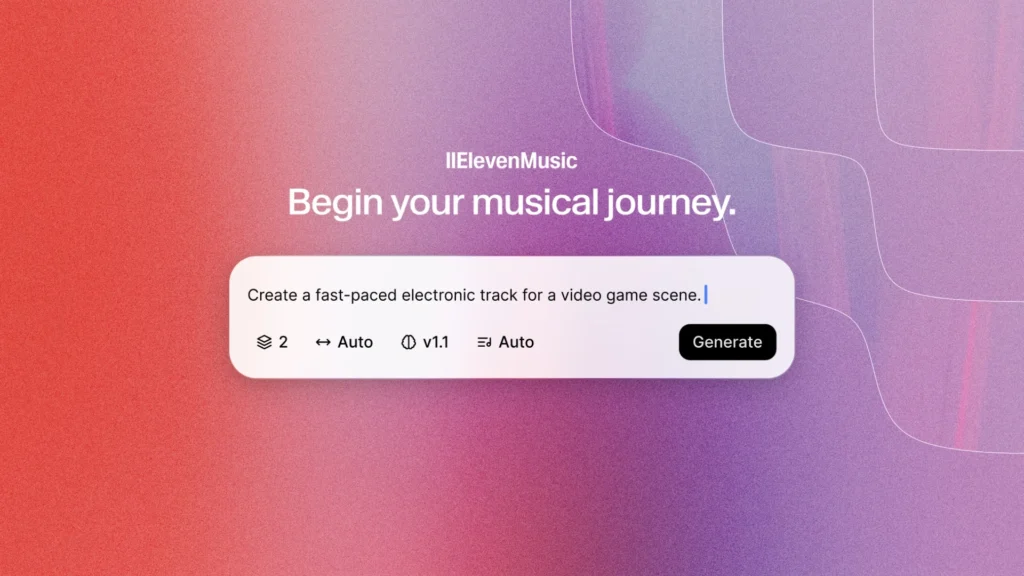
In essence, the positioning is clear. ElevenMusic allows users to generate tracks from text prompts, adjust factors such as duration, lyrics presence, or writing style, and also discover, listen to, and remix songs created by other users. Thus, the concept does not resemble a mere isolated generator: ElevenLabs is already building a hybrid experience between a creative tool and a consumption platform.
Seven Tracks Per Day for Free, Then a Pro Offer

According to TechCrunch, the free version allows up to seven song generations per day. The paid plan, priced at $9.99 per month or $95.90 per year, allows for 500 tracks per month, over 500 GB of storage, and access to a wider range of styles and moods.
The app also integrates familiar elements from streaming services: top charts, trends, new releases, mood-based selections, live stations, and pre-made albums. This detail is significant, as it shows that ElevenLabs is not only trying to compete with generation tools like Suno or Udio on raw creation; the company is also looking to control the distribution and discovery layer.
ElevenLabs Has Been Preparing for This Moment for Months
This launch is not out of the blue. ElevenLabs introduced Eleven Music as a web product and API focused on music back in August 2025, emphasizing that the model was trained on licensed data and designed for broad commercial use. The official ElevenLabs website still positions Eleven Music as a “studio-grade” music generator and clarifies that, in self-serve aspects, commercial use is allowed in many cases, with fewer restrictions than some rivals, depending on the context of use.
Moreover, in March 2026, the company added a Music Marketplace that enables users to publish, license, and monetize tracks generated on the platform. ElevenLabs states that creators can be compensated when their songs are used, remixed, or licensed for videos, games, product demos, or other content.
In other words, ElevenMusic is not an opportunistic mobile trial. It is the public-facing extension of a stack already in development: generation, editing, marketplace, monetization, and now a discovery application.
ElevenLabs Aims to Avoid Becoming an Interchangeable Provider
The central issue is likely here. ElevenLabs has established itself through voice technology, but the AI audio market is becoming more crowded, standardized, and thus susceptible to commoditization. By expanding its offering to music and broader creative tools, the company is clearly seeking to elevate its position in the value chain: to be less dependent on a single model and to have a more direct relationship with creators and users.
The financial timing further strengthens this perspective. ElevenLabs announced in early February a $500 million funding round, valuing the company at $11 billion, with the explicit goal of accelerating its expansion and new product categories. Within this context, promoting music and mainstream creative tools appears less like a decorative diversification and more like a significant growth strategy.
A Genuine Offensive Against Suno and Udio
In competing with Suno and Udio, ElevenLabs attempts to differentiate itself with a more reassuring message regarding licensing and commercial use, where AI-generated music remains a legally sensitive area.
This does not guarantee market dominance by itself, but it provides ElevenLabs with a more “business-compatible” narrative than that of a mere viral generator. And this may be where the company aims to succeed: not just in the quality of the tracks but in the trust surrounding what can be done with them afterward.
A Modest App in Appearance, but Very Revealing
On its own, ElevenMusic may seem like just another small app in the wave of creative AI. However, it reveals something much more ambitious: ElevenLabs no longer wants just to lend its voice to the industry. It aims to become one of the interfaces through which audio generated by AI is created, listened to, remixed, and monetized.
If this strategy holds true, the company could significantly impact generative music as it has already influenced voice synthesis.



