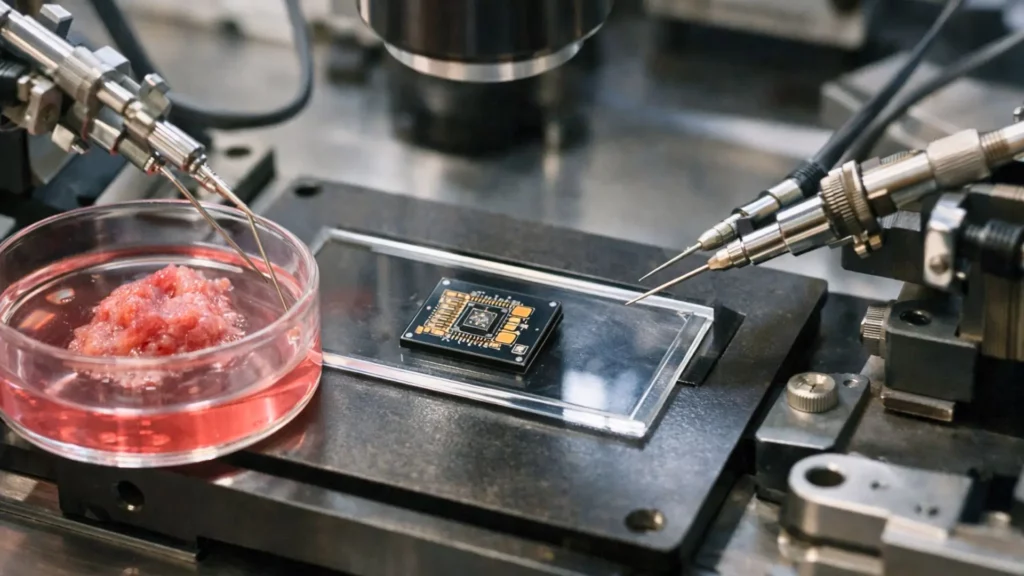
Published in September 2025 in Nature Communications, this artificial neuron designed at UMass Amherst operates at 0.1 volts. It processes biological signals without heavy amplification. The promise scales up for bioelectronics, medical sensors, and interfaces with living cells.
Why Older Artificial Neurons Were Too Power-Hungry and Noisy for Communication with Living Cells
For years, prototypes hit the same wall. They sent signals that were too strong, necessitating amplification, filtering, and corrections. Ultimately, the useful signal got drowned in a bulky, inefficient device poorly suited for living cells.
According to the team from the University of Massachusetts Amherst, previous versions required significantly more voltage and demanded a hundred times more energy. This difference hindered direct interfacing with biological cells and diminished the practical relevance of these electronic neurons.
At 0.1 Volt, the New Device Finally Mirrors the Body’s Electrical Rhythm and Changes the Game
The breakthrough lies primarily in the operating voltage. The new neuron functions at 0.1 volt, within the range of biological signals. This proximity prevents the electric shock seen in older systems and makes communication much more credible in a wet environment.
The core of the system is based on protein nanowires produced by the bacterium Geobacter sulfurreducens. These structures are used in a memristor, a component that reacts, memorizes, and releases current. As a result, the electrical response more closely resembles that of a biological neuron.
Another key point is that the team did not opt for a light-based route to connect machine and living entities. Instead, they maintained a classic electrical logic. This choice aligns neuron dynamics with natural conditions and simplifies integration into future bioelectronic devices.
What the Experiment Really Showed with Heart Cells and Why the Nuance Matters
The strongest result does not yet involve a human brain connected to a machine. The researchers linked their artificial neuron to cultured heart cells to read signals in real-time. The nuance matters, as it places the announcement in its proper context.
In their trials, the device distinguished a normal state from one altered by medication. It observed the frequency of signals. This direct reading suggests a real-time sorting of biological information, with less intermediary electronics and reduced losses.
From More Efficient Medical Sensors to Brain-Machine Interfaces: How This Advance Can Truly Make a Difference
The most immediate benefit pertains to wearable sensors and medical devices. Currently, many amplify bodily signals before analysis. With more efficient circuits, this step could be streamlined, reducing size, complexity, and power consumption.
Looking ahead, research aims for more efficient neuromorphic systems. The brain processes a vast amount of information using very little energy. By aligning electronic parameters with biological values, energy efficiency shifts from being a slogan to a credible objective.
However, significant steps remain before a functional brain-machine interface can be achieved. Researchers must prove stability, biocompatibility, and scalability. Nevertheless, the voltage barrier has finally been pushed back, and this detail often determines the transition from the lab to practical use.